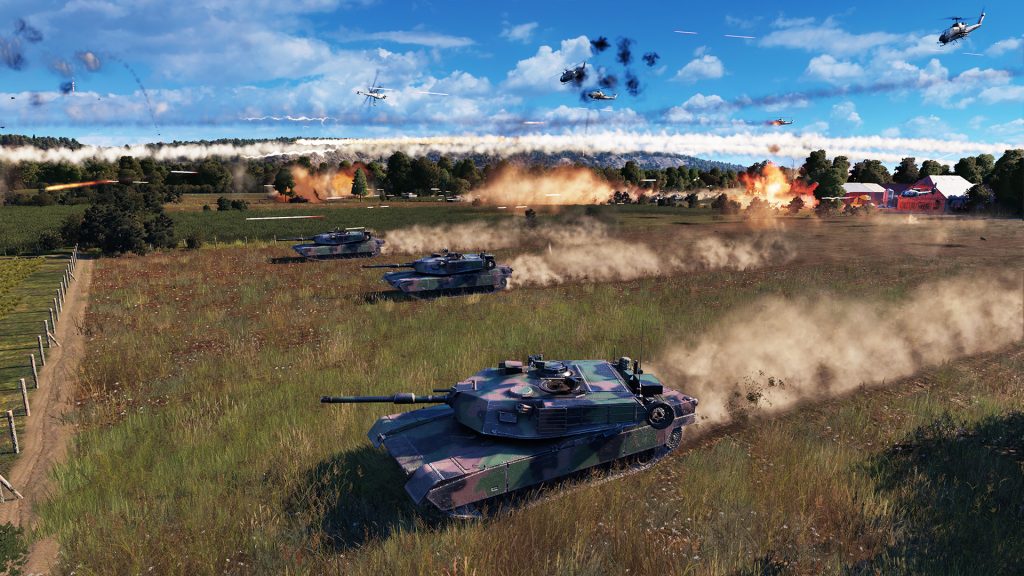
WARNO and Steel Division 2 are the best war strategy games for large multiplayer teams on this shortlist. Both advertise 10v10 battles, so twenty commanders can share a battlefield. Choose WARNO for Cold War combined arms or Steel Division 2 for World War II divisions. The useful difference is what your group wants to coordinate, rather than a bigger number beside the lobby.
These recommendations use the games’ official mode descriptions. They establish supported team sizes, not how many populated matches you will find at your preferred hour. Check the current lobby and the edition each friend owns before organizing a regular session.

On this page
WARNO: assign sectors before the shooting starts
WARNO puts NATO and Warsaw Pact battlegroups into an alternate 1989 war in Europe. Its official selection includes ranked 1v1, smaller team matches and 10v10 battles. Stand-alone skirmish also supports solo, cooperative and multiplayer play, giving a group a route to learn together before facing human opponents.
The arsenal includes infantry, tanks, artillery, reconnaissance helicopters, anti-aircraft systems and strike aircraft. You build a battlegroup from the units available to a parent formation. That makes a useful preparation task: compare what each player can bring, then identify missing reconnaissance, anti-air coverage or a reserve before everyone picks the same attractive tanks.
For a large group, start with geographical responsibilities. Give each player a clear sector and name who can reinforce it. An air-support player still needs to know which friendly lane is pushing and where enemy air defenses were last seen. A support role should contribute to a shared plan, rather than leave teammates guessing who will hold the ground.
WARNO’s pre-combat deployment commands and Smart Orders can help organize movement. They do not remove the need to watch the fight. The drawback for newcomers is the volume of unit information: range, role and availability all compete for attention while several fronts change at once. Practice with one familiar formation instead of changing every card between matches.

Steel Division 2: coordinate a World War II battlegroup
Steel Division 2 also explicitly supports massive 10v10 multiplayer battles. Its original setting is the Eastern Front in 1944, with division-based deck building and infantry, armor, artillery and aircraft. Pick it when the group would rather compare WWII formations than Cold War missile and helicopter systems.
The division is an important choice before the match begins. Players can inspect available unit cards and configure a battlegroup, so a team’s discussion can happen before anyone deploys. Decide which formations suit the intended front and where a teammate’s force can cover a weakness in yours.
Use a small shared vocabulary for requests. “Help on the left road” gives less information than naming a map landmark, the enemy type and the support needed. Report a threatened position early enough for the adjacent commander to respond. Several players sending reinforcements after the same collapse is a poor substitute for one planned reserve.
The tradeoff is another substantial roster to learn. Historical familiarity helps identify a vehicle, but does not tell you how to use its particular card in a match. The Army General campaign is a separate attraction, not evidence that a twenty-player session works like a turn-based operation. Choose the game for its supported tactical team battles.
A workable first evening for a large group
- Confirm the lobby before inviting everyone. Check slots, teams, map, rules and access to the selected content.
- Allocate sectors and support. Name an adjacent partner for each frontline player and agree how to ask for help.
- Use one coordination channel. Keep messages about sightings, retreating units and support requests short enough to act on.
- Review one failure afterward. Identify whether the problem was an uncovered sector, late information or incompatible force choices.
A smaller practice match can make the first large battle more useful. For tighter individual accountability, compare our 1v1 war strategy picks. For the setting rather than team size, see the modern warfare shortlist. Choose WARNO if your friends want Cold War coordination; choose Steel Division 2 if the WWII roster is the reason they will keep returning.
Sources and further reading
Keep exploring

Hearts of Iron 4 occupation laws: control resistance without draining reserves
Match occupation policy to resistance, compliance and a garrison you can actually supply; use stronger control only when the situation justifies its cost.

wargame red dragon radar anti air management: coverage and weapon-state decisions
A source-backed guide to managing specific radar-related weapons within a complete Wargame Red Dragon air defense.
wargame red dragon sead aircraft: choose a mission that helps
A concise source-backed guide to choosing and reassessing a useful SEAD mission in Wargame Red Dragon.