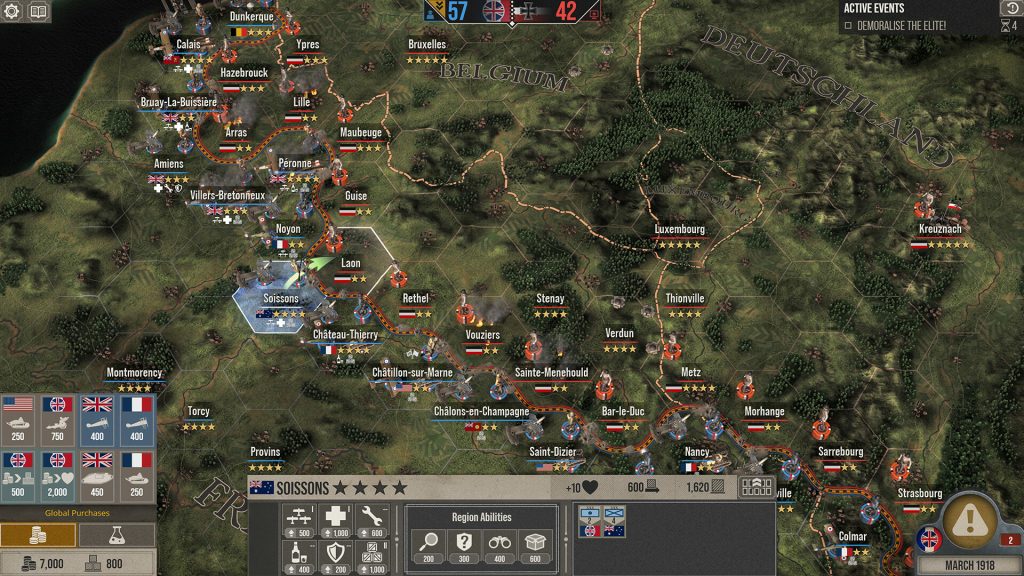
For the best WW1 strategy games on PC, first decide whether you want to command the Western Front or manage a country’s entire war effort. The Great War: Western Front combines a theatre campaign with direct trench battles. Making History: The Great War puts national economics, diplomacy and military policy under your control.
These two games make a useful focused shortlist because they answer different questions about the same period. The first asks where and how to fight along a particular front. The second asks how a state sustains war and handles its wider consequences. Neither should be selected simply because its title mentions the Great War.

On this page
Best Ww1 Strategy Games Pc: If you want the battlefield to remember earlier fighting
The Great War: Western Front is the stronger candidate to investigate for trench warfare. The official description connects turn-based theatre decisions to real-time field command, covering the Western Front from 1914 to 1919.
As theatre commander, you deploy forces, research technology and distribute resources. As field commander, you design trenches and direct assaults. This makes it suitable for a player who wants campaign preparation to lead into a battlefield they personally manage. Choosing where to commit is part of the same experience as deciding how to attack.
The persistence of battlefields is a distinctive feature. The listing explains that damage accumulates and trench networks remain when you return to a location. An earlier engagement can therefore leave a practical landscape for later fighting. That is a more specific reason to choose the game than a generic desire for realistic-looking uniforms.
Weather and technology also belong to the documented framework. The description connects changing weather to movement and artillery performance and lets research alter the timing of military developments. Investigate how those systems affect a complete engagement, rather than assuming every assault will become easy once a new technology is unlocked.
The main reservation is geographic scope. This is a Western Front game, not a promise of a single campaign covering every WW1 theatre and political economy. It also combines real-time battles with a turn-based strategic layer; players wanting exclusively turn-based combat need to inspect the field-command experience carefully.
Its official modes include campaign, historical battles, skirmish and multiplayer. Choose a historical battle or a full campaign video as your first inspection depending on which you intend to buy it for. A mode’s presence does not establish current matchmaking activity or the quality of every scenario, and this shortlist makes no such claims.

If you want to run the state that supplies the front
Making History: The Great War is the candidate for broader national command. Its official description puts you in the role of a head of state responsible for economy, diplomacy and armed forces, with independent nations available during the WW1 era.
The attraction is the connection between industrial capacity and military action. The game description requires munitions for the guns and food for the population and includes trade in resources and manufactured goods. It is aimed at someone who finds the ability to sustain an army as interesting as the army’s advance.
Domestic management extends the decision beyond production. Government spending and radicalization are part of the documented national framework. That gives a campaign a political pressure that a purely tactical trench battle cannot provide. Choose it if you want to examine what a prolonged war does to the state supporting it.
Military systems include trenches, adjacent-region artillery bombardment, airships, aircraft and submarine warfare affecting naval and trade vessels. These are described at the game’s strategic level. Do not interpret a mention of trenches as proof that you will draw detailed defensive networks and command individual assaults in the same way as Western Front.
The limitation is the amount of attention given to national systems. If your main goal is a visible local battle, economic and diplomatic work can be a poor fit even when the historical period is correct. Inspect a turn showing the economy and international decisions before selecting it for its military imagery alone.
The official description also offers scenario editing and Workshop sharing. Those are useful points to investigate for custom campaigns, but they do not guarantee that a particular modern community scenario exists or works with your setup. The recommendation rests on the documented national game, without assuming unverified mods will provide missing features.
Use three questions to settle the choice
- Which map do you want to spend time on? Choose Western Front for a focused theatre connected to local trench engagements. Choose Making History for national and international decisions.
- What do you want losses to change? Investigate Western Front for persistent battlefield damage and resource commitments. Investigate Making History for industrial supply and domestic pressure.
- Which kind of management sounds satisfying? Positioning forces and constructing defenses point toward Western Front. Trade, production and diplomacy point toward Making History.
A concrete purchase check is to watch one complete decision cycle: a strategic move followed by its battle in Western Front, or a national economic and military turn in Making History. That establishes whether you enjoy the work between the historical moments. A trailer can show the setting without showing that workload.
Both recommendations are based on their linked official Steam descriptions. Their screenshots illustrate their own game interfaces, rather than standing in for every WW1 title. This is a fit comparison, with no claimed personal campaign, benchmark, current price or objective superiority score. Check the current product requirements and edition before buying.
If you want to change periods while keeping a similar command level, our WW2 strategy game selection provides national, squad, division and turn-based alternatives. Decide the command level first; the historical era then narrows the choice.
Sources and further reading
Keep exploring

Hearts of Iron 4 occupation laws: control resistance without draining reserves
Match occupation policy to resistance, compliance and a garrison you can actually supply; use stronger control only when the situation justifies its cost.
wargame red dragon radar anti air management: coverage and weapon-state decisions
A source-backed guide to managing specific radar-related weapons within a complete Wargame Red Dragon air defense.
wargame red dragon sead aircraft: choose a mission that helps
A concise source-backed guide to choosing and reassessing a useful SEAD mission in Wargame Red Dragon.