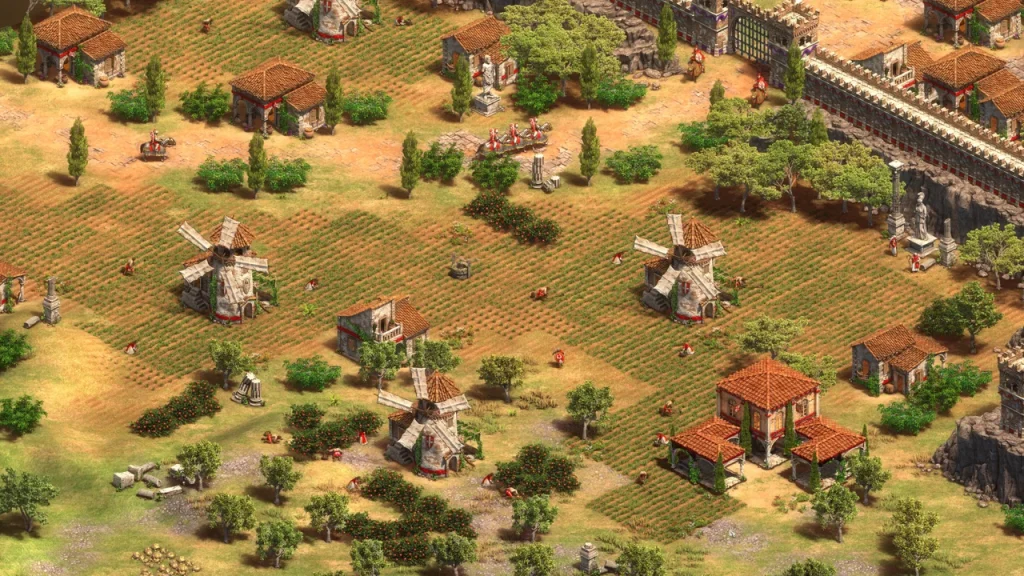
TL;DR: In a Nomad-style start without a Town Center, inspect the workers and starting resources, reserve the first Town Center purchase, and choose a reachable site with usable wood and food access. Complete construction, restore gathering jobs, then add worker production and any affordable coastal economy.
This Age of Empires 2 Definitive Edition nomad opening guide begins before the ordinary Town Center queue exists. The checked standard Town Center profile costs 275 wood and 100 stone, while a House costs another 25 wood. Spending the starting stockpile on optional structures before preserving that construction reserve can delay the production building the rest of the opening needs.

The instructions refer to a Nomad-style setup in Age of Empires II: Definitive Edition. Building and unit costs were checked against the English technology tree. Inspect your actual map, starting units, resources, and civilization modifiers; this guide does not assume every variant gives the same worker count or stockpile.
On this page
Age of Empires 2 Definitive Edition nomad opening: six steps
1. Inspect the actual starting situation
Select the available workers and look at their locations, nearby resources, and reachable terrain. Confirm whether the setup begins without a Town Center and what construction the current rules allow. Do not run a standard settled-base sequence without first checking that its starting building exists. A worker can have a useful movement or construction task before there is a production queue to maintain.
Check the starting resource bar before placing optional buildings. A remembered stockpile from another map or civilization is not a reliable substitute for the current numbers. Note usable wood, food, shoreline access, and the routes between workers. The first task is to choose a practical construction plan from what is visible, rather than assuming a predetermined site exists in every generation.
2. Reserve the first Town Center and population access
The ordinary Town Center profile costs 275 wood and 100 stone. A standard House costs 25 wood and supplies five population spaces, so the two purchases total 300 wood and 100 stone before modifiers. Keep their construction and capacity roles separate. A House creates room but does not train Villagers or replace the Town Center’s production function.
Use the actual builder menu when a civilization or variant changes the cost or available sequence. Do not spend the reserved wood on several optional structures simply because they can be placed. If the first Town Center is not funded, the opening lacks its normal worker-production loop. Prioritize a usable first construction over a collection of buildings with no economy to support them.
3. Choose a reachable site with useful resources
Inspect where the workers can build without an unnecessarily awkward route. Consider usable forest access, food gathering, and space for later Houses or Farms. The closest visible object is not automatically the best entire base layout. Leave room for workers to move between gathering sites and the finished Town Center.
Bring the selected builders toward the chosen site and verify their movement. If one worker is still far away or has an old instruction, the intended construction group may not be present. Use the workers available now rather than treating every starting unit as already standing at the foundation. Additional builders change gathering time elsewhere as well as construction progress.
4. Complete construction and restore gathering jobs
Place the Town Center using the current builder controls, then watch its actual completion state. An abandoned foundation does not supply worker production. If construction stops, inspect the builder, route, resources, and queued task before adding another unrelated structure. Give remaining workers useful resource jobs while the building is being completed.
Once the Town Center finishes, assign its builders to food or wood according to the next purchases. Do not leave them idle beside the new building. The first completion creates the production panel, but the economy still needs active gatherers. Review the selected jobs and nearby drop-off routes before assuming the base is operating like an ordinary settled start.
5. Start Villager production and check capacity
A standard Villager costs 50 food. Select the completed Town Center and queue the next worker when food and population space permit. Give the new worker a resource task after it appears. Keep checking the queue during further construction, because the Nomad opening’s first production cycle is easy to miss while attention remains on map exploration.
Add a House before capacity becomes a problem, using the actual population counter rather than an assumed starting number. Starting units, civilization effects, and any early ships can change what the counter represents. A worker queue can be blocked by missing food or missing space; inspect both before moving a large group to another resource.
6. Add a coastal route only when the map supports it
If the setup offers a usable shore and fish, inspect a Dock placement and the wood needed for that additional route. The standard Dock costs 150 wood and a Fishing Ship costs 75 wood. The Town Center and Dock together cost 425 wood and 100 stone before a House, ship, or modifier. Include the first ship rather than treating the Dock alone as completed fishing income.
On a land-focused variant or a start with unsuitable shoreline access, use the land economy you actually have. A map label does not justify an automatic Dock purchase. If you do build one, assign its builder afterward and give each produced Fishing Ship a useful resource task. Keep land Villager production and population checks active while adding the second queue.
Separate starting construction from ongoing income
The initial Town Center reserve is a stockpile requirement, while later worker and building purchases depend on active gathering. Having enough resources to place the first foundation does not prove that you can continuously produce Villagers afterward. Inspect foodworkers as soon as production becomes available and add wood income for Houses and drop-off buildings.
A standard Lumber Camp costs 100 wood and can improve the practicality of a forest gathering route. A Mill also costs 100 wood and supports food drop-off and later Farm construction. Choose these from actual gathering needs instead of placing every economic structure at once. The Town Center accepts resources, but travel distance and access still matter.
Keep builders in the resource ledger. Two workers assigned to a Dock and House are not collecting while those tasks continue. When a resource reserve grows more slowly than expected, check temporary construction and idle jobs before assuming the opening needs a completely different worker ratio. A useful plan follows the workers’ current tasks, not only the destinations they were originally given.

Use a clear first-age plan
The ordinary Feudal advance costs 500 food and needs two eligible Dark Age building types. The checked list includes Lumber Camp, Mining Camp, Mill, Dock, and Barracks. Your new Town Center and several Houses do not substitute for those two types. Choose economic structures that serve gathering while meeting the actual prerequisite list.
A completed Dock and Lumber Camp can satisfy the building condition in a coastal example, while a Mill and Lumber Camp can do so in a land-focused example. The current food reserve and completed construction still need checking. Do not pause worker production for a long period simply to imitate an unverified age timestamp from a different starting setup.
After advancing, choose one funded production or economic objective. The first base may still need better gathering access, additional capacity, or a reliable food transition. A later age label does not automatically fix those issues. Inspect what the economy can pay for before placing several new buildings whose queues would all require different resources.
Keep exploration and production connected
Use short camera checks between workers, the Town Center, and any Dock. Give a useful instruction, then return to the production and resource jobs. A no-Town-Center start can encourage prolonged exploration even after the first base is complete. That habit can leave several new workers idle or the first production queue empty without being noticed.
Do not move the entire economy toward a distant resource without including walking time and the next construction reserve. Compare the current site with the specific problem you intend to solve. A new drop-off building or a smaller reassignment can sometimes restore usable gathering without another full base change. Review what is actually blocking the next purchase.
Civilization-specific starting effects require their own checks. The ordinary object cost is a baseline rather than a complete description of every first-Town-Center bonus or restriction. Read the civilization and match panels when an exception affects construction or production. Avoid extending a rule observed in one civilization to every Nomad-style opening.
Review the first completed economy
For a first exercise, inspect when the Town Center completed, whether its builders resumed work, and what interrupted the first Villager purchases. Add Dock production only if it was part of the chosen map and resource plan. Record actual stockpiles and capacity checks rather than comparing only an age label with another player’s opening.
The practical target is a working production-and-gathering loop after the unusual start. A quicker foundation followed by idle workers may not improve the economy. Correct the first repeated interruption, such as an unfunded House or an inactive food source, before attempting to compress the construction sequence. No fastest completion time is promised here.

Troubleshoot the Nomad start
If the first Town Center cannot be placed, check the current rules, resources, location, and builder access. If it is placed but not completed, inspect active builders and queued tasks. If worker production does not begin afterward, check food, population space, and the selected panel. These are different stages and require different corrections.
If a coastal purchase leaves construction short, compare the Dock, House, Town Center, and ship reserves separately. If gathering appears weak, inspect walking distance, temporary builders, and idle units before adding more structures. Use the actual map variant rather than treating every optional water route as a required part of the opening.

Nomad-opening questions
Does every Nomad variant start identically?
No identical resource bar or worker count is assumed in this guide. Check the chosen map and match rules, then adapt the construction reserve and gathering plan to the actual start.
Should the Dock always come first?
The coastal option depends on usable shoreline, resources, and the first Town Center reserve. A land-focused or awkward-water setup requires another plan. Include the ship and its assignment rather than equating Dock placement with working food income.
What should I practice next?
Read the AoE2 beginner guide for the settled worker loop, then browse the guide library for the next production topic. Repeat the first Town Center under the same settings before adding more simultaneous construction and gathering tasks.
Sources and further reading
- https://www.ageofempires.com/games/age-of-empires-ii-definitive-edition/
- https://store.steampowered.com/app/813780/
- https://aoe2techtree.net/
- https://raw.githubusercontent.com/SiegeEngineers/aoe2techtree/e56728e76b7d08301fba7b18d5f16bc8554c109a/data/data.json
- https://raw.githubusercontent.com/SiegeEngineers/aoe2techtree/e56728e76b7d08301fba7b18d5f16bc8554c109a/data/locales/en/strings.json
- https://raw.githubusercontent.com/SiegeEngineers/aoe2techtree/e56728e76b7d08301fba7b18d5f16bc8554c109a/data/trees/BYZANTINES.json
Keep exploring
Age of Empires 2 Definitive Edition vs Total War Rome 2: choose your scale
Choose a historical RTS scenario library or an ancient territorial campaign linked to real-time battles.
Age of Empires 2 Definitive Edition vs Age of Empires 4: where to start
Choose campaign breadth in AoE II DE or documented onboarding and newer presentation in AoE IV.
Age of Empires 2 Definitive Edition vs Total War Shogun 2: match or campaign?
A comparison of immediate RTS development and the continuing clan campaign in SHOGUN 2.