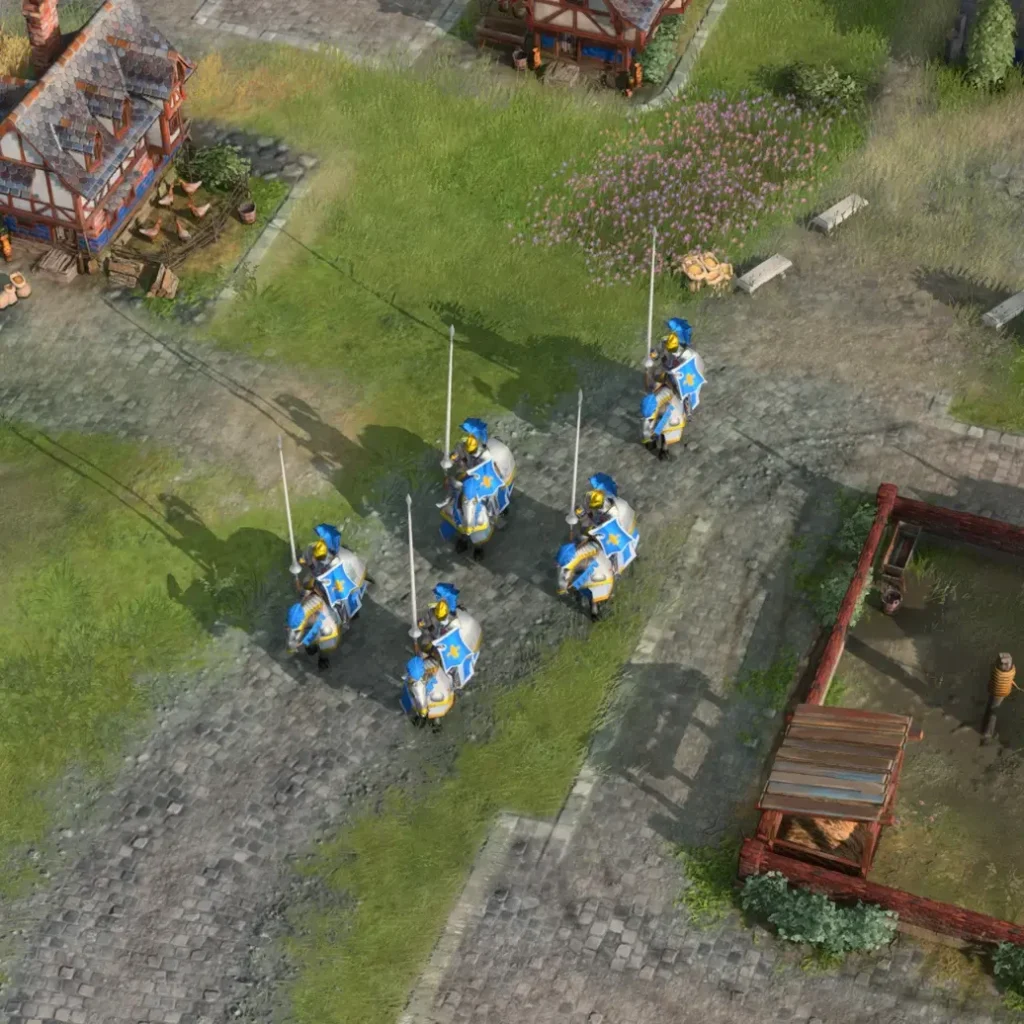
TL;DR: This Age of Empires 4 French build order is a standard AI practice route through the School of Cavalry. Maintain Villager production, establish food and gold income, complete the Feudal landmark and produce a Royal Knight. Inspect Chivalry and the next economic improvement only after accounting for the units and buildings you still need to fund.
Quick answer: The School of Cavalry costs 400 food and 200 gold in the checked data and acts as a Stable. The Royal Knight is available in the Feudal Age, with a listed cost of 140 food and 100 gold. Landmark construction and the Knight purchase are separate expenses; finishing the age-up does not provide that unit automatically.

The official French civilization page supports early Royal Knights and the civilization’s economic identity. Specific menus and costs were checked against the original-French files in AoE4 World building data, plus its unit and technology files, on November 8, 2026. This is a researched learning opening, not a claimed current ranked optimum or an observed arrival time. It uses the French civilization rather than a separate variant roster.
On this page
Age of Empires 4 French build order: seven practice steps
1. Establish the Town Center’s food supply
Select the Town Center and queue a Villager. The checked worker cost is 50 food. Your opening needs a continuing supply for that queue as well as the much larger food reserve required by the Feudal landmark.
Aim for six food workers in this drill, then direct new arrivals toward the next resource need. That count is a teaching choice, not a tested distribution for every map. Give the Scout a manageable resource-discovery task while the workers continue gathering.
The French have faster Town Center production as part of their civilization identity. The benefit increases the importance of having food ready; it does not fund the queue itself. A Town Center that could produce quickly still waits when the next Villager cannot be purchased.
2. Fund gold gathering and population space
Build a House before population space runs out, then use a nearby gold deposit for a Mining Camp. Assign two workers to gold for this learning route. Return the camp’s builder to an explicit resource task rather than leaving the worker beside the finished structure.
The checked French Mining Camp costs 25 wood. Their Mill and Lumber Camp also have 25-wood entries, reflecting cheaper resource drop-offs. The lower cost helps open gathering routes, but it does not mean every French building has that price.
Keep this gold allocation connected to the landmark reserve. The selected School of Cavalry requires 200 gold before the subsequent Knight purchase. An early economic research choice can use part of that gold and move the landmark later, even if the research is beneficial.
3. Add wood workers and select the first infrastructure purchases
Build a Lumber Camp and aim for three wood workers as the opening develops. The wood income supports Houses, later production buildings and the transition to a replacement food source. More gold alone cannot build a structure whose cost is wood.
The three checked French drop-off buildings together cost 75 wood. This offers a useful distinction from a civilization with more expensive versions. It should not persuade you to build all three immediately when the Town Center already provides a usable drop-off for the current food source.
Add a Mill when its location or research menu has a clear purpose. Each building should solve a particular gathering or menu need. Keep the remaining workers on the food and gold needed to complete the selected age-up path.
4. Advance with the School of Cavalry
Once the available reserve funds 400 food and 200 gold, choose the School of Cavalry from the Villagers’ landmark construction options. Assign four builders for this drill so the construction task is easy to follow while the other workers continue gathering.
That builder count is an illustrative choice. It changes how many workers temporarily stop gathering and is not a measured fastest Feudal time. Keep food collection functioning because both the Town Center and the first Knight will need it after the landmark completes.
The School of Cavalry acts as a Stable and improves stable production speed according to the checked description. The alternative Chamber of Commerce acts as a Market with a different economic function. Pick the landmark for the route you intend to practice; the two names are not interchangeable upgrades.
5. Queue the first Royal Knight
Select the completed School of Cavalry and purchase a Royal Knight. The original-French unit data lists 140 food and 100 gold for the Feudal unit, produced from the School of Cavalry or a Stable.
Confirm the entry and wait for the unit to appear before budgeting a larger group. For this exercise, build toward two Knights while keeping the Town Center active. Two is a manageable roster goal, not a claim that every opponent or map requires the same opening count.
The first two Knights represent 280 food and 200 gold in the checked unit costs, beyond the landmark expense. Continued Villagers consume additional food. If you only saved for the age-up, an idle School afterward may simply mean you have not yet funded the next part of the route.
6. Inspect Chivalry as a separate research decision
Open the School of Cavalry or Stable research menu and inspect Chivalry. The checked technology costs 100 wood and 200 gold and gives Royal Knights regeneration while out of combat. It is research for the units you already own or intend to produce, not a replacement for a Knight purchase.
For a first drill, decide whether maintaining the next unit queue or adding this improvement matters more. The research uses as much listed gold as two initial Knights, although its wood expense and effect are different. That makes the tradeoff concrete without establishing one universally correct purchase order.
If you choose it, observe the research completion and the relevant unit information. Do not record the upgrade as active simply because you opened its tooltip. If you defer it, note which production or recovery need kept the resources committed elsewhere.
7. Choose the next economic or production branch
Review the current food source, wood reserve and production capacity before adding a second Stable. The checked Stable costs 150 wood. It provides another production building, but it does not make the combined queues affordable by itself.
If the food source is running low, inspect a Mill and the next gathering location or Farm plan. If the existing School queue is well funded and genuinely limiting production, inspect the second Stable. Give the new structure a defined purpose before spending the same wood needed elsewhere.
End the exercise with one explained branch and a functioning economy. The beginner guide covers the surrounding worker and queue controls. The useful milestone is understanding what each purchase adds, rather than building every structure listed in a later-age roster.
Budget the full School of Cavalry route
The landmark and first Knight together use 540 food and 300 gold in the checked entries. Adding a second Knight takes those purchases to 680 food and 400 gold. These totals describe those specific purchases, excluding Villagers, Houses, drop-offs, research and other spending.
This distinction explains why a visible 400-food reserve can disappear when you commit the landmark and continue the worker queue. The amount that funded an age-up is not also available for the unit you plan to produce from it.
Watch the builders’ resource assignments after construction. Returning several to food supports both workers and Knights; maintaining gold gathering supports the cavalry queue. The right redistribution follows the expenses you chose, rather than a fixed worker chart disconnected from the actual purchases.
Keep the second Stable separate from the second Knight. One costs wood and adds capacity; the other uses food and gold and adds a unit. Confusing them can create a larger base with insufficient resources to operate either cavalry queue.

Read French economic discounts per technology
The official overview describes cheaper economic technologies and drop-offs. The checked data gives concrete item entries, so use those entries rather than applying a remembered discount to every research icon.
For example, the French Double Broadax entry at the Lumber Camp lists 35 food and 70 gold. Horticulture at the Mill lists 35 wood and 70 gold, with a description that excludes hunted meat. Wheelbarrow has its own listed cost of 50 wood and 150 gold. Those are different purchases with different applicability and reserve requirements.
A cheap upgrade can still arrive before the economy that makes it useful. If few workers are on wood, ask what the wood-gathering research improves now. If your current food comes from hunting, read the stated food-technology limitation instead of assuming every source receives the same benefit.
The practice decision is to identify the worker group, select its research building and compare that cost with the next planned unit. You are learning a civilization-specific economy menu, not trying to click every discounted item before advancing.
Keep later bonuses separate from the Feudal budget
French Keep influence can reduce the cost of units from nearby Stables and Archery Ranges according to the civilization data. That is a later infrastructure condition, not a discount this opening receives merely because the French faction was selected.
Budget the early Knight from the active production card. When a later Keep and its influence become relevant, inspect the actual affected buildings and modified prices. Do not subtract a future benefit while saving for the first unit.
The French also have a civilization bonus for free melee-damage technologies through Blacksmiths. This does not make every Blacksmith upgrade free. Inspect which research is completed and which still has a cost at the relevant age before buying an unrelated improvement.
Practice case: Chivalry replaces the next two Knights
Imagine the first Knight has appeared and you have 200 gold reserved for the next cavalry purchases. You start Chivalry and then wonder why the School cannot immediately produce the two units you had planned.
The technology’s checked gold cost consumed that reserve. Its effect improves Knights under its stated condition, but it does not train additional units. Compare the actual queue and resource balance rather than treating research completion as production completion.
For the next attempt, label the reserve by purpose before spending it. Choose the improvement or the units deliberately, then maintain enough gathering to fund the later choice. Neither decision proves an optimal match opening; the exercise makes the purchase order understandable.

Troubleshoot the opening
The landmark is ready but there is no Knight. Select the School and inspect its unit queue and food/gold balance. Landmark completion is not the unit purchase.
A trade menu appears instead of cavalry production. Check which Feudal landmark you built. Chamber of Commerce and School of Cavalry provide different functions.
The second Stable is idle. Review the resources required by its units. Additional production capacity does not generate the food and gold that operate it.
A research price differs from a remembered discount. Read that item’s card. The checked French technology entries should not be replaced by one blanket percentage.
A later Keep discount is absent. Inspect the current building, age and influence conditions. A bonus tied to infrastructure is not an automatic early-game price change.

Frequently asked questions
Is this a tested competitive French opening?
It is a source-checked AI practice sequence. No current-meta ranking, completion minute or measured win rate is claimed.
Does the School of Cavalry provide a free Knight?
The selected route still requires a separate unit purchase. The landmark’s checked function is Stable production and a speed benefit.
Must Chivalry precede another Knight?
Choose based on the owned units, reserve and practice goal. It has a separate cost and does not replace additional production.
What should I practice next?
Repeat the route while keeping one production reserve clearly assigned. Use the Age of Empires 4 beginner guide for worker and queue controls.
Sources and further reading
- https://www.ageofempires.com/games/age-of-empires-iv/civilizations/french/
- https://github.com/aoe4world/data/blob/main/buildings/french.json
- https://github.com/aoe4world/data/blob/main/units/french.json
- https://github.com/aoe4world/data/blob/main/technologies/french.json
- https://github.com/aoe4world/data/blob/main/civilizations/french.json
Keep exploring
Games Like Age of Empires 4: economy, settlement or tactics?
Northgard fits resource and victory planning; Manor Lords fits settlement design; COH3 fits tactical combat with a campaign layer.
Age of Empires 2 Definitive Edition vs Age of Empires 4: where to start
Choose campaign breadth in AoE II DE or documented onboarding and newer presentation in AoE IV.
Age of Empires 4 Relic Collection: 6 Practical Checks
A collection sequence separating discovery, religious-unit eligibility,pickup,compatible deposit and building income.