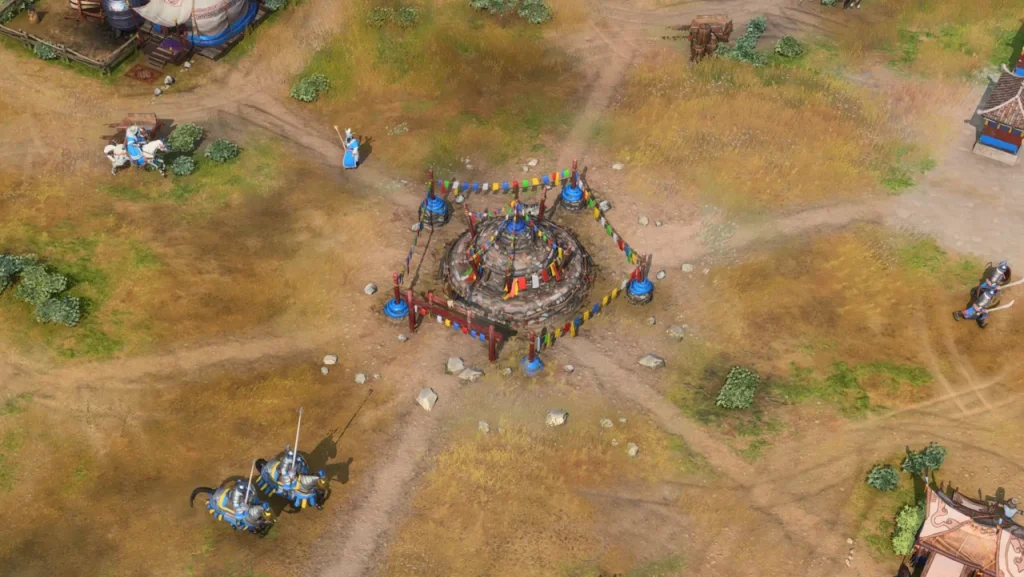
TL;DR: This Age of Empires 4 Mongol build order is an AI practice route through a working Town Center, Ger, Ovoo and Deer Stones. Gather the food and gold for the Feudal landmark, then use a Stable to produce a Keshik. Keep stone-funded production and the Pasture food transition separate from the ordinary unit queue.
Quick answer: Original Mongols use the Ger for food, wood and gold drop-offs and the Ovoo to gather stone. The checked Deer Stones cost 400 food and 200 gold. A Stable can exist in the Dark Age, but the checked Keshik unit requires the Feudal Age and costs 120 food and 80 gold.

The official Mongols page supports the nomadic economy and Ovoo identity. Specific production details were checked in original-Mongol building data, alongside its unit, technology and civilization files, on November 8, 2026. This is a researched learning sequence, not a tested current ranked opening. It uses the Mongols roster rather than a separate variant civilization.
On this page
Age of Empires 4 Mongol build order: six practice steps
1. Establish the Town Center and food gathering
Select the Town Center and establish a working production queue, unpacking it first if the chosen setup requires that action. Queue a Villager when the 50-food purchase is funded and assign workers to a nearby food source.
Aim for six food workers in this drill while directing new arrivals to the other resources. This is a manageable practice distribution, not a measured optimum for every map. The food supply supports workers, the landmark and the later cavalry purchase.
Locate the Khan separately. The checked unit description includes scouting vision and herding, making it useful for locating resources while the economy works. Only one Khan is allowed per Mongol player; it is not a production option to buy repeatedly like Villagers.
2. Use the Ger to open gold and wood income
The checked civilization description starts the Mongols with a packed Ger. Inspect that available structure and unpack it where it serves the intended workers before paying for an unnecessary duplicate.
The Ger accepts food, wood and gold and houses resource-gathering technologies. A separately constructed Ger costs 100 wood in the checked entry. This replaces the assumption that you must begin by finding the same separate drop-off menus used by another civilization.
Aim for two gold workers and a small wood group as the route develops. Assign the Ger’s position around their actual delivery needs. If a gathering site changes, a relocated drop-off should be unpacked and usable before you treat the move as a completed economy improvement.
3. Construct the Ovoo on a stone deposit
Choose the Ovoo from a Villager’s construction menu and place it on a Stone Outcropping. The checked building costs 150 wood and requires that terrain. A visually convenient open area is not a substitute for the required deposit.
The Ovoo gathers stone; the original-Mongol Villager description explicitly says workers cannot gather stone themselves. Give those workers food, wood or gold assignments rather than leaving them waiting for a stone-mining action their roster does not provide.
Inspect the Ovoo’s influence before positioning a production building for stone-funded options. The civilization data connects that influence with double production and improved technologies. Building another Ovoo destroys the previous one according to the checked entry, so replacement is a change to the existing economy and influence, not a free additional source.
4. Advance through Deer Stones
When the available reserve funds 400 food and 200 gold, choose Deer Stones as the Feudal landmark. For this practice, assign four builders and keep the other economy gathering. The builder count is illustrative; no fastest completion minute is claimed.
The checked Deer Stones description instantly researches Yam Network and grants access to the Khan’s Hunter at the Archery Range. Those effects are distinct from producing a military unit automatically. Inspect the resulting menus after the landmark finishes.
The Silver Tree is the alternative economic landmark and acts as a Market in the checked data. This route selects Deer Stones rather than building a trade opening. Keep the chosen function clear when following later production steps.
5. Produce a Keshik from the Stable
Construct a Stable when its 150-wood cost can be funded, using the Ovoo’s shown influence if your next plan includes stone-funded production. The Stable is available in the Dark Age, but that early building access does not open every later cavalry unit immediately.
After the Feudal age-up, select the Keshik entry. The original-Mongol unit data lists 120 food and 80 gold for the ordinary purchase. Queue one, observe its arrival and build toward two as a small roster exercise.
Read any double-production option separately. It uses stone under the civilization’s influence system and has its own displayed purchase requirements. A resource total that funds one ordinary unit should not be assumed to fund a different production option with an additional resource cost.
6. Plan replacement food and one research choice
Inspect the remaining food supply before extending the cavalry queue. Original Mongols use Pastures instead of Farms. The checked Pasture costs 150 wood and automatically produces gatherable Sheep, rather than depositing food directly into your reserve.
Assign workers to gather from the produced food source. A completed Pasture can exist while the food economy still fails if the workers are elsewhere. Its production can stop when too many produced Sheep remain ungathered, according to the building description.
For the research exercise, inspect Wheelbarrow or Double Broadax at the Ger. Pick one for the worker group and next expense you actually have. Keep the Pasture, another unit and stone-funded improvement as distinct choices rather than buying every option because the population limit feels generous.
Use Mongol population and mobility correctly
The checked civilization data gives original Mongols the maximum population limit at the start and no need for Houses. This removes one familiar wood expense, but it does not remove the cost of the Ger, Ovoo, Stable or Pasture.
If you needed to construct each of those four buildings, their checked entries would total 550 wood. An already provided Ger changes that particular construction bill. Track what the selected setup actually supplied rather than paying again because another civilization’s opening begins with multiple drop-offs.
Packing and redeploying core buildings can change the economy’s geography. A moved building should be operational at the new position before its queue or drop-off function is counted in the plan. For the Ovoo, use its specific replacement rule instead of assuming a second one simply adds influence everywhere.

Keep the cavalry and ranged menus separate
The Keshik belongs to the Stable’s Feudal roster. Mangudai are a separate Archery Range production option, with a checked ordinary cost of 90 food and 60 gold. A Stable existing early does not mean the Mangudai card should appear there.
The Archery Range itself is another 150-wood building in the checked file. Adding that branch therefore means construction followed by the chosen unit purchase. It does not produce a ranged unit merely by increasing the number of military structures you own.
For this first drill, finish the Stable route before experimenting with the alternative menu. The beginner guide covers surrounding selection and resource controls. A small understood roster is easier to compare with a later practice variation.
Budget the ordinary Feudal purchases first
Deer Stones and two ordinary Keshiks together use 640 food and 360 gold in the checked purchase entries. That total excludes Villagers, any new Ger, the Ovoo, military buildings, Pastures and research. A large stone reserve does not make those separate food and gold expenses disappear.
Wheelbarrow adds 50 wood and 150 gold in the ordinary Ger technology entry. Double Broadax instead adds 50 food and 100 gold. Their resource combinations differ, and both can compete with the cavalry plan even though the research affects workers.
For a useful practice comparison, keep one record for ordinary purchases and another for the influence-dependent stone option you are inspecting. Read the latter’s actual card when choosing it. This prevents the cost of a single unit from being mistaken for the complete cost of a different production action and keeps the chosen research connected to the worker group it improves.
Practice case: an Ovoo replacement changes the plan
Imagine you place a new Ovoo at another deposit and expect both stone sources to operate. A production building near the original site no longer shows the influence-dependent option you planned to use.
Read the Ovoo’s checked replacement rule: constructing a new one destroys the previous one. The original area cannot be assumed to retain that same building’s influence after the replacement. Confirm the new influence and the production structure’s actual position.
Then decide whether to relocate an appropriate building, use its ordinary production option or revise the next purchase. You do not need to invent a missing technology when the building placement explains the changed menu.
For the next attempt, identify which production building should use the new Ovoo before replacing the old one. Record the planned move and resource expense. This makes the nomadic system a deliberate menu decision rather than an unexpected interruption to the queue.

Troubleshoot the opening
Workers cannot mine stone. Use the original-Mongol Ovoo system. The checked Villager roster does not provide ordinary stone gathering.
A Keshik is unavailable from an early Stable. Inspect the Feudal Age requirement. Building access and unit-age access are different prerequisites.
A Mangudai is missing from the Stable. Select the Archery Range instead. The two cavalry-related units use different production buildings.
A double-production choice is unavailable. Inspect stone funding and the production building’s Ovoo influence. Do not substitute the ordinary unit cost for that option.
The Pasture has not restored the food reserve. Check produced Sheep and worker assignments. Sheep production is not the same action as gathering their food.

Frequently asked questions
Is this the current best Mongol opening?
It is a source-checked AI practice route. No ranked-meta claim, measured arrival minute or tested win rate is represented.
Do original Mongols need Houses?
The checked civilization data states maximum starting population and no need for Houses. Other construction and unit costs still apply.
Does a Dark Age Stable immediately produce Keshiks?
The checked Keshik entry requires the Feudal Age. Early Stable construction does not remove that prerequisite.
What should I practice next?
Repeat one Ger, Ovoo and Stable arrangement while keeping ordinary and stone-funded production distinct. Use the Age of Empires 4 beginner guide for the surrounding controls.
Sources and further reading
- https://www.ageofempires.com/games/age-of-empires-iv/civilizations/mongols/
- https://github.com/aoe4world/data/blob/main/buildings/mongols.json
- https://github.com/aoe4world/data/blob/main/units/mongols.json
- https://github.com/aoe4world/data/blob/main/technologies/mongols.json
- https://github.com/aoe4world/data/blob/main/civilizations/mongols.json
Keep exploring
Games Like Age of Empires 4: economy, settlement or tactics?
Northgard fits resource and victory planning; Manor Lords fits settlement design; COH3 fits tactical combat with a campaign layer.
Age of Empires 2 Definitive Edition vs Age of Empires 4: where to start
Choose campaign breadth in AoE II DE or documented onboarding and newer presentation in AoE IV.
Age of Empires 4 Relic Collection: 6 Practical Checks
A collection sequence separating discovery, religious-unit eligibility,pickup,compatible deposit and building income.