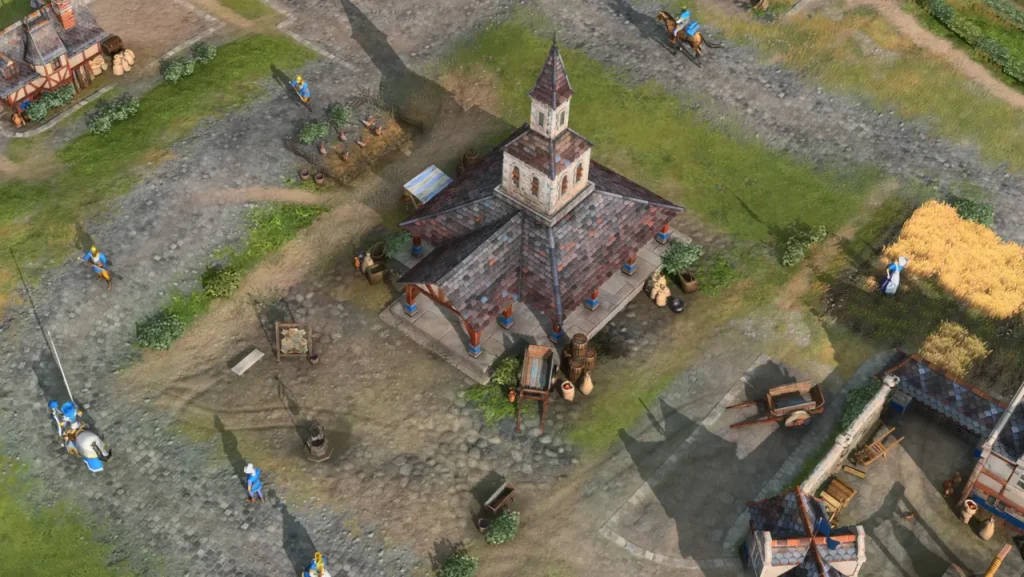
Age of Empires 4 team game trade routes need a Home Market, a valid trade destination, and Traders completing the journey. The checked Trader description permits a Trade Post or another player’s Market and says greater distance yields more gold per trip. Choose a route you can sustain with your team; a larger trip value is not automatically higher realized income when travel or interruptions differ.
For an English example, a Market costs 100 wood and a Trader costs 60 wood and 60 gold. The Market also buys and sells resources, but that exchange function is separate from Trader route income. Build the route, assign the units, and observe completed trips before expanding the fleet of Traders.

This guide uses original English item descriptions and proposed AI or teammate practice observations. It does not promise a fixed gold-per-minute route or an exploit-based opening. Review the Age of Empires 4 beginner guide if economy queues and map control are unfamiliar.
On this page
Age of Empires 4 team game trade routes in 6 checks
The important checks are destination eligibility, Market placement, production budget, route assignment, completed return, and protection. Coordinate those checks with your team. A Market foundation, an idle Trader, and a completed income trip are different states, even though all three can appear in the same intended trade plan.
1. Confirm the destination with your teammate
Identify the Trade Post or allied Market you intend to use and confirm its location. The checked Trader travels between its Home Market and a Trade Post or another player’s Market. Do not build a plan around two nearby Markets belonging to you and assume that arrangement supplies the same valid partner destination.
In a team game, make the destination and proposed route clear before buying a large Trader group. A teammate’s Market can serve a different purpose or be placed somewhere unsuitable for your intended path. Agreement about location is more useful than assuming every completed allied Market automatically fits your economic plan.
2. Place the Home Market around the actual path
A checked English Market costs 100 wood. Choose a location with a workable route to the destination and space for units to leave and return. Examine terrain, crossing points, and nearby access rather than comparing two Market spots solely by their straight-line separation on the minimap.
Distance matters to the per-trip gold value in the unit description, but the traveled path matters to the practical journey. A longer route also asks the Traders to spend more time moving and to remain usable along more terrain. Keep the placement tied to the team’s actual ability to sustain that route.
3. Budget Traders separately from the building
An English Trader costs 60 wood and 60 gold. One Market plus three Traders therefore costs 280 wood and 180 gold before housing, other buildings, and protection. The calculation is 100 wood for the Market plus 180 wood and 180 gold for the units.
Do not treat the Market’s construction cost as the full trade investment. A completed building without Traders is not the planned income stream. The units also need production time and population room, while your ordinary economy must continue to fund workers, military needs, and any age or technology purchases already underway.
4. Assign the route and verify movement
Select the Trader and set the intended trade destination. Check its Home Market and current order so you know which route it is actually using. The checked description allows the Home Market or destination to be changed, but a change should be deliberate rather than an accidental command issued while selecting a group.
Watch the first unit leave and follow the intended path. A Trader waiting beside the Market is not proof that trade has started. Inspect whether the destination is valid, whether the order was issued to the correct unit, and whether terrain or an incomplete building is preventing the expected movement.
5. Observe a completed trip before scaling
Let the first Trader complete the relevant journey and inspect the resulting income. Record the route endpoints and the completed return state. This guide does not claim that a particular first-trip shortcut, destination swap, or previous-patch behavior is necessary for normal route income.
Keep the gold stockpile and route performance separate. The visible reserve can fall while a trip contributes gold because research or unit production is spending it. Compare completed journeys and current spending rather than using one stockpile snapshot as proof that the route is working or failing.
6. Expand with a team protection plan
Before adding more Traders, check whether the route remains usable and whether your team can respond to interruptions. Additional units increase the resources committed to that path. A route with a larger nominal payout is a poor expansion choice if Traders repeatedly fail to complete it.
Assign responsibility for relevant access points and keep communication specific. State which route is interrupted and where the units are waiting. A teammate cannot infer the whole trade state from the fact that you have built a Market. Keep the economy’s route needs connected to the rest of the team’s map plan.
Gold per trip versus sustained income
The retrieved Trader description says greater distances generate higher amounts of gold. That is a per-trip relationship. It does not establish one universal gold-per-minute winner across all paths, because trip duration, unit count, upgrades, route changes, and interruptions can differ.
For a useful comparison, record endpoints and observe several completed journeys under the same game conditions. Keep the civilization, relevant upgrades, and number of Traders consistent. These are proposed measurements, not results already obtained by this guide. Avoid comparing one successful long trip with a different route while several units were idle.
Travel interruptions also have a cost. A blocked or unsafe route can leave purchased units unable to finish their job. Check the actual unit state when deciding whether to add another Trader, change a route, or pause expansion. More production does not repair a route whose existing units are already waiting.
Use the first three-Trader example to learn the system rather than treating three as an optimal army-wide economy ratio. It is a small funded practice group derived from the unit cost. A competitive trade transition needs the current match context and a larger economic comparison than this simple purchase example supplies.

Buying resources is a different Market function
The Market’s checked description includes resource buying and selling. Those transactions affect your available stockpile immediately through the selected exchange. Trader income instead comes from units traveling the route. A Market can support both functions, but one should not be silently counted as evidence that the other is working.
If you use a Market transaction while measuring trade, record it separately. Otherwise, a sudden gold change can look like a completed route payment when it was actually an exchange. Likewise, a purchase of food or wood can make the reserve fall even though Traders have continued their normal work.
This guide does not promise a fixed exchange rate for every point in a match. Read the current transaction price and decide whether it serves an immediate need. A useful temporary exchange is not a substitute for understanding the route, production investment, and continuing economy you are trying to build.
Water trade uses a separate unit and venue
Trade Ships are produced at Docks rather than Markets. The checked English Trade Ship costs 90 wood and 90 gold and trades with a Coastal Trade Post or another player’s Dock. Its description supplies both gold and wood income, so it should not be modeled as an ordinary land Trader with a different picture.
One English Dock costs 150 wood. A new Dock plus two Trade Ships therefore requires 330 wood and 180 gold before all other spending. The ships also have their own population and production requirements. Keep that water-route budget separate from the 280-wood, 180-gold land example.
Whether water trade is practical depends on the actual map and route control. This section explains the menu difference, not a claim that every team-game map supports a safe water economy. Inspect eligible destinations and completed journeys before investing in a naval route you have not yet established.
A focused team trade exercise
With an AI partner or a willing teammate, identify a valid Market destination and build one English Home Market. Fund three Traders and record the 280-wood, 180-gold purchase budget. Assign the intended route and inspect the first departure before adding another economic task.
Record the unit state at departure, destination, and return. Note any Market resource exchanges separately. Then compare the completed route with your intended endpoints and actual path. These are proposed practice observations; no route timing, current meta claim, or recorded income measurement is invented here.


Troubleshooting and quick answers
Why is a Trader idle beside my Market? Check its assigned destination, Home Market, and current order. A completed Market does not automatically prove that every produced Trader has been assigned to the intended valid route.
Is the farthest Market always best? Greater distance increases gold per trip in the checked description. Sustained income also depends on the journey and whether Traders complete it. Inspect actual route behavior before treating a larger payout as a complete economic conclusion.
Can I use a Dock for the land Trader example? Land Traders and Trade Ships have separate venues and destination descriptions. Use the unit appropriate to the route and its current menu, rather than swapping the examples without accounting for the different building and unit costs.
Start with one functioning route and a clearly funded group. Sources checked on November 8, 2026 include English Trader data and English Market and Dock data. Current unit descriptions and completed trips control later route decisions.
Sources and further reading
Keep exploring
Games Like Age of Empires 4: economy, settlement or tactics?
Northgard fits resource and victory planning; Manor Lords fits settlement design; COH3 fits tactical combat with a campaign layer.
Age of Empires 2 Definitive Edition vs Age of Empires 4: where to start
Choose campaign breadth in AoE II DE or documented onboarding and newer presentation in AoE IV.
Age of Empires 4 Hotkey Setup: 6 Clear Profile Checks
A PC keyboard guide explaining separate layouts,context conflicts,gradual edits and verified save/profile checks.