TL;DR: Improve Crusader Kings 3 development and taxes by separating four jobs: restore control, improve appropriate income buildings, grow development in useful counties, and manage vassal contributions. A recently conquered county with poor control needs a different first action from a secure capital ready for long-term investment. Develop the personal core you expect future rulers to keep.
Development is part of the economy, but it is not the explanation for every low-income holding. Control, buildings, ownership, government, and active modifiers can change what the ruler actually receives.

This guide focuses on ordinary landed feudal economic planning. Other governments and campaign systems can use development and obligations differently. It does not apply a historical tax formula or fixed building cost to every current save.
On this page
Crusader Kings 3 development and taxes: diagnose low income first
Inspect the county and holding before assigning the steward or starting construction. Identify whether the land is personally controlled, how much income it produces, and which effects are reducing the result.
The archived Gamepressure gold guide separates domain taxes, vassal income, control, development, and buildings. Its old numerical bonuses and penalties are not used here.
Ask four questions: Is control poor? Are useful income buildings missing? Is development the long-term bottleneck? Is the money coming through a vassal rather than direct ownership? The answers point to different actions.
Do not assume a rich-looking county on the map supplies the same amount to the liege as it would under personal ownership. Follow the actual ownership and contribution relationship.
Restore control before treating conquest as finished
Poor control can reduce the value of newly acquired personal territory. Inspect it after war, rebellion, or occupation, then use an appropriate recovery plan before expecting the county to fund another campaign.
The archived titles guide distinguishes county control from development and describes the marshal’s control task. These are separate administrative jobs.
For a hypothetical newly conquered county with low control, assigning control recovery can be more useful than immediately sending the steward to grow development there. The existing economic base needs to function before you judge the value of a longer-term improvement.
Keep the county secure while it recovers. Repeated occupations or unrest can undermine the same investment and delay the moment it becomes dependable personal income.
Build income where ownership supports the plan
Choose appropriate economic construction in holdings you expect to retain. Read the building’s actual benefits and conditions, including the holding type and terrain where it can be built.
The next purchase should solve a named problem. A missing basic income source in the personal core can deserve attention before another military upgrade whose role is already funded.
Compare construction with the treasury’s immediate needs. An investment can be useful over time while still being poorly timed if it consumes the reserve needed for an impending war or faction crisis.
For a hypothetical secure capital, a suitable income building may provide a dependable foundation for future reigns. For surplus land about to be granted away, the same purchase has a different purpose: strengthening the recipient or realm rather than your direct income.
Use development for the longer-term county
Development supports a county’s economic position, and the steward’s development task can help grow it. Relevant buildings, innovations, and county conditions also affect the process.
Choose a county worth sustained attention. The capital or another stable part of the intended personal core is a clearer investment than a location likely to leave direct ownership at the next succession.
Do not change the development target constantly merely because another county looks attractive. Give the task a defined purpose and review progress alongside the rest of the domain plan.
Also distinguish development from immediate treasury relief. If the army is about to require substantial raised expenses, a long-term growth task does not replace the cash needed to sustain the campaign now.

Choose the steward task for the current constraint
Tax collection and development growth serve different time horizons. Consider immediate fiscal pressure, the quality of the councillor, the condition of the county, and the stability of the realm before choosing.
Use this practical comparison:
- A strained treasury before an unavoidable war calls for immediate budget attention.
- A newly conquered county with poor control calls for administrative recovery as well as economic review.
- A secure personal core with funded military needs can justify longer-term development.
- Land leaving direct ownership deserves a clear realm or dynasty reason for additional investment.
The appropriate task should support that diagnosis. It should not remain unchanged simply because it was the initial setting at the start of the reign.
Separate personal income from vassal contributions
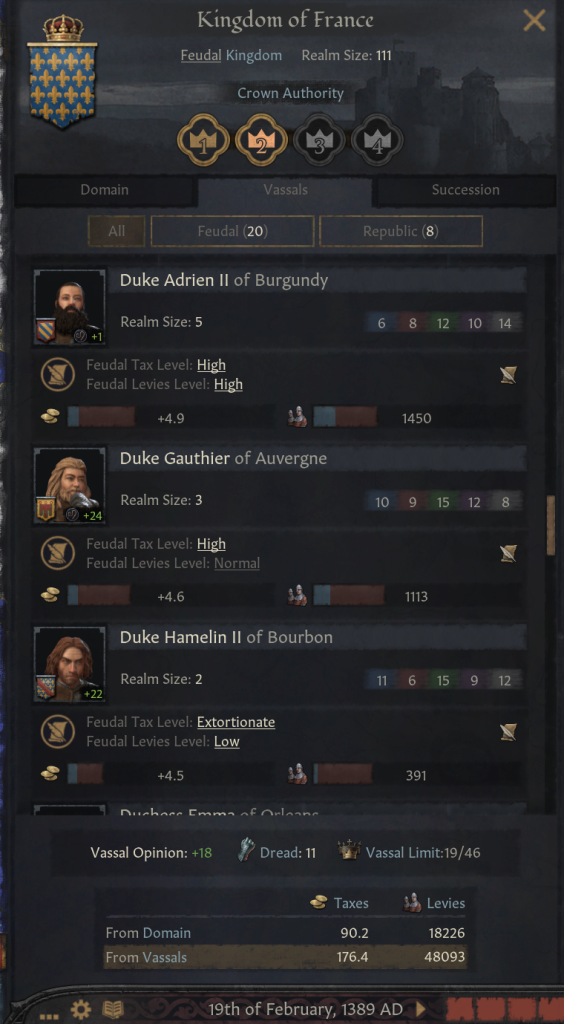
Improving a vassal’s county can strengthen the realm, but the liege does not automatically receive its full income. Obligations and the government relationship determine the contribution.
For feudal vassals, contracts can adjust taxes and other terms. Compare the benefit with rights, opinion, and political costs rather than assuming higher obligations are always the best economic answer.
Religious holdings and other arrangements can introduce additional contribution conditions. Inspect why money is reaching the ruler instead of treating every holding as the same direct tax source.
The result should be a clear budget: personal-domain income, vassal contributions, and other recurring sources, set against ordinary and raised military expenses. A larger realm is not a substitute for understanding that budget.
Combine economic and military building plans
A holding can support both income and a military role. The official 1.9 announcement documented major building changes and the move toward benefits for regiments stationed at particular holdings.
Read economic and military choices together. A building useful to the stationed regiment can support the army, while an income investment helps fund its use. Neither role should be evaluated without the other when resources are limited.
Avoid applying old advice that assumes every military building improves every regiment across the realm. Use the actual holding-regiment relationship for the current plan.
After succession, inspect which holdings remain with the new ruler and whether the support arrangement still makes sense. An inherited title does not automatically preserve every previous economic and military choice.
Build a budget that survives a delay
Keep funds for raised troops, recovery, political responses, and unexpected disruption. A profitable domain can still leave the ruler vulnerable if every available coin is committed to construction.
The official AI economy diary discusses capital development, broader domain investment, and different approaches to war reserves. Its historical AI outcomes are not presented here as your expected result.
Use the principle to set a practical order: make the personal core function, fund the military you actually need, and invest in lasting growth when the immediate obligations are covered.
For broader context, see the published Hearts of Iron 4 versus Crusader Kings 3 comparison. Your next action is to inspect one low-income personal county and choose the intervention that matches its actual constraint.
FAQ
Is development the same as control?
No. They are separate county conditions. Restoring control and growing development solve different economic problems.
Should I always use the steward to increase development?
No. Compare immediate fiscal needs with long-term growth and the county’s condition. A task should support the current constraint.
Does improving a vassal’s county give me all its extra taxes?
No. The ruler receives contributions through the relevant relationship and obligations. Personal ownership and vassal income are different budget sources.
Where should I invest first?
Start with a stable personal core you expect to retain. Fix poor control, choose suitable income, and fund current obligations before committing everything to longer-term development.
Sources and further reading
Keep exploring

Crusader Kings 3 faith reformation: holy sites, rites and the realm afterward
Reform an unreformed rite with holy-site access and Piety, then check doctrine choices, divergence and which rulers will follow the change.
Crusader Kings 3 cultural innovations: choose the unlock your realm needs
Prioritize the innovation that removes a current realm obstacle; check the head, matching skill, cultural Development, spread and era restrictions.

Manor Lords vs Crusader Kings 3: build a town or guide a dynasty?
Pick Manor Lords for a medieval settlement and its household economy; pick Crusader Kings III for rulers, relationships and a realm passed between generations.