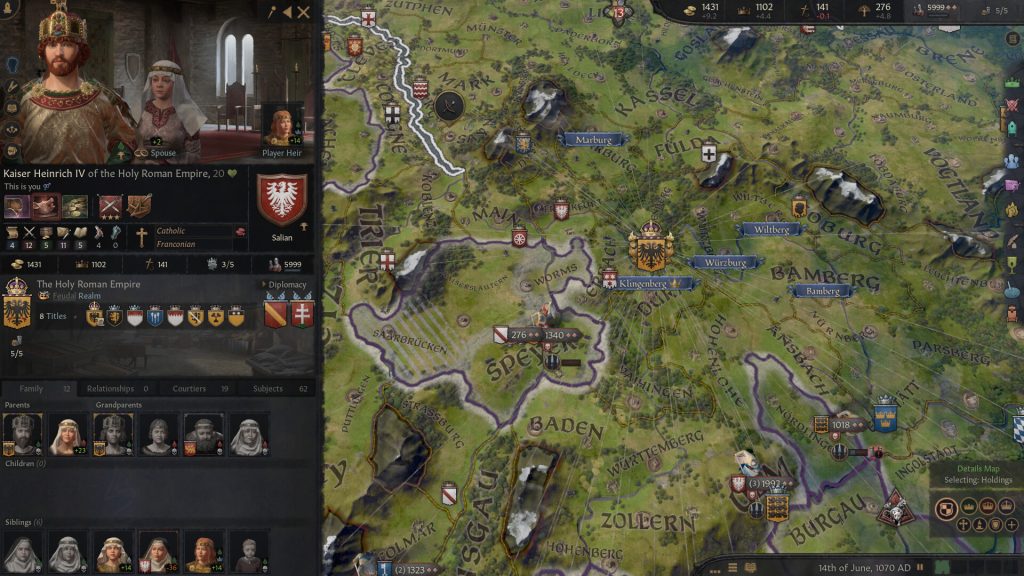
TL;DR: Manage Crusader Kings 3 domain limit by keeping a useful personal core within the ruler’s capacity, then granting surplus holdings deliberately. Improve sustainable capacity when it fits the character, but prepare for the heir’s different limit. A larger realm does not mean the ruler should personally hold every acquired county.
Your domain is the land you directly control; your realm also includes territory governed through vassals. The goal is a personal base that funds the army and survives succession, rather than the largest possible collection of scattered holdings.

This guide focuses on ordinary landed feudal domain planning. Government, rank, innovations, character skills, and game rules affect capacity. It gives no universal domain size or current penalty percentage.
On this page
Crusader Kings 3 domain limit: inspect capacity and ownership
Open the domain information and identify the holdings counted against the current limit. Separate those holdings from land controlled through vassals, then inspect which ones produce the income and military support you actually need.
The archived Gamepressure titles guide distinguishes the domain from the wider title hierarchy and identifies rank, stewardship, and innovations as capacity factors. Its historical numerical penalties are not used here.
Use this opening review:
- Identify the current capacity and the holdings counted against it.
- Mark the capital and the personal core you intend to keep.
- Compare scattered acquisitions with that core’s income and defense.
- Inspect expected succession before distributing important land.
- Choose a recipient and political role for holdings you will grant away.
Avoid solving an excess by giving away the first county in the list. Compare what each holding contributes before changing ownership.
Keep a compact core that performs several jobs
Choose personal land according to its practical value. Recurring income, useful development, military support, geography, and the ability to defend the area all matter.
A compact domain can make military response and planning easier than several isolated acquisitions. That does not mean every distant holding is worthless; an exceptional location can deserve special consideration. The important point is to know why you are keeping it.
For a hypothetical ruler with a secure developed core and a new county beyond a difficult frontier, granting the distant county can be more useful than discarding a core holding to retain it personally. Compare the actual income, development, and strategic role rather than judging by map size.
Also consider the holdings that support regiments. The official 1.9 announcement documented stationing-based men-at-arms bonuses. Personal territory can serve an economic and military role at the same time.
Improve capacity through choices you can sustain
Stewardship and relevant character support can affect the domain the ruler can manage. Consider appropriate lifestyle choices and available spouse assistance when they support the broader reign.
The marriage strategy guide discusses spouse skills and domain management. Its old numerical skill-transfer examples are not used here.
Do not build an oversized personal domain around one temporary or fragile benefit. A spouse’s death, a new ruler, or a changed situation can alter the capacity you were relying on.
Relevant innovations and rank-related benefits also deserve attention, but a future unlock does not resolve an immediate excess. Use the current ruler’s actual capacity while planning the later improvement.

Grant surplus land without creating an unnecessary rival
Choose a recipient whose role makes sense within the realm’s hierarchy. Read the title rank and resulting relationship before confirming. Granting an equal-ranking title can produce a different political outcome from creating an ordinary subordinate vassal.
Consider the recipient’s existing power. A county can be a useful political gift, but several gifts to the same influential character can create a much stronger domain that survives the current friendship.
Use a coherent arrangement where practical. A recipient governing related land has a clearer role than one receiving random scattered holdings solely because the ruler wants to empty the excess list.
After the grant, inspect the personal domain and the recipient’s relationship again. Confirm that you retained the intended core and that the new hierarchy matches the plan.
Prepare for the heir’s different capacity
The next ruler may have different stewardship, spouse support, rank, and available bonuses. Do not assume the current limit passes unchanged with the primary title.
Inspect what the player heir stands to inherit and which holdings will remain in that character’s direct control. A realm can stay united while the personal domain is divided or the new ruler cannot comfortably retain the same arrangement.
For a hypothetical handover, a capable administrator can maintain a larger personal collection than the heir’s expected setup supports. Prepare which holdings matter most and which can be granted after succession, rather than treating every excess as an unexpected crisis.
Pause when succession happens. Review capacity, ownership, regiment support, and vassal relationships before launching another external war.
Invest in land you expect to keep
Construction in the personal core can support several reigns if you preserve ownership. Improvements in holdings likely to leave your direct control serve a different objective, such as strengthening the realm or a family vassal.
The archived gold guide connects personal holdings and buildings with the ruler’s economy. Use that relationship to decide where the next investment belongs.
Avoid spending the entire treasury improving a surplus holding immediately before giving it away, unless the recipient’s stronger position is the intended benefit. The investment may be useful, but it should be deliberate.
Also preserve funds for war and the transition to the next ruler. Domain optimization is less valuable if the realm cannot respond to an immediate threat.
Troubleshoot an unexpected change in the limit
Inspect the capacity breakdown and recent character changes. Succession, spouse assistance, temporary modifiers, or changed rules can explain why a previous arrangement no longer fits.
The official 1.9 announcement documented a domain-limit game rule and a wider economic rebalance. This is a reason not to treat a number from an old guide or another player’s save as your universal baseline.
Once you understand the change, decide whether a sustainable capacity improvement or a deliberate grant best solves it. Do not chase a temporary increase only to repeat the same problem soon afterward.
For context on personal power within CK3’s dynasty campaign, see the published Hearts of Iron 4 versus Crusader Kings 3 comparison. Your next action is to rank the current holdings by role and protect the core that supports the heir.
FAQ
Is domain limit the same as realm size?
No. The domain covers personally controlled holdings. The realm also includes land governed through vassals.
Should I keep every county I conquer?
Not automatically. Compare capacity, income, military support, defense, and succession. Grant surplus land with a clear political plan.
Why did my heir have a different limit?
The new character can have different skills, spouse assistance, and bonuses. Inspect the actual breakdown after succession.
Which holding should I grant first?
Compare the holdings’ roles rather than list order. Preserve a useful personal core and give surplus land to a suitable recipient without creating an unnecessarily powerful rival.
Sources and further reading
Keep exploring

Crusader Kings 3 faith reformation: holy sites, rites and the realm afterward
Reform an unreformed rite with holy-site access and Piety, then check doctrine choices, divergence and which rulers will follow the change.
Crusader Kings 3 cultural innovations: choose the unlock your realm needs
Prioritize the innovation that removes a current realm obstacle; check the head, matching skill, cultural Development, spread and era restrictions.

Manor Lords vs Crusader Kings 3: build a town or guide a dynasty?
Pick Manor Lords for a medieval settlement and its household economy; pick Crusader Kings III for rulers, relationships and a realm passed between generations.