TL;DR: Crusader Kings 3 succession planning starts with the titles your player heir actually receives. Preserve a useful personal core, review the effect of additional heirs and high-ranking titles, and leave money for the new ruler’s alliances and internal politics. A realm that remains under one crown can still leave its heir with too little direct income to control it.
Plan two handovers together: the legal transfer of titles and the political transition to a different character. The first determines ownership. The second changes opinions, relationships, available skills, and the ruler’s ability to hold the realm together.

This guide focuses on ordinary landed feudal succession. Special governments, title-specific election systems, culture, and game rules can change the result. Use the expected distribution in your save as the working plan, rather than a universal script for every dynasty.
On this page
Crusader Kings 3 succession planning: audit the actual inheritance
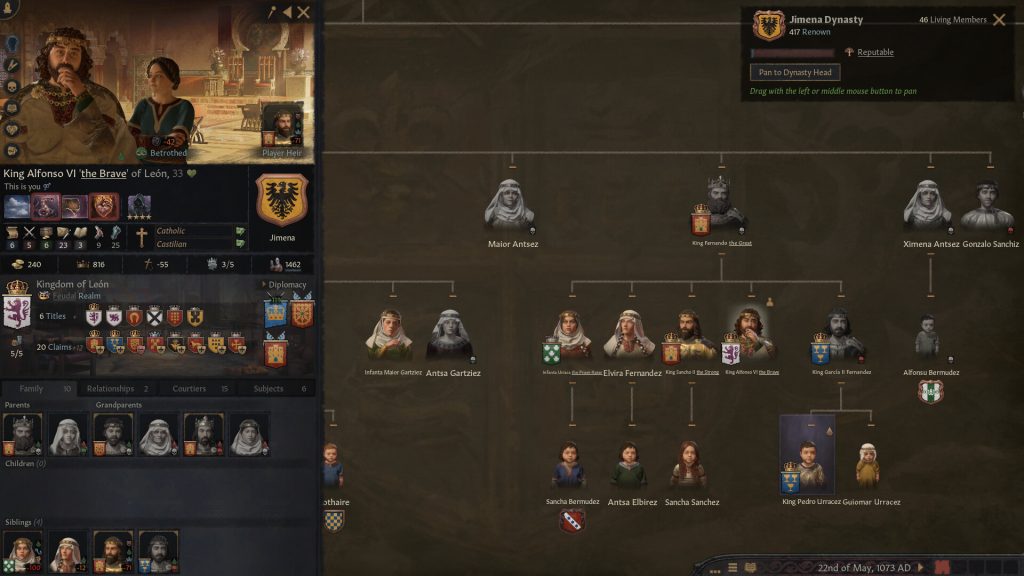
Pause and open the succession information before changing laws, granting land, or disinheriting anyone. Identify the player heir, the titles assigned to each eligible heir, and the holdings that fund your current ruler. Write down which part of that power base will remain with the next playable character.
Then inspect important titles individually. A prestigious title can have its own succession rule, so the realm-wide label alone may not explain every result. Do not assume the person inheriting the primary title also inherits every county you developed.
The archived Gamepressure first-steps guide demonstrates why a ruler’s family and succession tab deserve attention before unpausing. Sputnik’s succession guide separately emphasizes preparing the incoming ruler’s political position and treasury.
The practical output should be a simple statement: my next ruler receives these titles, keeps this income base, and faces these likely rivals. If you cannot make that statement yet, resolve the uncertainty before launching another major conquest.
Separate realm fragmentation from a divided personal domain
A realm can remain united while the ruler’s own holdings are split among siblings. In that case, the heir may still be the king but depend on vassals for much more of the military and income than the previous ruler did.
Realm fragmentation is a different problem. If another heir receives a title that produces a separate realm of equal rank, the political map changes as well as your personal property. A crown on the heir’s portrait is not proof that all the previous territory remains under that crown.
Consider a hypothetical king with several valuable counties and more than one eligible child. If the player heir gets the royal title but only a small portion of the developed personal land, the kingdom can look intact while the new ruler is much weaker. Preparing only the border defense misses that internal shift.
Inspect both results. Which lands leave your direct ownership? Which titles change the relationship between the heirs? The titles guide explains why rank and a personal economic base are separate parts of the ruler’s power.
Do not treat every partition law as the same rule
Confederate Partition, Partition, and High Partition are different succession laws. They should not be reduced to one slogan about dividing everything equally. The distribution also depends on the titles and eligible heirs present in the current situation.
- Confederate Partition can create additional titles for younger heirs when the ruler holds enough qualifying land. Leaving a potential title uncreated therefore does not necessarily prevent a split.
- Partition divides the existing titles without the Confederate law’s automatic creation of additional titles. Existing titles of equal rank can still produce separate realms.
- High Partition favors a larger share for the player heir while other eligible children still inherit. It is an improvement in distribution, not a promise that every holding stays with one character.
These qualitative distinctions are supported by CK3 Database’s published law descriptions and succession fields. Its pages identify the game-script file and a patch version; this guide does not turn that version into a claim about your installed save. Government restrictions, eligible heirs, and title-specific rules still need to be included in the actual inheritance preview.
Read the law’s description together with the expected title distribution. Identify what the primary heir receives and what other heirs receive. If you are considering a change, compare the result that matters to you instead of pursuing a law name solely because it sounds more advanced.
Also distinguish eligibility from preference. Gender rules and title-specific rules determine who can inherit, while other systems can affect which eligible person is chosen. Selecting a preferred heir in one part of the interface is not a guarantee that every other succession rule disappears.
If a law change is unavailable, do not build the entire reign around an immediate switch. Work with the inheritance you can currently plan: retain a useful core, arrange appropriate titles, and improve the future ruler’s ability to manage the result. A later legal improvement is useful when it becomes available, but the next succession may happen sooner.
Protect the income base that makes the crown useful
Identify the holdings you want the player heir to retain because they support recurring income and a dependable military. Your capital and a compact group of developed holdings deserve particular attention when planning the handover.
Avoid distributing land by appearance alone. A county you recently captured can be large on the map yet contribute less to your personal position than a well-developed holding close to the capital. The useful question is what the heir can govern, defend, and fund.
Plan construction with this in mind. Improving a holding that will belong to a sibling can still strengthen the dynasty or realm, but it is a different investment from strengthening the future ruler’s direct power base. Know which objective you are funding.
Regiment stationing makes the domain’s military role worth reviewing too. The official 1.9 release announcement documented the change toward holding-based men-at-arms bonuses. After succession, inspect the relationship between the new ruler’s holdings, stationing, and military support rather than assuming the old arrangement remains equally useful.

Granting land is a political decision, not a universal shortcut
Giving titles to family members can help organize the realm and provide them with a role. It can also strengthen a future rival or change the inheritance you are trying to manage. The rank of the granted title matters as much as the recipient’s current opinion.
Before a grant, compare the expected succession distribution with the proposed arrangement. After the grant, inspect it again. Do not assume that giving any spare county to any sibling automatically satisfies every future inheritance claim.
Avoid handing away the entire personal core merely to make the preview look tidier. Your present ruler still needs enough power to defend the realm, and the incoming ruler needs a sustainable position after the handover.
A useful hypothetical is a spare duchy with appropriate counties that you are willing to govern through another family member. That can be a more coherent arrangement than scattering isolated counties across several siblings. However, whether it achieves your intended succession depends on the actual title and heir distribution, so verify the outcome rather than relying on the example alone.
Disinheritance has a dynasty cost
Disinheriting an eligible family member can change succession, but it consumes resources and damages relationships. It should be compared with the value of accepting a divided inheritance and managing it afterward.
The available action and its conditions matter. Dynasty leadership, the target, and other restrictions can affect whether you can use it. Read the actual consequences before spending dynasty resources on a change that may not solve the main weakness.
Be precise about the objective. Are you preventing a separate realm, preserving the heir’s personal domain, or removing an unsuitable candidate? One disinheritance should have a named purpose. Repeatedly removing every possible heir can become an expensive habit rather than a careful plan.
This guide does not recommend engineering deaths or treating a dangerous battle as a dependable succession tool. Besides the loss of a useful character, uncertain outcomes make that a fragile planning method. Prepare a viable inheritance through legal and political choices you can evaluate directly.
Prepare the heir as a character
The future ruler needs education, relationships, and a suitable marriage as well as titles. A strong current king does not pass his personal skills and every friendship to the next generation.
Choose an education plan that gives the heir a useful role, and consider the safety and suitability of the guardian. Do not assume one trait or a famous educator guarantees a perfect adult ruler. Use the character you actually get as the basis for the next reign’s strategy.
Marriage should serve a deliberate purpose. You may need an alliance, useful spouse skills, a dynastic continuation, or claims relevant to a later objective. Those priorities can compete. Review where the couple and children belong before accepting a match that looks attractive for only one reason.
Keep spare family relationships usable where possible. An heir with relatives available for alliances has more options than one who begins the reign with every relevant marriage already committed to unsuitable partners. That flexibility can matter more than extracting one immediate advantage during the old ruler’s final years.
Leave funds for the transition
The incoming ruler needs money for military readiness, political responses, and unexpected disruption. Do not spend the entire treasury finishing construction just because the current reign is prosperous.
Estimate the military cost of a likely crisis and consider what political actions you may need. Gifts, activities, and other responses have different costs and conditions. There is no one reserve amount that suits every ruler or realm.
Also examine wars already underway. An unfinished war transfers an obligation along with the titles, and the new ruler may have different allies, skills, or internal support. Ending an optional conflict on acceptable terms can sometimes improve the handover more than insisting on an ideal result at any cost.
Preserve military condition as well as cash. A treasury is useful, but a severely depleted army can invite pressure before replacements are ready. Allow recovery where practical and avoid risking the only dependable force in a marginal final conquest.
Rebuild the political arrangement immediately after succession
When the ruler changes, pause. Inspect the new domain capacity, council, alliances, vassal opinions, and active factions. The old ruler’s long reign and relationships should not be treated as permanent properties of the crown.
Prioritize the strongest actionable problem. A powerful vassal wanting a specific title arrangement requires a different response from a weak character with a broad dislike of the new ruler. The vassal guide explains why opinion causes and faction contributions deserve separate inspection.
The official 1.9 announcement also documented vassal stances with preferred heirs and temporary succession-related opinions. This is another reason the political result can differ from the legal title preview. The realm may transfer correctly while key vassals are disappointed with the incoming character.
Do not begin by declaring another external war. Stabilize the position you inherited, restore essential relationships, and confirm that the army and treasury can support the next objective. For broader context on CK3’s character focus, see the published Hearts of Iron 4 versus Crusader Kings 3 comparison.
FAQ
Why is my heir weaker even though the kingdom stayed united?
The royal title and personal domain are different. Siblings may receive valuable holdings while remaining inside the realm, leaving the player heir with less direct income and military support.
Should I disinherit every other eligible child?
Not automatically. Compare the dynasty resource cost and relationship damage with the actual inheritance problem. A manageable partition can be preferable to repeatedly paying for a perfect-looking preview.
Is a succession preview permanent?
No. Recheck it after births, deaths, title changes, law changes, and important grants. Title-specific rules can also make the final arrangement more complicated than the realm-wide law label.
What should I prepare before the ruler dies?
A useful inherited domain, a workable heir and marriage, military recovery, and funds for the transition. Immediately after succession, rebuild the council, alliances, and vassal relationships around the new character.
Sources and further reading
- https://www.gamepressure.com/crusader-kings-3/first-steps/z4f0f8
- https://www.gamepressure.com/crusader-kings-3/titles/zff0fc
- https://www.gamepressure.com/crusader-kings-3/vassals/z0f0fd
- https://store.steampowered.com/news/app/1158310/view/6557848386941142486
- https://steamcommunity.com/sharedfiles/filedetails/?id=2776845816&l=english
- https://ck3db.com/laws/confederate-partition
- https://ck3db.com/laws/partition
- https://ck3db.com/laws/high-partition
Keep exploring

Crusader Kings 3 faith reformation: holy sites, rites and the realm afterward
Reform an unreformed rite with holy-site access and Piety, then check doctrine choices, divergence and which rulers will follow the change.
Crusader Kings 3 cultural innovations: choose the unlock your realm needs
Prioritize the innovation that removes a current realm obstacle; check the head, matching skill, cultural Development, spread and era restrictions.

Manor Lords vs Crusader Kings 3: build a town or guide a dynasty?
Pick Manor Lords for a medieval settlement and its household economy; pick Crusader Kings III for rulers, relationships and a realm passed between generations.