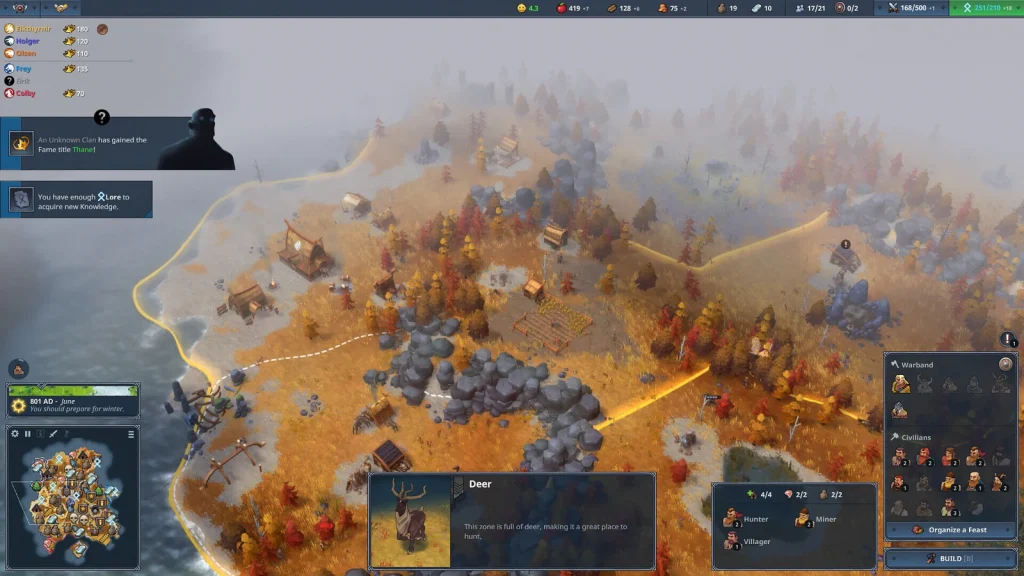
TL;DR: Northgard food production improves when you staff the right source and keep its output ahead of the population’s consumption. Check available fields, deer and fish, fill useful worker positions and read the current food balance. If food is still falling, diagnose staffing, season and competing jobs before building more.
The important figure is the food remaining after consumption and spending. A settlement can have productive buildings while running a deficit because it has added too many people, converted gatherers into other jobs or spent the reserve on expansion.

On this page
Restore an underfilled Hunter’s Lodge before expanding
For an ordinary Viking-clan example, suppose you already own a deer zone with a completed Hunter’s Lodge, one open worker position and falling food. Your scout has revealed the next useful territory, while the Woodcutter’s Lodge still needs its present worker. Fill the hunting position before spending wood on another food building.
- Select the deer zone and the Hunter’s Lodge. Confirm that construction is complete and an actual hunter position is available. The zone’s deer resource and the building’s worker capacity are separate checks.
- Choose a healthy, available villager. If you are using the optional scout, return that unit to civilian work before assigning the new production job; keep the woodcutter working so the next house or building remains affordable.
- Assign the villager to the lodge and confirm the unit becomes a Hunter. A villager merely standing in the deer zone does not establish that the specialized job is staffed.
- Let the worker reach the job, then compare food balance with the earlier reading under the same season. Also check wood: the change should improve food without silently stopping the essential construction supply.
- If food is still negative, distinguish an improved deficit from a solved deficit. Check other open food positions and consumption before spending upgrade resources. Once the lodge is fully staffed, compare its available upgrade with a second accessible food source.
The result to look for is an operating hunter job and a better food balance. It need not make the whole settlement self-sufficient immediately. This example converts capacity you already own into output; it does not prescribe a ranked opening or promise a fixed production rate.
Northgard food production: distinguish stock, output and balance
Read the stored food separately from its displayed change. Storage tells you what you can spend now; the balance indicates whether that stock is growing or shrinking under the current conditions.
The official Northgard description identifies worker assignments and resource management as central to survival. A food shortage should therefore start with the workforce and production information, rather than with a fixed number of buildings.
Look for what changed before the deficit began. More population increases the settlement’s requirements; converting workers into scouts, miners or soldiers changes the output available to meet them. Seasonal conditions can change the same economy again.
If you need a simple record, note the food stock and balance before and after a job change. Keep the comparison within similar conditions. A change that coincides with winter or an attack may have several causes, so don’t attribute the entire result to one worker.
Match specialized production to the zone
Select the territory and read its resource information. Fields support farming opportunities, deer support hunting and fish support fishing. Choose a building the actual resource allows, then inspect its workers once construction is complete.
Compare access as well as the source. A rich food zone requiring difficult clearing and an exposed claim may contribute later than a nearby source you can staff now. The immediate shortage needs an improvement that can begin operating in time.
Use the present source’s available positions before adding another project automatically. An empty worker position may represent useful capacity already paid for. If every suitable position is filled, inspect upgrade options and another accessible zone.
Read seasonal effects in the installed game when comparing sources. Farming, hunting and fishing have distinct worker jobs; the June 2019 food-production balance notes name Farmers, Hunters and Fishermen separately. Their old percentage changes and construction prices are not a current ranking or price list.
Clan buildings can also change the choice. The July 2019 Kraken introduction describes that clan’s Fishery on lake tiles and beaches, where villagers are assigned as fishermen. This is a documented clan exception; do not assume every ordinary Viking clan can put the same building on any beach.

Assign workers without creating another shortage
Choose where the next food worker comes from. An idle villager is a different commitment from your only woodcutter, a needed miner or a scout revealing the next objective. Food may improve while another critical project stops.
Keep construction labor in the plan. A food building that is still unfinished produces no specialized output, and the person finishing it gives up another task for that period. Budget the time before assigning the same worker to a future production position.
After staffing, inspect the new balance. If it barely improves, check whether the worker is injured, the building’s conditions are met or another consumption change occurred. More staffing is useful only when it addresses the actual limit.
If the hunting assignment improves food but stops wood production, reconsider the donor job. Keep the wood worker and postpone an optional miner or scout instead when the map permits it. The aim is a food surplus that the rest of the settlement can maintain, rather than a favorable food reading bought by an immediate construction shortage.
Improve capacity when the extra output has a use
Read building upgrades, tools and relevant knowledge in the current interface. Compare their resource cost with the additional staffed production they can support. An upgrade to an empty building cannot solve the same problem as assigning workers.
Choose the project for a defined requirement: maintaining a larger population, supporting a warband, funding a useful claim or recovering the winter reserve. That requirement helps you decide whether the investment is worth delaying another project.
Inspect storage capacity if food is near its limit. Further production may have less immediate value when the reserve cannot increase. A suitable storage improvement or a planned expense can change that situation; read its actual cost and effect before building.
Protect the production route. If one exposed zone supplies most of the settlement’s food, an attack can disrupt the whole plan. Keep an appropriate defense and an alternative staffing response so the economy can recover if access is interrupted.
Read consumption effects and sheep correctly
Consumption reductions and production bonuses act on different sides of the budget. Read the affected resource and the scope: one zone, the whole clan, a particular season or certain unit types. A bonus to winter wood consumption isn’t a bonus to ordinary food output.
The released Claws & Jaws update reworked sheep and specifically describes their general winter wood-consumption role, alongside clan-specific interactions. It also sought to make sacrificing sheep for food a choice rather than the automatic use.
Compare immediate food with the benefit of retaining the sheep under your clan’s current rules. A sacrifice can address an urgent stock shortage, but a recurring production or consumption problem still needs a lasting change.
The September 2025 patch notes corrected food-consumption reductions that were being applied additively instead of multiplicatively. Avoid simply adding every percentage shown in an older guide; use the resulting consumption and balance in the game.
Fund expansion and feasts after accounting for the reserve
Set aside the food required for an essential commitment before making an optional purchase. Colonization and feasts can consume the same reserve used to survive a deficit. A positive balance does not make those expenses free.
Judge a food-funded claim by its follow-up. If it provides a new source you can build and staff promptly, it may strengthen the economy. If its resource cannot be used for a long time, the claim may worsen the current shortage.
After winter, recruitment or an attack, reassess the food plan rather than automatically restoring the previous jobs. Population, injuries and required reserves may have changed. The useful next worker is the one who addresses today’s constraint.
| Symptom | Food decision |
|---|---|
| Building has open positions | Compare staffing before another construction project |
| All food positions are filled | Inspect upgrades, accessible sources and consumption |
| Reserve vanishes after claims | Budget colonization separately from the survival stock |
| Sheep advice conflicts with the interface | Read the current resource and clan-specific effect |
| Output is strong but vulnerable | Protect the key zone and retain a recovery plan |
Use the Northgard guides hub for the wider settlement loop. Before adding another food project, identify the missing output, the worker who will provide it and the spending that the improved balance must support.
FAQ
Why is my food falling when I have a food building?
Check whether its specialized worker positions are staffed. Then compare total production with consumption and recent spending. More inhabitants, military recruitment, injuries or a seasonal change can outweigh the output of a working building.
Should I build another lodge or upgrade the first one?
Fill a useful open job first. If the existing source is fully staffed, compare an affordable upgrade with a second source you can claim, build and staff. An upgrade that offers capacity still needs workers, while a new source also adds clearing, territory and defense commitments.
Are farming, hunting and fishing equally good all year?
Compare the current seasonal output, clan bonuses and available workers. Do not treat one old balance table as a permanent ranking. The source you can operate before a shortage becomes urgent may be the better immediate choice even when another has more long-term potential.
Do two food-consumption reductions simply add together?
The September 2025 fix specifies multiplicative application. As an arithmetic example, two applicable 20% reductions leave 0.8 × 0.8 = 64% of the original consumption, a 36% reduction. Check that both effects apply to the same workers and conditions before using that calculation.
Sources and further reading
- https://store.steampowered.com/app/466560/Northgard/
- https://steamstore-a.akamaihd.net/news/externalpost/steam_community_announcements/2411028931136383187
- https://steamstore-a.akamaihd.net/news/externalpost/steam_community_announcements/3364670677178342655
- https://steamstore-a.akamaihd.net/news/externalpost/steam_community_announcements/5759616966664557837
- https://steamstore-a.akamaihd.net/news/externalpost/steam_community_announcements/1811138915522958
Keep exploring
Northgard vs Manor Lords: clan objectives or settlement planning?
Choose Northgard for clan-specific strategy and explicit victory routes; choose Manor Lords for the placement, households and production of a medieval settlement.
Games Like Northgard: 4 Picks by Strategy Style
Games like Northgard: compare Banished, Against the Storm, Age of Empires IV and They Are Billions by economy, challenge structure and combat.
Northgard Review: Settlement Strategy, Clans and Co-op
Northgard review: decide whether its worker economy, winter pressure, clan variety and solo or co-op Conquest fit the strategy game you want.