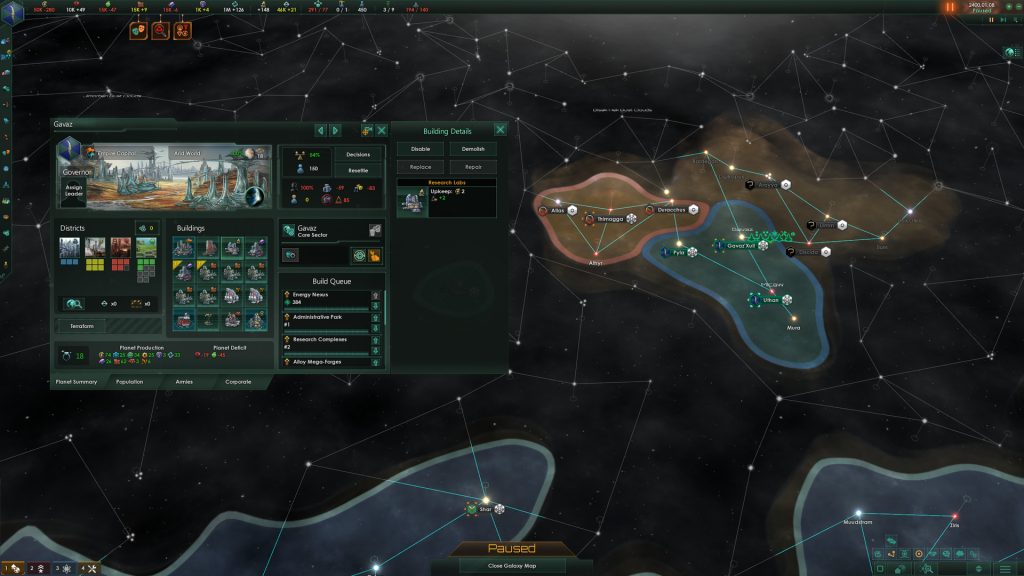
TL;DR: Effective Stellaris crisis preparation builds a replacement economy, useful fleet designs and routes to the front before the threat appears. Keep reserves for upgrades and losses, inspect the actual crisis objectives when it arrives, and use battle reports to revise your ships instead of relying on fleet power alone.
Prepare to fight more than one engagement. A fleet that wins once but cannot repair, reinforce or afford prolonged operations leaves the empire exposed to the next wave. Your preparation should connect resource production, shipyard capacity, movement, intelligence and diplomatic access into a plan you can sustain.

This is a research-based PC preparation guide, not a claimed successful crisis run or a recommended competitive build. Crisis content, strength and timing vary with your galaxy settings, enabled DLC and version. The Machine Age also adds Cetana, whose event-driven threat should not be approached as a generic hostile fleet.
On this page
Stellaris crisis preparation: record the galaxy settings
Before starting a campaign, record the crisis selection and strength settings, relevant date settings, difficulty and enabled content. When using a saved campaign, recover the settings you can verify rather than assuming defaults. A guide built around a different strength setting or DLC selection cannot tell you that a particular fleet total will be sufficient.
Use that information to set a preparation window. If you have chosen a compressed campaign, begin replacement capacity and transit planning earlier relative to your expected threat period. If the campaign allows a wider window, invest in the productive base that supports later ships. Do not interpret the endgame date as a guaranteed appointment with every possible event; follow the actual notifications and event conditions in your game.
Build income that survives a deployment
Check monthly production and expenses while the main fleets are operating, not only while they are parked. The official Phoenix explanation makes Trade a logistics resource in PC 4.x: planetary deficits create transport expenses, and fleets cost more in hostile territory than around friendly starbases. A comfortable peacetime balance can narrow during a long operation.
Inspect alloy output, energy and Trade reserves, and the strategic resources required by your current designs. Trace a shortage to its producing jobs, their inputs and available Workforce. Do not add more advanced jobs without confirming that the empire can supply them. When expanding alloy production, check which other worked output will be reduced and whether consumer or maintenance needs remain affordable. The aim is a usable replacement stream that continues after the fleet leaves home.
Keep upgrade and replacement reserves separate
Estimate what you need to upgrade the existing fleet and what you need to replace losses afterward. These are different expenses. A design change can consume the resources that you expected to use for new ships, leaving upgraded survivors with no reinforcement capacity.
Inspect the actual upgrade order before sending every fleet into a queue. When the threat is close, consider which formations can upgrade first while another force remains available to defend. Preserve resources for components that require rare inputs and for the immediate ships in your reinforcement plan. Avoid spending the full reserve on a new megastructure stage just because the order is available. The crisis does not wait for a construction project to become useful.
Make shipyards productive and reachable
Check whether fleet replacement is limited by resources, occupied construction queues or travel time. A Mega Shipyard can address production throughput, as the Federations description explains, but it cannot fund its own construction queues or teleport the replacement ships to their assigned fleets.
Place your production and repair plan on the galaxy map. Identify a secure main production center, a reachable repair destination and a route to likely theaters. Consider what happens if a border system is lost or another empire denies access. If your only replacement route crosses the threatened area, maintain an alternate route or a defensive staging point. Ships arriving singly into a hostile system are not equivalent to a fleet regrouping safely before battle.

Prepare designs by role, then adapt to the enemy
Save designs whose weapons, defensive components and combat behavior support a defined role. The official Orion combat explanation describes the importance of range, target size, screens and counters. Its beta numbers and known issues are historical, so inspect current tooltips for the behavior of the components you actually own.
Check whether your long-range weapons can operate at their intended distance and whether your close-range ships can reach the target. Compare shield, armor and hull interaction, penetration and available hardening. Use appropriate point defense or strike-craft counters when the observed threat makes them relevant. Avoid assuming that a mixed fleet is automatically effective: a mixture of incompatible ranges and unsupported roles can still fail. The design should answer an observed problem, not merely contain several ship classes.
Read the threat’s event and objective screens
When the crisis appears, pause and read its notifications, situation or event log, visible objectives and restrictions. Determine what progress actually removes the threat. Some crises have important objectives beyond destroying the nearest fleet, so make those objectives part of the operational plan.
The Machine Age announcement identifies Cetana as a distinct endgame crisis with opaque aims and choices about collaboration or resistance. Follow the current events and eligible actions rather than treating the first visible contact as proof that every normal combat action is available. Record deadlines or progress requirements that the interface shows. If an action is disabled, inspect its reason before redirecting the entire fleet. Event progress and military readiness can require attention at the same time.
Gather evidence before committing the whole force
Inspect the enemy information that your current vision reveals, its direction of movement and the location of supporting forces. Keep reconnaissance assets out of an avoidable battle. Knowing that one hostile fleet is isolated can matter more than knowing the combined power shown for the entire crisis.
After an engagement, open the report and examine losses and weapon performance. Check whether an apparently favorable exchange actually destroyed enemy ships or merely drove them away. Identify the class losing ships first and the layers your weapons are damaging. Change the relevant design, upgrade surviving ships and regroup replacements before repeating the same encounter. Do not promise yourself victory from one headline power comparison; composition, range and the surrounding campaign state still matter.
Coordinate access, defense and recovery
Check agreements and borders before assuming allies can assemble in your theater. The original Galactic Community design includes a crisis-related focus affecting member access, but the active resolution in your current galaxy determines its actual effects. Inspect what has passed and who is bound by it.
Coordinate one reachable staging system and one immediate target. Keep enough defense to protect your principal production worlds, and stop the offensive if replacing losses would expose them. After each important engagement, repair, inspect reinforcements and recheck logistics balances. Our Stellaris hub provides related fleet, economy and council guides for building that support network.
FAQ
How much fleet power do I need for a crisis?
There is no reliable universal figure across settings, factions, versions and designs. Compare current enemy information and battle results while keeping the production capacity to replace your losses.
Should I build ships or a megastructure first?
Check your deadline and bottleneck. An immediate defense needs available ships; a later campaign with enough alloys but slow queues can benefit from additional production capacity.
Why did my balance collapse after deployment?
Inspect fleet upkeep, PC 4.x Trade logistics, planetary imports and changed worked production. A reserve can hide an unsustainable monthly expense.
Is every crisis just a normal war?
No. Read the specific crisis objectives and event rules. Threats such as Cetana add choices and progression that cannot be inferred from an ordinary declaration window.
Sources and version boundaries
Sources: official Machine Age release announcement, Phoenix economy explanation, Orion combat design diary, Galactic Community diary and Federations description. Historical combat and diplomatic figures are not current crisis benchmarks.
Sources and further reading
- https://steamstore-a.akamaihd.net/news/externalpost/steam_community_announcements/5766372999962280903
- https://steamstore-a.akamaihd.net/news/externalpost/steam_community_announcements/1798454487635615
- https://steamstore-a.akamaihd.net/news/externalpost/steam_community_announcements/6402455182504234312
- https://steamstore-a.akamaihd.net/news/externalpost/steam_community_announcements/2448197582018837238
- https://store.steampowered.com/app/1140001/
Keep exploring
Stellaris vs Crusader Kings 3: build a society or guide a dynasty?
Pick Stellaris when your campaign idea starts with a civilization and unknown stars; pick Crusader Kings III when rulers, relationships and the next heir are the central attraction.

Total War Warhammer 3 vs Stellaris: battles or a galaxy to discover?
Choose WARHAMMER III for commanding fantasy armies; choose Stellaris for exploring a galaxy and shaping the society, technology and fleets of an empire.
Stellaris vs Hearts of Iron 4: discovery or industrial war planning?
Choose Stellaris for discovering a galaxy and shaping a space society; choose Hearts of Iron IV for coordinating industry, army design and politics around a WWII nation.