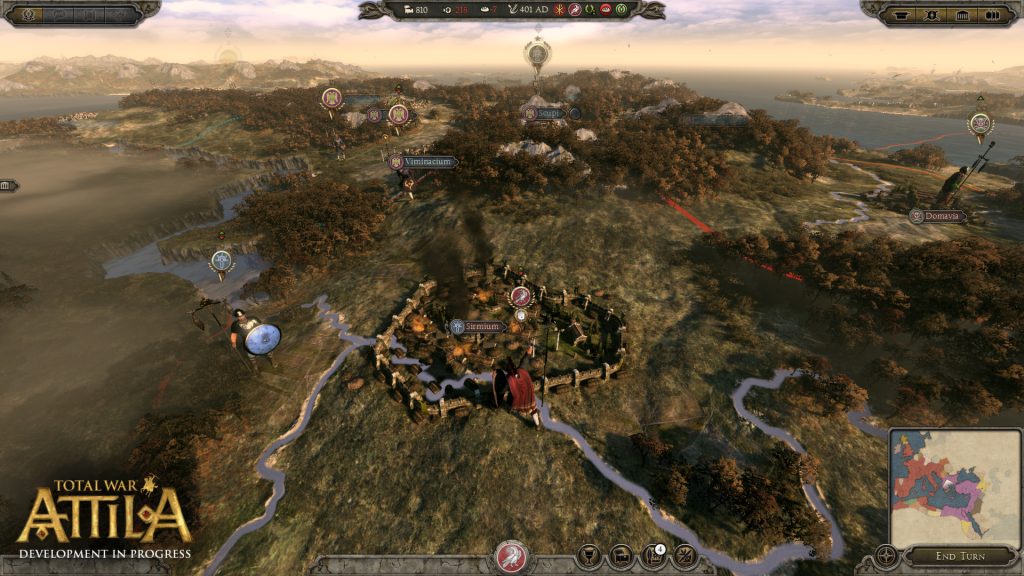
TL;DR: The Total War Attila Eastern Roman Empire opening should preserve its economic advantages while addressing the immediate Visigoth threat near Constantinople. The official faction profile places Alaric’s forces in Thracia and Macedonia and identifies treasury interest and trade tariffs as eastern strengths.
Spend enough to make the northern defense workable, keep important provinces fed and healthy, and retain flexibility on the Sassanid frontier. Hoarding money while a necessary defense fails is no better than spending the entire reserve on an optional expansion.

Sources and scope: The official Eastern Roman faction profile supplies the economic identity and starting threat. Creative Assembly’s fertility blog explains the eastern food base and pressure from the north. The PC manual and dated economy guide support the decisions below. Reviewed November 9, 2026. Exact treasury, interest rate, roster and diplomatic acceptance depend on the current campaign and are not invented here.
On this page
Total War Attila Eastern Roman Empire opening: separate the two fronts
The ERE has an economic foundation that differs from the Western Roman crisis. The official profile describes centralized administration, treasury interest and trade tariffs. That gives the opening a different objective: protect a productive state while preventing a nearby military problem from consuming the advantage.
The immediate documented threat is Alaric’s Visigoth force in Thracia and Macedonia, close to Constantinople. The eastern frontier also faces the Sassanid Empire, but the profile does not establish that every possible eastern war must be started immediately. Treat those fronts as related resource commitments with different urgency.
Before moving an army from one to the other, ask what its current position protects. A transfer can improve the northern response while exposing a useful eastern route. Leaving every force where it starts can also be wasteful if the nearest threat requires concentration.
1. Give the northern army a concrete defensive task
Identify the approach that threatens the capital’s surrounding network and the army that can contest it. Choose a useful position for reinforcement, a supported field engagement or a settlement defense. The force needs a defined job rather than a general instruction to remain somewhere in the region.
Compare enemy routes and the position of your support. A short movement that preserves reinforcement can be better than pursuing an isolated target beyond the network. The immediate objective is to contain the threat without leaving the army unable to respond elsewhere.
The dated movement guide describes fortification and zones of control as tools for limiting approaches. Use them where the terrain and current stance rules support the plan. A fortified position in an irrelevant location does not solve a route that the enemy can bypass easily.
Avoid turning pursuit into the whole opening
If the enemy withdraws, reassess what the pursuit would accomplish. Chasing far from the useful defense can turn a successful containment into a new exposure. Protecting the capital’s support and maintaining a usable force may be more important than finishing a target immediately.
Also consider the aftermath of the intended battle. A victory with a depleted army can create an opportunity for another force. Keep a recovery endpoint and enough nearby support to preserve the result after the tactical engagement ends.
2. Preserve useful treasury income without neglecting defense
Treasury interest is an officially documented eastern advantage. Keeping funds available can therefore have an ongoing economic purpose, in addition to providing an emergency reserve. Read the current faction effect before calculating its exact value; this guide does not assume one universal interest percentage.
Compare retained funds with the benefit of necessary spending. Recruitment that makes the immediate northern defense viable can protect the productive state. Optional units with no near-term job can reduce the reserve while adding recurring upkeep.
Treat spending as an operational decision rather than a contest between saving everything and buying everything. The ERE’s advantage is most useful when it supports a sustainable response. A large treasury beside an undefended route can be an inefficient opening, just as a large idle army can be.
Distinguish a reserve from uncommitted surplus
Allocate money for the next necessary repair, recovery or diplomatic response. What remains after those commitments is the amount you can compare with optional development. The visible total alone does not identify how much the faction can spend safely.
In a hypothetical choice, a cavalry unit useful only for a later campaign competes with food support behind the northern army. The food investment can help keep the present operation functional. The comparison depends on the actual need, not simply the unit’s tier or price.
3. Keep the food base productive locally and nationally
The official fertility blog identifies the eastern Nile area as part of the fertile foundation supporting the Roman and Sassanid economies. A productive region deserves attention because its contribution can matter beyond one settlement. Preserve the routes and local support that let it continue functioning.
The economy guide distinguishes provincial food balance from the national pool. A healthy faction total does not automatically remove every local shortage in a taxed province. Read the local deficit before upgrading another settlement or public-order consumer.
Queue production and consumption together. If a planned upgrade creates demand, identify the building or branch that supports it. The objective is not to maximize every settlement’s tier during the opening; it is to keep the state able to supply defense and recovery.
Account for fertility dependence
Creative Assembly distinguishes food buildings with flat output from those relying on soil fertility. Compare the actual branch and its current contribution. A province that will support the faction for many turns should not be designed around an unexplained exact-balance assumption.
Use a food margin appropriate to the current plan. Climate and additional construction can change the balance, so a modest surplus gives you time to adapt. It does not establish that every future event is harmless, but it reduces avoidable fragility.

4. Make recovery locations healthy before relying on them
The northern operation needs somewhere to recover, and the eastern frontier needs a force able to remain useful. Sanitation shortfalls can create disease problems in the dated settlement guide. A strong economic city can still be an unsuitable recovery location if its health support does not cover the current squalor.
Compare each settlement’s coverage. Some sanitation effects apply locally, while others support the province. Plan health support before completing optional construction that adds a burden. The cost of keeping the location functional belongs in the investment calculation.
If a force is infected, do not treat movement into a healthy province as an automatic recovery solution. Consider disease-spread and replenishment conditions before choosing the route. A damaged army should not create another crisis in the network intended to support it.
5. Use diplomacy to reduce an unnecessary second commitment
The official faction profile identifies the Sassanid threat, while the broader campaign requires managing relationships across several neighbors. Inspect the actual agreements and military situation before deciding whether an eastern offensive serves the opening objective.
A useful diplomatic arrangement can preserve attention for the immediate northern problem. Compare its cost and obligations with the defense it enables. A better relationship is not a guarantee that the border is permanently safe, so maintain enough information and flexibility to respond.
Avoid relying on promised acceptance of a specific first-turn deal. The target’s current situation, wars and relationship conditions matter. If the desired agreement is unavailable, adjust the military commitment rather than continuing the opening as though the negotiation succeeded.
Do not transfer the whole eastern defense casually
The temptation to concentrate every available unit in the north should be weighed against the route and economic support left behind. Keep enough capability to avoid making the eastern frontier an obvious new constraint.
This does not require equal armies on both fronts. It requires a deliberate division between immediate response and retained security. The stronger front should have a task; the smaller one should still have a viable position and an escalation plan.
6. Assign governors where their effects matter
The official manual documents governors providing provincial edicts and effects through their traits, skills and household. Choose appointments around a concrete need: control, recovery support, development or another actual provincial contributor.
An important food or income province can justify administrative attention when the appointment keeps it productive. A threatened region may need support to remain stable after the field army leaves. Compare the governor’s contribution with the province’s existing condition.
Avoid assuming that any appointment removes every source of unrest. Food, taxes, religion and recent conflict remain separate contributors. The useful administrative choice addresses a meaningful part of the problem while other investments handle the rest.
Preserve stability when the northern army moves
Before advancing, compare the public-order trend without the army’s support. A province that is stable only while the force remains inside may require a governor or other correction before the military plan can continue.
This creates a practical opening sequence: stabilize the support area, position the army, then pursue the next objective. Skipping the first step can turn an external success into an internal problem immediately behind the victorious force.
7. Manage the family as part of the fiscal and military plan
Arcadius and the court are part of the official eastern campaign context. Attila’s manual distinguishes political control from dominion, with influence gained and spent through character roles and actions. Internal politics should support the defense rather than consume its reserve indiscriminately.
Keep a suitable heir, useful commanders and administrative roles. Read the effect of an optional action before spending a politically important character’s influence. A short-term gain can change the family’s position or leave fewer resources for the next event.
Do not import a later Rome II party-loyalty target into Attila. The games’ political models differ. Evaluate the current power effects and character situation, especially when several military or administrative changes are being made together.
A practical opening sequence
First, inspect the northern threat and the routes around the capital’s network. Identify the army that can respond and the support that makes its position viable. Plan recruitment only for the gaps in that immediate task, with a recovery endpoint already chosen.
Next, address the most consequential food or sanitation problem behind the defense. Retain enough funds for the next necessary response, then compare optional development with the current treasury effect. The goal is to keep the economic advantage useful through several turns, not just improve one display immediately.
Finally, inspect the eastern commitment and diplomatic options. Preserve enough capability there to avoid replacing one urgent problem with another. Reassess the plan after the enemy turn and the result of any negotiation.
| Opening concern | Immediate question | Reason to delay an optional action |
|---|---|---|
| Visigoth pressure | Which route must the army contest? | Pursuit would expose the defense network |
| Treasury | What spending makes the current task viable? | The new unit has no useful near-term role |
| Food | Is the local province as healthy as the national total? | An upgrade adds unsupported demand |
| Sanitation | Can the recovery location support new squalor? | Development would create avoidable disease risk |
| Eastern frontier | What remains protected after a transfer? | A second commitment exceeds the current plan |
Frequently asked questions
Should I save every coin for treasury interest?
No. Retained funds can have value, but necessary defense and support can protect the income base itself. Compare the current interest effect with the concrete benefit of spending rather than adopting an absolute hoarding rule.
Is the eastern opening the same as Western Roman survival?
The official profiles describe different economic positions. The ERE has interest and trade advantages alongside the immediate Visigoth and Sassanid concerns. A blanket WRE contraction script should not replace the eastern faction’s own opening calculation.
What should I secure before expanding?
A workable northern response, supported food and recovery locations, a manageable eastern commitment and sufficient financial flexibility. Expansion becomes more useful when it builds on those conditions instead of interrupting their formation.
Sources and further reading
- https://wiki.totalwar.com/w/Eastern_Roman_Empire_(TWA_faction).html
- https://wiki.totalwar.com/w/The_Lay_of_the_Land.html
- https://store.steampowered.com/manual/325610/
- https://www.gamepressure.com/totalwarattila/economy-basics/z373d5
- https://www.gamepressure.com/totalwarattila/settlement-management/z573d7
- https://www.gamepressure.com/totalwarattila/moving/z073ea
Keep exploring

Total War Warhammer 3 vs Total War Attila: fantasy or survival?
Choose WARHAMMER III for fantasy races and Legendary Lords; choose ATTILA for late-antique survival, vulnerable territory and destructive warfare.
Total War Rome 2 vs Total War Attila: build an empire or survive?
Choose ROME II for classical empire growth; choose ATTILA for late-antique survival, a vulnerable Western Roman Empire and destruction mechanics.
Total War Attila vs Total War Shogun 2: survive or reunite?
ATTILA offers late-antique survival and destructive warfare; SHOGUN 2 centers a clan campaign on reunifying Japan.