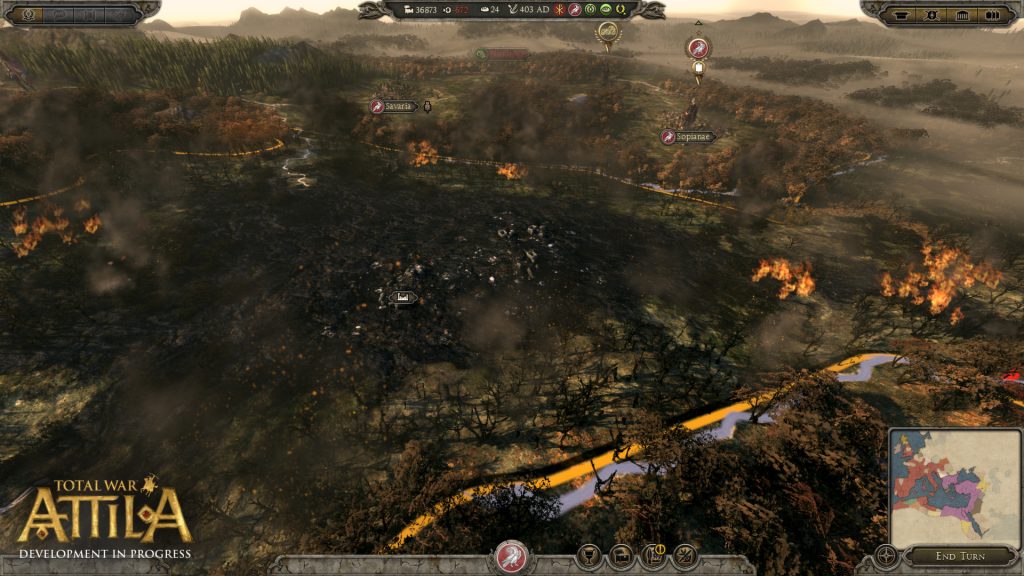
TL;DR: Total War Attila Huns campaign strategy should keep a permanent horde system working. The official manual excludes the Huns from settling cities, so camp development, movement, recruitment and recovery remain central throughout the campaign. Choose targets that support the next cycle rather than relying only on repeated raids against an exhausted region.
Preserve the mounted force’s mobility and condition. Use ranged pressure and supported close attacks where the actual units and terrain permit, then leave enough time for camp turns and replenishment. A successful battle is useful only if the horde can sustain the next operation.

Sources and scope: The official Huns faction profile describes mounted strengths and campaign effects. The PC manual documents horde encampment and the Huns’ settlement restriction. Dated horde and economy guides explain recurring obligations. Reviewed November 9, 2026. This concerns a player-controlled Grand Campaign, without invented rules about AI army spawning, Attila’s arrival or guaranteed immortality.
On this page
Total War Attila Huns campaign strategy: plan a permanent mobile state
Other eligible migrating factions can use hordes as a bridge to a settled kingdom. The Huns cannot follow that endpoint in the official rules. Do not plan to solve the economy by taking one rich city and converting the faction into a provincial state.
Each horde combines a military force with a camp’s development and support. The manual distinguishes Army View from Buildings View and explains that encampment enables construction, upgrades, food and recruitment functions. Moving changes the contribution to the overall economy.
The campaign therefore needs a cycle: choose a useful target, fight or apply pressure, move toward a viable next area, and make time for camp support. Continuous travel without recovery can leave a large-looking force unable to fight. Remaining indefinitely in a depleted region can weaken the income supporting it.
1. Give each horde a useful operational role
Compare the force’s composition, development and immediate position before assigning a target. One horde may be best placed to pressure a settlement, while another needs a camp turn or recovery. Ordering every force to advance simultaneously can create several unsupported engagements.
Keep the horde’s economic state in the calculation. A force with a strong roster but weak food or recurring income can be a liability after the first battle. A smaller force with a viable support cycle may sustain the operation longer.
Coordinate around reachable objectives rather than a rigid timetable. Terrain, enemy movement and the state of the next region can change the plan. The useful question is what each horde contributes to the campaign now, not whether all of them moved the same distance.
Preserve a response option
Leave at least one practical alternative if the intended target becomes unfavorable. That can mean a different route, a camp turn or support from another horde. A force that has spent its resources on one unavoidable assault has fewer ways to handle an unexpected defender.
The alternative should be economically viable. Waiting is not free when recurring costs continue, but neither is a costly battle. Compare the reserve and support conditions before deciding which action preserves more useful strength.
2. Plan camp turns before the army becomes desperate
Encampment is the documented mode for horde construction and development. Treat it as part of the operation rather than an interruption to be postponed forever. Check the current stance requirements and route so the force can actually establish the camp when needed.
Choose a position with useful information about nearby threats. The manual describes the camp’s support functions, but that does not mean the force should ignore enemy approaches. A productive camp turn must fit the military position as well as the building queue.
Use the time for the constraint that matters most: food, recruitment options, recurring support or recovery. Upgrading whichever branch is available can spend growth and money without improving the operation the horde is about to perform.
Compare movement with development deliberately
Moving may reach a fresh source of income or avoid a threat. Camping may restore the force and improve the economy supporting the next move. The choice depends on the horde’s current condition, not a universal instruction to remain mobile every turn.
Plan enough time for the improvement to become useful. A recruitment branch finished after the intended operation cannot solve the immediate roster gap. A force that needs recovery may have to postpone the target rather than continue at the expected schedule.
3. Select targets for income and the next route
The economy guide explains that repeated raiding can reduce the value of the region providing the income. A convenient target is not an unlimited source of funds. Compare the next profitable area and the cost of reaching it before the current one becomes depleted.
Choose objectives that improve the route and support the campaign’s requirements. A rich settlement can be attractive, but the surrounding enemy forces and recovery conditions determine whether attacking it is affordable. The largest immediate payout is not automatically the best operation.
Also evaluate recurring income where the present diplomatic and camp options permit. The dated guide discusses camp production and dependent payments as part of horde finances. Those can reduce reliance on one more successful raid, while retaining their own costs and risks.
Separate a payout from sustainable surplus
A battle or settlement action can produce money without making the recurring budget positive. Include upkeep, development and recovery in the comparison. If the next camp phase consumes the entire payout, the horde still needs another useful source before it can expand further.
In a hypothetical budget, assume one raid covers the army for several turns but leaves little for a needed camp building. Compare another attack with a shorter development phase or a smaller recruitment plan. The decision concerns the campaign cycle, not just the current treasury total.

4. Use documented faction effects without inventing guarantees
The official Huns profile describes taking regional food supplies and undermining enemy replenishment. It also connects fresh war declarations with horde loyalty and razing with new recruits. These are relevant campaign effects, but the source does not provide a universal numerical recipe for every current situation.
Use them as part of target evaluation. Pressure that affects an enemy’s support can matter before the next engagement. An action that contributes to the horde’s condition can support the ongoing campaign. Read the actual effect in the current rules before calculating exact value.
Do not start an unnecessary war solely to chase a favorable modifier. The new opponent creates another military obligation. A useful faction effect should improve a viable strategy, not replace the assessment of what the horde can afford to fight.
5. Make mounted mobility serve the battle plan
The faction profile emphasizes ranged attacks and mounted speed. That supports a plan in which mobile forces create pressure and choose engagements. It does not establish that every Hunnic unit should fight the same way or that cavalry can ignore the opponent’s defensive capabilities.
Compare the actual roles in the roster. Ranged cavalry needs safe movement and ammunition use; close-combat units need suitable targets and support. A force made entirely of one role can struggle when terrain or the enemy prevents its preferred engagement.
Use missiles to support a specific decision, such as pressuring an exposed unit or creating a better close-combat opportunity. Avoid spending ammunition on an irrelevant target while the part of the enemy formation that blocks your plan remains untouched.
Plan the return route as well as the approach
A mobile group that moves around the enemy needs a safe route back to support. Hostile cavalry, terrain or another force can cut the route and isolate it. Mobility is useful when the force can choose another engagement, not merely reach a distant position once.
If the enemy contests the available space, shorten the maneuver or add support. Continuing a wide movement while the main force deteriorates can create two losing fights. The battle should remain coordinated around a reachable local objective.
6. Use shock and rest at useful moments
Attila’s official manual describes more dynamic fatigue and recovery. Running troops continuously can tire them quickly, while resting allows faster recovery. Preserve energy for the decisive approach instead of using movement simply because the unit remains controllable.
The same manual describes flank and rear attacks combined with local superiority as potentially powerful morale pressure. Apply that principle when a suitable target is occupied and your force can reach the angle. It does not justify a fixed instant-routing formula.
Keep the commander supported. The general supplies morale benefits in the official rules, and losing the leader imposes a significant penalty. Sending the command unit into an isolated engagement can undermine the rest of the army even if it is individually strong.
Do not confuse routing with permanent removal
The official pacing description notes that units can rally more swiftly when enough soldiers remain. A routed target may return. Pursue selectively when it serves the local battle, but do not scatter the entire mounted force after several retreating enemies.
Maintain enough structure to handle surviving support. A successful shock attack can create a useful opening; the next decision should exploit that opening without exposing the missiles or commander to a new threat.
7. Preserve experienced units and army integrity
The land-army guide discusses experience and integrity as distinct military concerns. Preserving an experienced unit can keep its development useful, while replacing destroyed formations creates a new cost. A victory fought to the last soldier can weaken the horde’s next campaign phase.
Check the actual integrity contributors if the force deteriorates. Stance, events and military outcomes can affect the situation. Do not assume that a healthy treasury alone means the army is politically and militarily stable.
Choose recovery before losses force a complete rebuild. A camp turn that restores a useful force can be more valuable than another marginal attack. The Huns’ permanent mobile model makes that preservation a continuing requirement rather than a temporary opening concern.
Example: choose between another raid and a camp turn
Assume a horde has earned a payout but taken losses, and the nearby target region has already been raided repeatedly. A fresh area is reachable, but the army would arrive tired and under-strength. These are illustrative conditions, not a reported campaign result.
Compare the next attack with a productive camp turn. If support and recovery restore a useful force while the budget remains viable, delaying the advance can improve the next operation. If the local military threat makes camping unsafe, choose a route to a more suitable position instead.
The relevant outcome is a sustainable cycle with an army that can exploit the next target. Continuing automatically because the Huns are mobile is not enough. Mobility, development and battle preservation need to work together.
Frequently asked questions
Can the Huns settle a conquered city?
The official manual excludes them from that option. Plan a permanent horde economy and support cycle. Do not rely on the settlement transition available to eligible migrating factions.
Should I declare war whenever it gives a faction benefit?
Only when the new commitment serves a viable campaign plan. The official profile documents a loyalty-related effect, but another opponent creates military obligations. A favorable modifier is not a guarantee that the war is affordable.
Does this guide explain AI Hunnic respawning?
No. It concerns the player-controlled faction’s documented mechanics. Claims about spawn rules, Attila’s timing or immortality require their own version-specific evidence and are not assumed here.
Sources and further reading
Keep exploring

Total War Warhammer 3 vs Total War Attila: fantasy or survival?
Choose WARHAMMER III for fantasy races and Legendary Lords; choose ATTILA for late-antique survival, vulnerable territory and destructive warfare.
Total War Rome 2 vs Total War Attila: build an empire or survive?
Choose ROME II for classical empire growth; choose ATTILA for late-antique survival, a vulnerable Western Roman Empire and destruction mechanics.
Total War Attila vs Total War Shogun 2: survive or reunite?
ATTILA offers late-antique survival and destructive warfare; SHOGUN 2 centers a clan campaign on reunifying Japan.