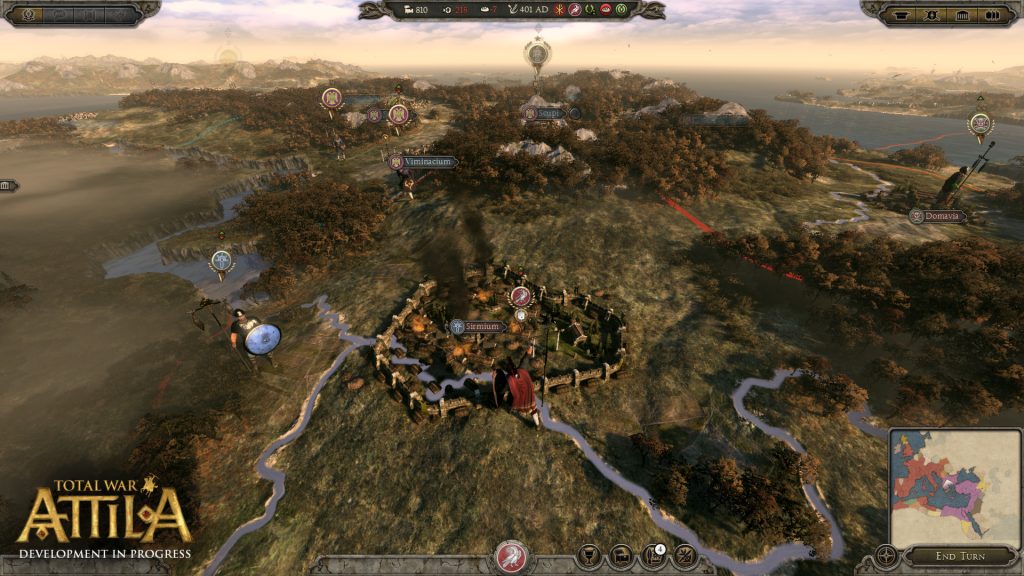
TL;DR: Total War Attila migration mechanics let eligible factions exchange a settled state for mobile hordes. The economy changes with that transition: armies gain camp functions, while the old city and trade support no longer provide the same income. Plan the mobile budget before leaving the settled network.
The most important settlement rule is faction-wide. The official manual says that when one eligible horde settles, the whole faction adopts a city-based society and the other hordes become ordinary armies. The Huns cannot settle. One attractive city must therefore be evaluated against the support requirements of the entire former horde faction.

Sources and scope: The official PC manual provides the camp, settlement and reversion rules. The dated horde guide describes migration preparation and lost income. Creative Assembly’s fertility explanation supplies the campaign motivation. Reviewed November 9, 2026. Eligibility and exact action timing should match the current Grand Campaign or modification; migration is not assumed available to every faction.
On this page
Total War Attila migration mechanics: distinguish three stages
Leaving a settled state, operating a horde and settling again are separate stages. Each changes what the faction must support. A successful movement across the map does not establish that either economic transition was affordable.
Migration is also different from abandoning one city. Individual abandonment removes that settlement, while a migration decision changes the faction’s broader campaign model where eligible. Read the current action’s scope before treating it as a local retreat.
The official manual identifies the Great Migrators and Huns as horde users, with an important settlement difference between them. An eligible migrating tribe can seek a new city-based home. The Huns retain the permanent horde model instead of using the same endpoint.
1. Verify eligibility and the preparation consequence
Check whether the current faction offers migration and what the action will change. The dated guide describes a preparation turn followed by abandoned cities, retained armies, fleets and agents, and a financial transition. Do not apply that exact timing automatically to an overhaul mod.
Before starting, list the support being left behind: income, food contribution, recruitment and routes. A one-time financial benefit is different from recurring provincial revenue. A migration can supply cash while making the ongoing budget less sustainable.
Choose the destination and route before the preparation completes. The plan needs both a military journey and an economic cycle. Becoming mobile without a useful direction can leave the faction spending the transition payout while searching for its next source of support.
Keep individual abandonment separate
The PC manual describes individual settlement abandonment as a full-turn action that can be canceled by enemy capture before completion. That is useful timing evidence for the local action. It should not be confused with proof that every faction-wide migration or modded transition uses the same procedure.
Read the current confirmation carefully. The difference between losing one exposed settlement and converting an entire settled network is large enough that the action’s scope matters more than its familiar name.
2. Learn what the horde can do while encamped
The manual distinguishes Army View from Buildings View for a horde. Encampment enables buildings and upgrades that improve economy, food and recruitment. Changing to a mobile stance changes the camp’s contribution to the overall economy.
Plan camp turns around the needs of the force. A development turn can expand recruitment or support; a movement turn can reach a safer or more useful area. The choice is not simply whether the army can travel farther.
Check the current stance requirements before relying on construction or recovery at the end of a route. The manual describes encamped hordes as protected from attrition, but the exact stance and effect must be the one actually used. An ordinary army stop is not the same action as forming the supported camp.
Camp development travels with the campaign model
While the faction remains a horde society, its mobile forces provide settlement-like functions. This is why the economy cannot be judged only by the army roster. A force also carries support that matters to the faction.
Choose buildings for the next operation, with enough food and recurring income to maintain the camp. Development that unlocks an impressive unit can still be a poor purchase if the additional upkeep prevents the force from completing the journey.
3. Budget movement independently from the old cities
The horde guide explains that losing the settled model removes the previous city and trade income, while raiding, dependent payments and camp production become important support sources. The transition’s cash is a buffer, not proof of a permanent surplus.
Track the budget in the stance you intend to use. A profitable encampment can become a different financial picture while moving. If several hordes travel at once, compare their combined obligations rather than assuming each can consume the same reserve independently.
The dated guide also describes horde food as independent rather than freely shared among armies. A healthy-looking force does not establish that another camp has enough production. Address the actual horde that has the shortage.
Choose a route with a workable support cycle
A route through exhausted or dangerous areas can consume more resources than expected. Repeated raiding is not unlimited income, and a difficult battle can create recovery costs. Identify where the faction can camp, recover or obtain fresh support.
Do not plan the whole journey around a guaranteed sequence of weak targets. Enemy movement can change which settlement or army is available. Keep another route or development option that remains affordable if the intended opportunity disappears.

4. Evaluate the destination as a settled support network
The fertility blog explains why migrating factions seek more hospitable land as climate conditions worsen. Compare the target’s actual fertility and food-production choices, but include defense, recruitment and neighboring threats as well.
A rich-looking city can be a poor destination if the faction cannot protect or support it. Local food and sanitation obligations appear once the faction returns to city management. The former camps’ income does not remain available as a fallback after the conversion.
Faction differences also matter. The official Ostrogoth profile describes particular advantages associated with Roman territories and military assets. Do not assume those advantages apply to every migrating tribe. Choose a destination for the actual faction and its current campaign requirements.
5. Understand the all-faction settlement conversion
The PC manual states that when one horde settles, the entire faction becomes city-based. The other hordes lose their ability to encamp and contribute the same mobile economic support. This is the central planning rule of the transition.
Calculate the new state’s obligations before ordering settlement. Include every former horde’s military upkeep, the acquired city’s condition and the recurring income now available. One captured location can be insufficient to support the army network it must replace economically.
The manual suggests considering several cities as part of a coordinated settlement transition. That is a strategic option, not a guaranteed safe recipe. The proposed locations still need to be reachable, defensible and capable of supporting the new state.
| Transition choice | Immediate attraction | Required comparison |
|---|---|---|
| Remain mobile | Keep camp functions and movement flexibility | Recurring horde budget and fresh support |
| Settle one city | Gain a fixed provincial base | All former hordes now need city-based support |
| Coordinate several captures | Potentially broader economic foundation | Reach, defense and recovery across the whole operation |
| Resettle a desolate region | Choose a vacant location | Resettlement costs and the same faction conversion |
6. Treat ruins and reversion as real costs
The official manual says that settling a desolate region has costs shown in its resettlement panel and produces the same horde-to-army change as settling a conquered city. An empty location is not a free way to preserve both a city and the old camp economy.
Include rebuilding and the region’s fertility condition. Razing and abandonment can damage fertility, and recovery takes time. A vacant destination may require more support before it supplies the army than a map glance suggests.
For eligible settled migrators, the manual also describes reversion to a horde society when the last city is captured, destroyed or abandoned. This provides a possible campaign change, but it is not a universal rule for every Roman or other settled faction.
Avoid using reversion as an unexplained rescue plan
If the settled economy cannot support the army, losing the last city may change the model for an eligible faction. That does not establish that the new mobile budget is automatically healthy. The horde still needs food, development and a useful route.
Plan either model deliberately. Repeatedly switching without accounting for the support lost at each transition can consume money and time while leaving the same military obligations unresolved.
Example: three hordes consider one city
Assume an eligible faction has three hordes, each providing some camp support, and one can take a promising settlement. The other two are not ready to gain nearby cities. These are illustrative conditions, not a reported campaign result.
Before settling, calculate the income and upkeep after all three become ordinary armies. Compare the acquired city’s food, health, repair and defense needs with the reserve. The attractive location may still be an expensive transition if it cannot support the whole faction.
Possible alternatives include remaining mobile for another development cycle or preparing a coordinated transition to several useful locations. Choose the option that preserves a viable state rather than assuming the first available settlement is always the best home.
Frequently asked questions
Can one horde settle while the others keep camp income?
The official manual says the conversion is faction-wide. Once one eligible horde settles, the others become ordinary armies and lose the same camp functions. Include all of them in the new budget.
Do the Huns use the same settlement transition?
No. They are excluded from settling in the official rules. Their campaign needs a permanent horde support cycle rather than a new city-based home.
Is a desolate region a cheaper guaranteed destination?
No guaranteed cost or outcome is assumed. The resettlement panel shows the cost, rebuilding may be needed, and the same faction-wide conversion applies. Compare the location’s future support with the whole army network.
Sources and further reading
Keep exploring

Total War Warhammer 3 vs Total War Attila: fantasy or survival?
Choose WARHAMMER III for fantasy races and Legendary Lords; choose ATTILA for late-antique survival, vulnerable territory and destructive warfare.
Total War Rome 2 vs Total War Attila: build an empire or survive?
Choose ROME II for classical empire growth; choose ATTILA for late-antique survival, a vulnerable Western Roman Empire and destruction mechanics.
Total War Attila vs Total War Shogun 2: survive or reunite?
ATTILA offers late-antique survival and destructive warfare; SHOGUN 2 centers a clan campaign on reunifying Japan.