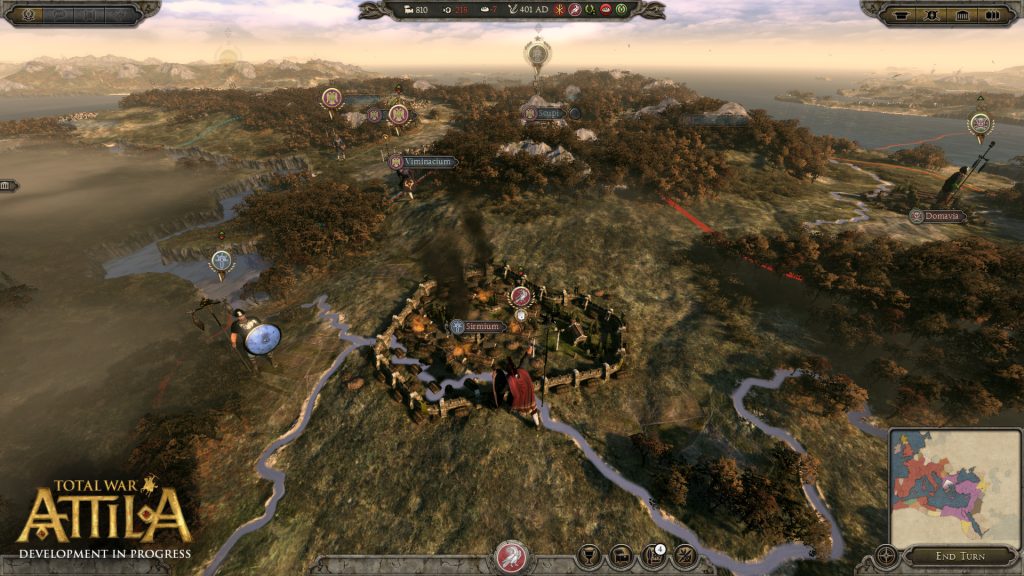
TL;DR: Total War Attila sanitation and disease management starts with each settlement’s coverage, not the province’s most impressive building. Match sanitation to the squalor generated by its city, workshops and other development. A building that helps only its own settlement does not automatically protect its neighbors.
Prevent the next deficit before upgrading, and separate prevention from an outbreak already affecting an army. An infected army can suffer losses and lose replenishment; moving it through clean settlements risks spreading the problem.

Sources and scope: This guide uses the dated settlement-management guide, the building guide and Creative Assembly’s Sassanid faction profile. Reviewed November 9, 2026. It explains decisions rather than guaranteeing current disease odds, cure times or building statistics. Mods and campaign conditions can change those details.
On this page
Total War Attila sanitation and disease: find the exposed settlement
Sanitation offsets the burden of squalor. The archived guide links a settlement’s excess squalor to the possibility of disease. That makes the relevant question local: which settlement lacks enough applicable coverage, and what is producing its burden?
Separate the province into its actual settlements. A capital can be well supported while a smaller industrial town remains exposed. Province-wide effects help across the province, while a local effect belongs to the settlement named by the building. Count those differently.
Do not wait for the province’s income to fall before investigating. Sanitation is a support requirement that can be planned alongside food and public order. The cheapest intervention is often delaying one optional upgrade until its support exists.
1. Match the building’s coverage to the deficit
Choose a sanitation branch for the location it actually serves. The building guide explicitly distinguishes effects that apply to one settlement from effects that apply across the province. A high value is useful only if it reaches the place with the problem.
Suppose a capital has surplus coverage but an industrial settlement does not. Another local improvement in the capital can leave the industrial deficit intact. Compare a relevant provincial effect with a local building in the exposed settlement before spending the money.
Building names alone are insufficient. Read the effect and scope together. You are deciding which settlements receive support, not simply collecting a category of infrastructure. This also matters when a conversion changes which effects remain available.
Budget each settlement separately
Use a simple planning table with one row per settlement: current sanitation, current squalor, queued changes and the resulting balance. Apply any province-wide contribution to each eligible row, then add the local contribution where it belongs.
For an illustrative example, a provincial effect supplies four sanitation to each settlement. One settlement produces six squalor and another produces three. The first still needs additional support even though the second is covered. These numbers illustrate coverage; they are not asserted building statistics.
2. Build support before adding more squalor
Evaluate the finished construction queue, not only today’s balance. The guide identifies expanding settlements and workshops as sources of greater squalor. An area that is covered now can become exposed after several upgrades finish.
If an optional industrial upgrade creates a deficit before a sanitation project is ready, change the order. Complete the support first or delay the new burden. This avoids accepting an unsupported period merely because the final plan eventually balances.
Food and public order still matter. An upgrade can create several obligations at once. A profitable workshop may also require control and sanitation support; a city improvement can increase consumption. Compare the complete supported investment with the income or recruitment function gained.
Include damage and conversion in the calculation
The building guide notes that damaged buildings operate less effectively and need repair. After a siege, the old province plan may no longer describe the current support. Inspect damaged infrastructure before using the settlement as an army recovery base.
Conversions can also change the support package. If you replace one branch to gain another benefit, count the effects being removed. A new economy arrangement is incomplete if it relies on sanitation from the building you just converted.

3. Find a workable slot without wrecking the province’s role
When the affected settlement has no spare slot, compare the options deliberately. A less useful branch can be removed or converted where the game permits, while undeveloped space may require population surplus. Those choices have different timing and opportunity costs.
Do not demolish the only relevant recruitment building without considering the front. Likewise, removing food production can trade a sanitation problem for a shortage. The aim is a settlement that can perform its campaign role after support is added.
Newly reclaimed ruins require particular care. The dated building guide describes ruins blocking space and population surplus being needed to clear them. Resettling an empty place does not immediately create unrestricted slots for the entire food, sanitation and income plan.
Consider reducing the burden instead
Another sanitation building is not the only response. Delaying an upgrade, changing an industrial branch or keeping a settlement at a lower development level can reduce the burden relative to the proposed plan. Compare the lost benefit with the support resources saved.
An ordinary income settlement need not imitate a major recruitment center. Specialization can keep the infrastructure affordable. Build the combination required for its actual job rather than upgrading every branch simply because the option is unlocked.
4. Distinguish prevention from an active outbreak
Improving sanitation addresses the environment that allowed disease risk to develop. It does not justify promising that every active outbreak instantly disappears. The archived source does not provide a reliable current cure timer for every condition.
Watch the actual disease effects and any spread notification separately. A settlement problem and an infected army are related but distinct states. The guide explains that disease can spread to an army, producing losses and preventing replenishment while it remains infected.
That distinction changes the military decision. A healthy but depleted army needs a suitable recovery location. An infected army needs a containment plan as well, because relocating it can carry the problem into another settlement.
Do not call every missing soldier a disease casualty
Winter, terrain, food conditions and recent battle losses can all matter to an army’s state. Diagnose the displayed reason before spending on sanitation as the supposed universal answer. An unrelated recovery restriction will not be solved by fixing a town’s squalor alone.
The same applies to provincial control. An outbreak can add pressure, but religion, taxes and other causes can remain after it ends. Removing one cause does not guarantee the province immediately becomes stable or profitable.
5. Contain an infected army where practical
Avoid moving an infected force into healthy settlements merely to search for replenishment. The dated guide warns that movement can spread disease and recommends waiting out the infection rather than exporting it. Treat the force’s route as part of the containment decision.
This is not a promise that an army can safely remain in any position. Enemy pressure still matters. If the location is threatened, compare the military necessity of withdrawal with the risk to the destination and any other forces using it.
Keep unaffected armies available for tasks the infected force cannot perform reliably. That can mean covering a nearby approach, delaying the next offensive or assigning another army to a clean recovery area. Avoid concentrating your whole campaign plan on an army whose condition is deteriorating.
Make replacements serve a clear purpose
Recruitment is a separate decision from curing infection. New units can help meet a defensive need, but adding more expensive formations to a compromised recovery plan does not remove the cause. Compare the immediate threat and the support location before committing the treasury.
A short pause can be cheaper than losing a second force to the same outbreak. Use that interval to repair or establish the infrastructure required for future recovery. The objective is to restore useful operations, not simply keep every army moving each turn.
6. Protect the locations that support your front
Give sanitation priority where an army repeatedly returns after fighting. A disease-prone industrial settlement beside the main front has a different strategic cost from a distant area no army needs to enter. Both matter, but their failure affects the campaign differently.
Creative Assembly’s Sassanid profile highlights sanitation in the capital as a planning concern. The broader lesson is location-specific: major population and development centers need support. Do not infer a universal faction immunity or an exact modifier from that qualitative advice.
Maintain more than one viable recovery option where the geography permits. One outbreak, siege or damaged building can otherwise interrupt the whole operation. The second location needs actual support rather than merely a friendly flag.
| Problem | Useful response | What to check next |
|---|---|---|
| One town lacks coverage | Apply local or relevant provincial sanitation | Effect scope and queued squalor |
| Slots are full | Compare conversion, removal or new space | Food and recruitment functions lost |
| Outbreak already active | Address support and monitor actual disease state | Army infection and losses |
| Army is infected | Contain movement where military conditions permit | Threats and clean destinations |
| Recovery remains blocked | Diagnose other recovery restrictions | Food, climate and stance |
Frequently asked questions
Does one sanitation building protect the whole province?
Only if its relevant effects have that scope. Some support applies locally. Read the branch’s coverage and compare every settlement separately before assuming a province is protected.
Can a clean settlement instantly cure an infected army?
Do not assume that. The dated guide warns that infected armies can spread disease when moved. Prevention and the duration of an existing infection are different issues; follow the actual campaign state.
Should every city be upgraded as soon as possible?
No. More development can add squalor and consumption. Fund the complete support plan first, especially where the settlement serves as a military recovery location.
What should I do before ending the turn?
Inspect the exposed settlement, compare the completed construction queue and keep healthy recovery locations separate from infected army routes. Change the most avoidable burden before it becomes another unsupported upgrade.
Sources and further reading
Keep exploring

Total War Warhammer 3 vs Total War Attila: fantasy or survival?
Choose WARHAMMER III for fantasy races and Legendary Lords; choose ATTILA for late-antique survival, vulnerable territory and destructive warfare.

Total War Rome 2 vs Total War Attila: build an empire or survive?
Choose ROME II for classical empire growth; choose ATTILA for late-antique survival, a vulnerable Western Roman Empire and destruction mechanics.
Total War Attila vs Total War Shogun 2: survive or reunite?
ATTILA offers late-antique survival and destructive warfare; SHOGUN 2 centers a clan campaign on reunifying Japan.