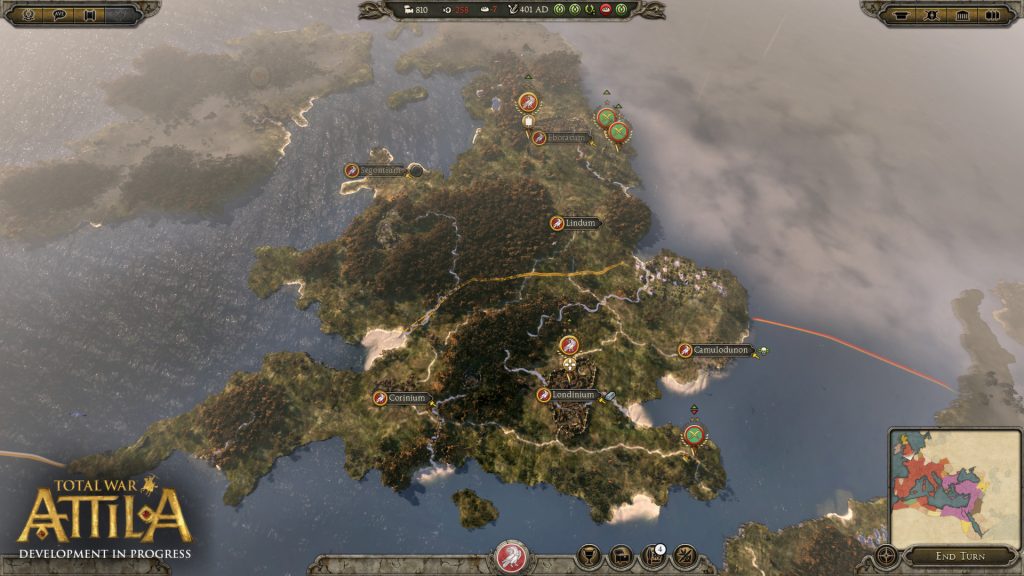
TL;DR: Total War Attila Western Roman Empire survival depends on making a large, weakened state manageable. Stabilize the food and health of important provinces, keep a connected defensive network, and use the limited armies where they can reinforce useful positions. Attempting to defend every exposed settlement equally can leave the whole empire under-supported.
Retreat or abandonment can be part of a plan, but neither is automatically required everywhere. Compare the production, routes and defense you lose with the commitment you save. Preserve the ability to recover and respond after the first wave of pressure.

Sources and scope: The official Western Roman faction profile describes its fiscal and military crisis. Creative Assembly’s fertility blog explains the shortage of armies across the empire. The PC manual documents abandonment, politics and defensive battle features. Reviewed November 9, 2026. This is a conditional Grand Campaign plan, not a fabricated exact first-turn roster or guaranteed survival script.
On this page
Total War Attila Western Roman Empire survival: define the state you can support
The WRE starts with territory that its available resources cannot automatically defend. The official profile describes insufficient money and manpower, poor administration and a worsening external threat. Large ownership is therefore both an asset and an obligation.
Identify a connected network of provinces that supports food, revenue, recruitment and military movement. The useful core is not simply whichever area looks most Roman or most central on the map. It needs to give the surviving armies a practical way to reinforce, recover and protect the faction’s resources.
Set the immediate objective as reducing simultaneous crises. An empire with fewer exposed commitments but functioning support can respond better than one nominally holding everything while its armies and provinces deteriorate. This is a planning recommendation, not a command to abandon a fixed list of regions.
1. Sort threatened provinces by consequence
Separate an imminent attack from an economic problem and from a negative public-order trend. They may occur together, but they require different responses. Sending the only field army to a local control problem can expose the route it was protecting.
Prioritize provinces whose loss would damage the rest of the network: major food production, useful recruitment or an important connecting route. A settlement with limited immediate value may be less urgent than a support area whose loss cuts two armies off from one another.
Also distinguish repairable trouble from a structurally expensive commitment. A modest food investment may stabilize one area. Another may require repeated defense, health spending and military occupation while providing little support in return. Compare the ongoing cost rather than the map color alone.
Assess what happens when the army leaves
A province stabilized by a field army may not remain stable after that force marches away. Read the order contributors and compare the trend without military support. Otherwise, a successful frontier move can recreate an internal crisis behind it.
A governor, appropriate buildings, tax decision or food correction can help make the province less dependent on the army. Choose the support that addresses the actual cause. Keeping a large force permanently in every troubled settlement is not an affordable universal answer.
2. Restore food before adding unsupported consumers
Food is part of both provincial function and military recovery. The dated economy guide separates local shortage from the national total, so do not assume a faction-wide surplus means each taxed province is healthy.
Compare the food effects of the construction already planned. Settlement upgrades and other consumers can deepen a shortage; production choices can address it. A small public-order benefit from an expensive consumer may be counterproductive when its food burden recreates the same unhappiness.
Keep the more productive provinces in the territorial calculation. Creative Assembly notes that WRE concessions can include fertile land, which means withdrawal can have a wider food cost. If the proposed defensive core loses its main production, the army savings may be partly consumed by another economic crisis.
Build for changing fertility
The official fertility explanation distinguishes food output that depends on soil from flat output. Use that distinction when investing in a province expected to support the empire for many turns. A narrow surplus relying on favorable current fertility can become fragile as climate conditions worsen.
Compare the exact building branch and current output before deciding. This guide does not assign one universal livestock or farm recipe to every Roman province. The practical objective is a sustainable balance for the actual territory you intend to retain.
3. Prevent health spending from becoming an emergency
Sanitation shortfalls can lead to disease in the dated settlement guide. Development can raise squalor, so sanitation is part of the cost of an upgrade. Queue the supporting work before the additional burden rather than waiting for the first infection.
Check whether the building’s effect is local or provincial. A health improvement in one settlement does not automatically establish enough coverage in another. Concentrate prevention in important recovery and recruitment locations where an army is likely to spend time.
If an army becomes infected, reconsider its route before sending it through healthier support areas. Disease can disrupt replenishment and create a new constraint. A sanitation investment should not be treated as a universal immediate cure for an infection already affecting the force.
4. Cut obligations by function, not by category name
Evaluate construction and maintenance around what the retained state needs. A building that supplies useful control, food or recruitment may be worth its cost. An expensive branch duplicating a function you no longer need may be a candidate for conversion or replacement.
Avoid a blanket instruction to demolish every religious building or switch the empire’s religion. Those changes can affect control and take time to justify. Read the current province’s effects and compare the alternative before removing a structure simply because an old strategy labels its category inefficient.
Likewise, do not preserve every military building automatically. A recruitment center has value when it supports a real force and route. Several expensive centers far from the retained army network can impose costs without supplying the defense plan.
Keep the savings useful to the next turn
An apparent reduction in upkeep matters only if it helps the faction function. Disbanding the unit that holds a critical route can save money while creating a larger military bill. Canceling optional recruitment may be a better first saving than removing a force with an immediate defensive job.
In a hypothetical budget, assume one optional recruitment package competes with food support and repairs behind the main army. Compare the operation each purchase enables. The correct choice is the one that preserves the current plan’s viability, not simply the largest short-term income display.

5. Concentrate armies where they can support one another
Use the campaign’s routes and terrain to position a force for a defined threat. The movement guide discusses zones of control and fortified positions as tools for limiting approaches. A smaller number of armies can cover more useful ground when they protect connections and reinforce nearby positions.
Avoid scattering weak detachments across every threatened town. Several isolated forces can each face an unfavorable engagement while the main army remains too far away to help. Concentration needs to be balanced against local production and control, but it is often the more manageable starting principle.
Preserve a response force where possible. Its role may be protecting a recruitment corridor, relieving a siege or preventing an internal disturbance from cutting the core. Place it according to that task rather than leaving it idle at an arbitrary center.
Plan withdrawals before movement becomes urgent
Identify the next safe position and the route connecting it. Forced march can extend travel but changes the force’s options and fatigue situation. Do not use it to finish a retreat beside an enemy that can catch the weakened army before it recovers.
Seasonal attrition and difficult terrain also affect the move. A retreat that saves the army from one battle can still lose strength on the route. Choose an endpoint where the force can regain usefulness, not merely escape the current settlement.
6. Use settlement defense to buy useful time
The official manual documents barricades and capture-point contests in Attila. These features can help organize a defense around workable streets and positions. They do not guarantee that a small garrison can defeat every attacking army.
Choose what the defense must accomplish. Holding long enough for relief is different from preserving every wall position indefinitely. Keep troops concentrated around a useful defensive plan instead of spreading them so thin that each group is defeated independently.
Fire, settlement damage and siege escalation can worsen the defenders’ condition in the official rules. A prolonged siege is not a permanent safe pause. If relief is part of the plan, calculate when it can arrive and whether the defender can remain functional until then.
7. Treat abandonment as a timed strategic decision
The PC manual states that abandonment takes a full turn and is canceled if the enemy captures the settlement before completion. It also damages fertility and removes the settlement’s value. Timing therefore matters: issuing the action after the enemy is already able to seize it may not achieve the intended result.
Before choosing it, compare what the faction loses: food, income, recruitment, movement support and a future recovery location. The saved commitment must justify those losses. An exposed region can still be worth retaining when it is the only practical support for another part of the defense network.
Withdraw the army with a separate route plan. Abandoning a settlement and moving the field force are related decisions, but one does not substitute for the other. The army still needs to end the turn in a position it can survive.
Avoid turning a retreat into a migration recipe
The official horde rules concern specific migrating factions and the Huns. A Roman survival plan should not assume that abandoning territory provides the same economic transition as a migrating horde. Preserve the actual settled faction’s support requirements.
Rebuilding a desolate region later also has costs. A scorched-earth buffer is not free future expansion space. Consider whether the retained state can afford resettlement and renewed support if reclaiming that area is part of the long-term plan.
8. Keep politics from consuming the recovery window
Attila’s manual explains control and dominion as separate components of political power. Characters gain and spend influence through offices, military achievements and political actions. Optional intrigues can therefore affect the resources needed to handle the next internal event.
Keep suitable commanders, governors and a succession plan. Use a political action for a specific support or stability problem rather than adding several changes merely because the family has influence available. The faction already has enough simultaneous obligations without creating another avoidable crisis.
Do not apply Rome II’s later party-loyalty recipe as though the games use the same political model. Read Attila’s current power effects and character situation. The goal is internal stability that supports the defensive campaign, not one universal percentage to maximize.
Example: keep a food province while reducing another commitment
Assume one outer settlement needs a large defense commitment, while a connected food-producing province supports the retained core. The field army can defend either immediately but cannot cover both. These are assumed conditions, not a reported opening turn.
Compare production and routes before choosing. Preserving the food province may keep the rest of the network viable, while withdrawing from the other commitment can free the army for a useful defense. If abandonment is chosen, account for the full-turn delay and the fertility loss.
Then invest the saved attention in local food, health or recovery behind the army. A contraction is useful when it produces a functioning state, not merely a smaller map. Reassess after the enemy turn instead of treating the first retreat as a permanent script.
Frequently asked questions
Must I abandon all outer provinces immediately?
No universal list is justified here. Compare each area’s support, defense cost and connection to the retained state. Some concessions can be necessary, but the objective is a workable network rather than abandonment for its own sake.
Should I raise taxes to pay for every defense?
Higher income can create control and growth costs. Compare the least stable provinces and the expense of the resulting unrest. A temporary emergency choice may be justified; a permanent maximum-tax recipe is not assumed.
What is the first sign the plan is improving?
The retained provinces support the army, urgent food and health problems are manageable, and the field forces can respond without abandoning every other route. Survival progress is a functional campaign position, not a promise that every starting settlement remains yours.
Sources and further reading
- https://wiki.totalwar.com/w/Western_Roman_Empire_(TWA_faction).html
- https://store.steampowered.com/app/325610/
- https://wiki.totalwar.com/w/The_Lay_of_the_Land.html
- https://store.steampowered.com/manual/325610/
- https://www.gamepressure.com/totalwarattila/settlement-management/z573d7
- https://www.gamepressure.com/totalwarattila/economy-basics/z373d5
- https://www.gamepressure.com/totalwarattila/moving/z073ea
Keep exploring

Total War Warhammer 3 vs Total War Attila: fantasy or survival?
Choose WARHAMMER III for fantasy races and Legendary Lords; choose ATTILA for late-antique survival, vulnerable territory and destructive warfare.

Total War Rome 2 vs Total War Attila: build an empire or survive?
Choose ROME II for classical empire growth; choose ATTILA for late-antique survival, a vulnerable Western Roman Empire and destruction mechanics.
Total War Attila vs Total War Shogun 2: survive or reunite?
ATTILA offers late-antique survival and destructive warfare; SHOGUN 2 centers a clan campaign on reunifying Japan.