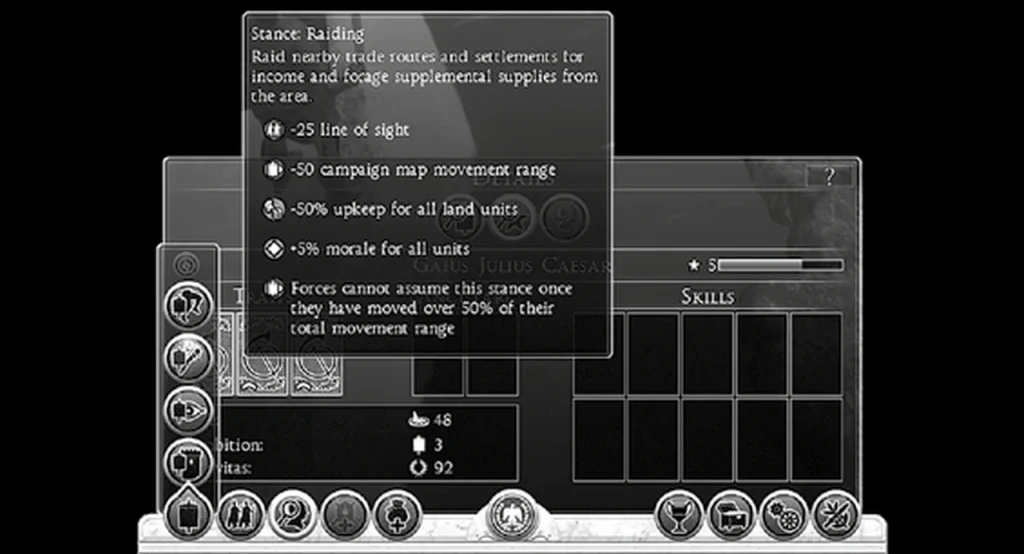
TL;DR: Total War Rome 2 agent actions work best when chosen for a specific campaign problem. Use a spy for reconnaissance or documented subterfuge, a dignitary for administration or manipulation, and a champion for military support or targeted disruption. An agent supporting your own army serves a different purpose from one attacking an enemy army, garrison or character.
Choose the target first, compare the available outcome and chance, then decide whether the action is worth its cost. A failed attempt must leave your army with a workable plan; assassination or sabotage should not be the only condition making an invasion possible.

Sources and version: The official encyclopedia documents spies, dignitaries and champions. Creative Assembly’s 2018 announcement confirms later agent and general changes. Reviewed November 9, 2026. Named actions below come from that official baseline; exact costs, damage and passive bonuses need the current campaign’s action panel, especially with mods.
On this page
Total War Rome 2 agent actions: choose the problem before the agent
Identify whether you need information, cheaper army operation, provincial control, disruption before a battle or removal of a dangerous character. Those are different jobs. Recruiting whichever agent has the highest visible attribute can waste both its skill development and the money needed elsewhere.
Spies, dignitaries and champions have distinct strengths in the official documentation. It also describes a relationship among opposing agent types: spies are effective against dignitaries, dignitaries against champions, and champions against spies. Treat that as context for comparison rather than a guarantee that every attempt succeeds.
Existing skills, traits and household effects influence the agent’s suitability. An experienced specialist near the target can be more useful than a newly recruited theoretical counter several regions away. Distance and timing are part of the decision because the army needs the effect before its operation, not afterward.
| Problem | Documented role to consider | Main comparison |
|---|---|---|
| Hidden enemy threat | Spy reconnaissance or Counter-intelligence | Information before an exposed movement |
| Friendly army administration | Dignitary Military Administration | Support value versus another agent assignment |
| Friendly military development | Champion Military Training | Current skills and embedded effects |
| Enemy field-army disruption | Army-targeted spy, dignitary or champion action | Relevant outcome and failure contingency |
| Enemy garrison disruption | Poison Wells or Assault Town Watch | Garrison target versus field army |
| Culture or local administration | Dignitary provincial role | Time needed and alternative building effects |
1. Use spies to solve an information problem
The spy documentation includes reconnaissance and the detection of hidden armies or agents. Counter-intelligence in friendly territory and information-gathering roles can be valuable before you expose an army to an uncertain border. The benefit is knowing what you are committing to.
Intercept Orders is a documented active action that reveals information connected to the target army’s faction. It can help locate forces or other targets. Its value is greatest when the missing information would change your next move, rather than when you already know the relevant enemy positions.
Do not judge a spy solely by direct casualties inflicted. Learning that another hostile army can reach the intended siege may justify delaying the assault or bringing reinforcement. That change can save more of your force than an uncertain damaging action against the visible garrison.
Choose between scouting and offensive subterfuge
A spy near an enemy settlement may be able to damage a target, but doing so has an opportunity cost. If the route beyond that settlement is unknown, reconnaissance could be the more useful assignment. The choice depends on whether the current bottleneck is enemy strength or incomplete information.
Scouting is especially useful before splitting an army or moving a support force beyond easy reinforcement. A smaller detachment is vulnerable when the map assumption is wrong. Information should resolve the assumption that matters to the operation.
2. Embed an agent when recurring army support is more valuable
The official baseline describes Military Intelligence for spies, Military Administration for dignitaries and Military Training for champions within friendly armies. These are support assignments rather than one-off hostile attacks. Their value comes from the army’s continuing role.
Dignitary administration is documented in connection with general authority and upkeep support. Champion training is documented in connection with military development and zeal. Because later updates changed agents and generals, do not assume an old exact experience amount or identical passive bonus applies to every current campaign.
Compare the agent’s present skill effects with the army’s use. Support attached to your main force can be worthwhile across several operations, while the same assignment to an idle force may contribute little. Moving the agent elsewhere can be the better decision when a different problem is urgent.
3. Match enemy-army disruption to the upcoming battle
Spies have documented army actions including Poison Provisions and Wreck Baggage Train. Dignitary actions include Undermine Authority, Mislead Command and Threats of Destruction. Champions can use Show of Force, Harass or Assault Patrol in the baseline documentation.
These names describe different strategic outcomes rather than equivalent ways to press an attack button. Show of Force targets army morale-related capability. Harass affects combat-related performance. Assault Patrol targets an individual unit, whereas other actions address the broader army or its general.
Choose the effect that supports your actual plan. If the enemy’s dangerous missile component is the issue, an action affecting its combat performance may be more relevant than changing an unrelated command attribute. If the desired outcome is uncertain or modest, a stronger battlefield position may be more valuable than another paid attempt.
Do not turn an uncertain action into a required victory condition
Before committing, ask whether your army can still fight, wait or withdraw if the agent fails. If failure would leave it trapped between a fortified town and a relief force, fix the operational position first. Paying for another attempt does not remove the underlying exposure.
An agent is support for a viable operation. It should not be the only reason that a weaker army expects to win a necessary battle. Keep reinforcement, a delayed assault or a safe retreat available when the action’s outcome is uncertain.

4. Distinguish settlement targets from army targets
The spy’s Poison Wells action is documented against a settlement’s local garrison, while Poison Provisions targets an army. The champion’s Assault Town Watch targets a local garrison unit, whereas Assault Patrol concerns a unit in an army. Confusing these targets can leave the real threat untouched.
If a strong field army occupies or approaches the settlement, reducing part of the local garrison may not solve the siege problem. Compare both forces before deciding. A smaller garrison matters less when a relief army can reach the besiegers before the assault.
Commit Arson is documented as building sabotage, with gate targeting relevant to an assault. Treat that as a specific option where eligible, not a universal promise that every spy can open every fortress. The available target and current campaign conditions determine whether the operation is possible.
5. Use provincial agents for a measurable local need
Dignitaries have documented Civil Administration and Cultural Propaganda roles. The former concerns administration and security; the latter supports conversion toward your culture. These address provincial conditions over time rather than instantly removing every source of unhappiness.
Separate culture from food, taxation, recent conquest and other order contributors. A culture-focused assignment will not automatically fix a deficit caused by unaffordable construction. Use the agent for the contributor it can influence, and use economic or building decisions for the other causes.
Champions also have a documented Military Fervour provincial role involving order and recruitment support. Consider it when that particular province needs the effect. Keeping a valuable military specialist there indefinitely has a cost if the main army needs its support more.
6. Compare character actions by attribute and target
The official pages tie named actions to authority, cunning or zeal, alongside the target character’s attributes. This is why a single highest-stat rule is insufficient. Different actions use different relationships between attacker and target.
For example, the spy’s Poison and Concealed Blade are separate character actions with different attribute comparisons in the documentation. Champions likewise have Single Combat, Marksmanship and Slaughter. Do not infer that a strong army-disruption specialist is automatically your best assassin.
Read the displayed possible outcomes before committing an important agent. Success, failure and severe outcomes have different campaign consequences. A source-supported action name does not justify inventing its current probability or treating character removal as guaranteed.
7. Budget the action against the cheaper alternative
Agent expenditure competes with recruitment, repairs, construction and diplomacy. A paid attempt makes sense when its likely useful result is worth that opportunity cost. Several marginal actions can consume the reserve needed to reinforce the army that must exploit the outcome.
Compare alternatives that address the same problem. Waiting for reinforcement can be better than repeated garrison sabotage. A suitable provincial building may provide lasting control while freeing the agent. Better reconnaissance may allow a safer route instead of trying to weaken an enemy you do not need to fight.
The comparison should include timing. A permanent improvement completed after the crisis is not an immediate substitute, while a temporary agent effect may expire before the army arrives. Align the support with the turn in which the operation can use it.
Example: prepare for one turn of siege pressure
Assume your army can maintain a siege but would prefer a safer assault, and an enemy relief force may approach. A nearby spy has an eligible settlement action, while a champion can disrupt a visible field army. These are illustrative conditions, not a claimed observed campaign.
First resolve the relief-force information. If its route threatens your position, scouting or delaying the assault may be more useful than damaging the garrison. If the route is secure, compare the settlement action with the garrison component causing the assault difficulty.
After the attempt, use the actual result. A success can improve the assault plan; a failure means returning to the viable siege or reinforcement option. Do not continue as though the promised damage occurred simply because you paid for the action.
Frequently asked questions
Are political intrigues agent actions?
They are separate systems. Political-party actions and statesmen missions belong to faction politics; spies, dignitaries and champions operate as campaign agents. Their costs, targets and effects should not be mixed together.
Which agent is best overall?
There is no universal winner. Choose the task, eligible target, relevant skills and timing. A scout answering an important map question can be more valuable than a powerful assassin whose target is irrelevant to the next operation.
Do old champion-training guides give current exact bonuses?
Not necessarily. Creative Assembly changed agents and generals in the Ancestral-era updates. Use the official baseline to understand roles, then confirm the present skill and support effects before relying on an old numerical training recipe.
Sources and further reading
- https://r2enc.totalwar.com/en/manual/single-player/0048_enc_page_campaign_play_characters_agents_spies/
- https://r2enc.totalwar.com/en/manual/single-player/0049_enc_page_campaign_play_characters_agents_dignitaries/
- https://r2enc.totalwar.com/en/manual/single-player/0050_enc_page_campaign_play_characters_agents_champions/
- https://steamstore-a.akamaihd.net/news/externalpost/steam_community_announcements/2447032361187650537
Keep exploring
Total War Rome 2 Diplomatic Expansion: protect your next conquest
Use diplomacy to support an expansion plan through reputation, understood treaty obligations and bounded allied war coordination.
Total War Rome 2 vs Total War Three Kingdoms: territory or characters?
Choose ROME II for classical civilizations and empire development; choose THREE KINGDOMS for Chinese warlords and relationships that connect statecraft with battle.

Total War Rome 2 vs Total War Attila: build an empire or survive?
Choose ROME II for classical empire growth; choose ATTILA for late-antique survival, a vulnerable Western Roman Empire and destruction mechanics.