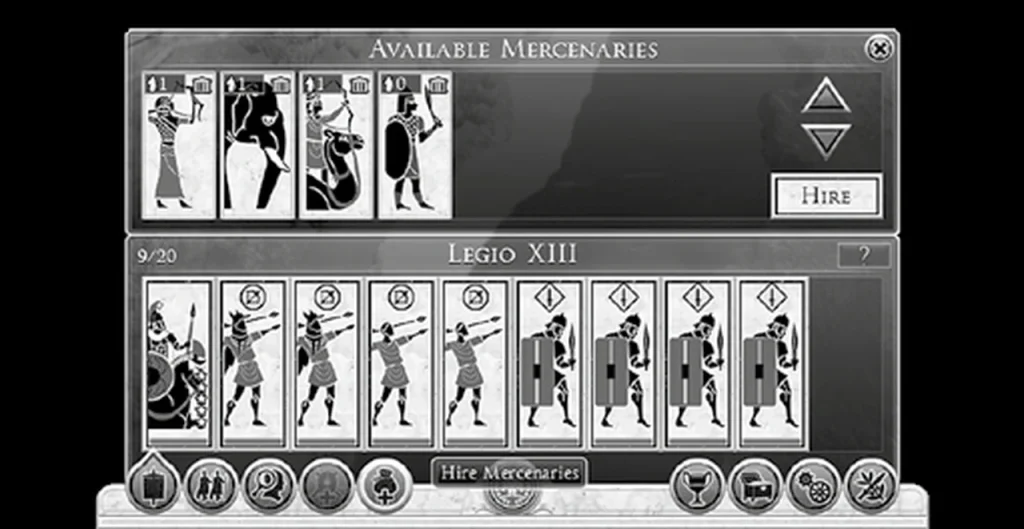
TL;DR: Choose Total War Rome 2 army traditions for the force’s actual job. A melee-heavy army benefits from a relevant melee effect, a missile-heavy force from missile support and an artillery operation from siege-weapon bonuses. The tradition belongs to the army’s legacy, so preserve and reuse that identity when raising a replacement force.
Keep army traditions separate from a general’s skills and individual units’ experience. A useful bonus improves an existing role; it does not replace the troops, recruitment access or positioning needed to perform it.

Sources and scope: The official legacies and traditions explanation and tradition catalog define the system. Specific examples use the official Accomplished Skirmishers, Formidable Fighters and Artillery Experts entries. Reviewed November 9, 2026; these documented entries illustrate selection, without a universal faction tree or a claimed new combat test.
On this page
Total War Rome 2 army traditions: identify the force’s next job
Before choosing the next tradition, name the operation the army will perform. Holding a field-battle line, supporting missile engagements and attacking defended settlements create different needs. An attractive bonus can be irrelevant if the army contains few units to which it applies.
Review both the current composition and the next recruiting plan. If most of the army fights in melee, a melee effect has a broad immediate audience. If you intend to add siege weapons for an upcoming operation, an artillery choice may become useful after those units are available, not merely after the point is spent.
The official catalog contains faction-specific traditions and variants. Use the entry available to the actual force rather than assuming every name and prerequisite appears in every army’s tree. A recommendation from another faction may describe a role worth considering while naming an option your current force cannot select.
| Army job | Documented example | Scope to preserve |
|---|---|---|
| Melee pressure | Formidable Fighters | Listed melee effects |
| Missile support | Accomplished Skirmishers | Listed missile damage and later fire-rate effects |
| Siege-weapon operation | Artillery Experts | Siege weapons |
| Replacement force | Inherited army legacy | Chosen force identity, rather than a new unrelated legacy |
1. Read the affected unit class before the percentage
An effect’s scope matters more than an impressive number without an audience. The official Formidable Fighters entry begins with weapon damage for melee units. It does not say that the same first-level effect increases every missile weapon or artillery shot by the same amount.
Accomplished Skirmishers lists weapon damage for missile units and adds further effects at later levels. Artillery Experts instead lists shots per minute for siege weapons at its first level. Keep those categories separate when deciding which part of the force receives value.
Do not turn a listed percentage into an automatic damage-per-second forecast. Actual combat depends on contact, firing opportunities, target protection and the force remaining usable. A weapon improvement can be meaningful while still failing to help a unit that spends the engagement out of position.
Compare one documented level at a time
The selected official entries show first-level examples of +3% melee weapon damage, +3% missile weapon damage and +4% siege-weapon shots per minute respectively. Later levels add or alter listed effects. Choose from the level you can actually obtain instead of crediting the army with the entire future chain immediately.
These are specific encyclopedia entries, not a promise that every similar faction variant has identical values. The useful habit is to match the available effect with the force’s current role and next operation. Do not add separate effects together without preserving their different scopes.
2. Match a mixed army to its main fighting contribution
Consider a hypothetical field army with a large melee line, a smaller missile group and cavalry support. A melee tradition can improve more of its immediate fighting contribution than a siege-weapon choice when the army contains no artillery. The numerical improvement still requires that the infantry reach and hold a useful engagement.
Now consider a hypothetical force built around substantial missile support and a holding line. Accomplished Skirmishers can be relevant where that entry is available, because more of the intended plan depends on missile fire. Keep the holding infantry and flank protection adequate so the ranged units can keep doing that job.
The two examples illustrate fit, not a ranked list of strongest armies. A tradition does not supply a missing frontline or make an unsupported ranged force safe. Fix major composition problems through recruitment and deployment as well as selecting an appropriate bonus.
3. Select artillery support for an actual siege plan
Artillery Experts affects siege weapons in its documented first-level entry. It is a candidate when the army has those weapons and a credible operation requiring them. A force without the relevant units receives no immediate siege-weapon benefit simply because it may attack a settlement someday.
Before investing, account for recruitment access, treasury, upkeep and the journey to the target. The recruitment explanation makes clear that units join through regional access and continue taking wages. The tradition improves the force you can field; it does not remove those production constraints.
Preserve protection around the weapons
Siege equipment still needs a useful position and supporting troops. An improved firing rate cannot protect an exposed battery when hostile units reach it. Keep infantry or other appropriate support able to contest the approach, and give the weapons the time and target needed by the plan.
If the next operation becomes a mobile field campaign without the artillery group, reassess the next tradition point. The existing investment belongs to the legacy, but every future choice should not automatically continue a role the army has stopped performing.

4. Keep general skills and unit experience distinct
Army traditions are the force’s institutional legacy. General skills belong to the character, while troop experience belongs to individual units. These layers can all influence the army, but they are not interchangeable names for one upgrade system.
For example, replacing a damaged infantry unit changes the troop composition. Selecting a new general changes the commander. The legacy framework described by the manual is tied to the force’s emblem and history, which can continue beyond the original soldiers.
This distinction helps when evaluating a seemingly weaker replacement army. It may retain useful traditions while lacking the same experienced troops or commander. Review all three layers before concluding that the tradition disappeared or the new recruit automatically has the previous unit’s experience.
Evaluate the next point alongside the commander
Choose an army effect that supports the actual force while the general’s available skills serve their own scope. Do not assume a tradition will solve a problem described only in a character effect. Conversely, a changed commander does not make an unrelated army tradition a better fit for the current roster.
Keep the reasoning concrete: which units gain, in which operation, and what supporting condition lets them use the gain? That gives the next upgrade a purpose without relying on an invented total-stack formula.
5. Preserve and reuse the army legacy
The official explanation says the legacy and traditions remain with the force’s emblem after the original troops are gone. The publisher manual also describes reinstating a destroyed or decommissioned force with its earned legacy. When raising a replacement, choose that established identity deliberately rather than assuming every new army starts with it.
Raise a genuinely new force when you want a separate identity and development path. An inherited force and a new force are different choices. The decision depends on whether the existing traditions support the new army’s intended role.
If a previous legacy emphasizes artillery and the replacement will initially contain only infantry, it can remain useful for a later siege plan while offering limited immediate benefit. An inherited history does not oblige you to recruit an unaffordable roster solely to justify the old upgrades.
Review traditions when the campaign role changes
An early frontier army can become a siege force, a replacement pool or a mobile response army later. Reassess its next upgrade at those transitions. Existing traditions remain part of the history, while new points can help the changing composition and operation.
Do not chase an additional tradition by exposing the force to an unnecessary losing engagement. The value of an experienced legacy depends on preserving the campaign’s ability to use it. Treasury, recruitment access and surviving units remain more immediate constraints than a future bonus you cannot exploit.
A worked change from field army to siege force
In a hypothetical campaign, the army first fights with infantry and a small missile group. Formidable Fighters supports the main contact role where its entry is available. Later, you recruit siege weapons for a defended capital and provide infantry to protect their position. The next available artillery effect now has a concrete audience and operation.
After that capture, suppose the siege equipment stays behind while the army returns to mobile frontier defense. The artillery tradition remains in the legacy, but a further artillery investment may no longer be the best immediate use of the next point. Choose from the force that will actually march, while keeping the older siege role available if the campaign needs it again.
Frequently asked questions
Do army traditions belong to the general?
They belong to the army legacy rather than the character’s personal skill tree. General abilities and individual unit experience are separate layers. The documented legacy can continue after the original troops have gone.
Which tradition should a melee-heavy army examine?
Where available, Formidable Fighters provides a documented melee-weapon effect. Match the actual entry and level to the force. It does not automatically apply the same bonus to every ranged or siege unit.
Is Artillery Experts useful without siege weapons?
Its documented first-level effect targets siege-weapon firing rate. An army needs those weapons and a useful firing opportunity to gain practical value. Recruiting and supporting them remains a separate task.
Can I reuse a lost army’s traditions?
The official legacy system supports handing the established history to a new force and the manual describes reinstatement. Select the intended legacy when raising the replacement rather than assuming a newly named army inherits it automatically.
Sources and further reading
- https://r2enc.totalwar.com/en/manual/single-player/0029_enc_page_campaign_play_military_legacies/
- https://r2enc.totalwar.com/en/traditions/
- https://r2enc.totalwar.com/en/tradition/army_tradition_1_accomplished_skirmishers/
- https://r2enc.totalwar.com/en/tradition/army_tradition_1_formidable_fighters/
- https://r2enc.totalwar.com/en/tradition/army_tradition_1_artillery_experts/
- https://store.steampowered.com/manual/214950
- https://r2enc.totalwar.com/en/manual/single-player/0017_enc_page_campaign_play_military_recruit/
Keep exploring
Total War Rome 2 Diplomatic Expansion: protect your next conquest
Use diplomacy to support an expansion plan through reputation, understood treaty obligations and bounded allied war coordination.
Total War Rome 2 vs Total War Three Kingdoms: territory or characters?
Choose ROME II for classical civilizations and empire development; choose THREE KINGDOMS for Chinese warlords and relationships that connect statecraft with battle.

Total War Rome 2 vs Total War Attila: build an empire or survive?
Choose ROME II for classical empire growth; choose ATTILA for late-antique survival, a vulnerable Western Roman Empire and destruction mechanics.