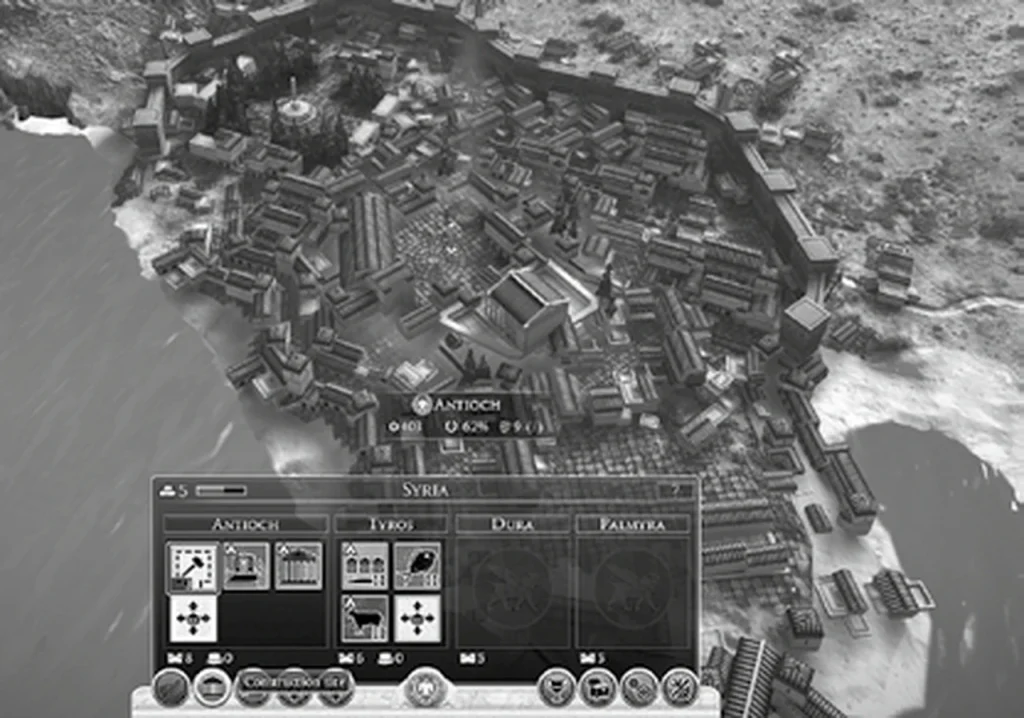
TL;DR: Total War Rome 2 food and sanitation depends on the campaign and building branch. In the Grand Campaign, Roman sanitation buildings can provide growth, culture and public order; some branches also consume food. Compare the actual effect rather than assuming every aqueduct or bath has the same cost.
Empire Divided adds a different campaign problem: plagues and sanitation protection, plus Banditry that can reduce food. Fix the food budget and the health or control problem separately. Do not apply an Attila sanitation calculation to Rome II without checking the campaign’s own rules.

Sources and scope: The official building catalog supplies Roman sanitation effects. Gamepressure explains building categories and food-producing province examples. The official Empire Divided listing documents plagues, sanitation and Banditry. Reviewed November 9, 2026; specific catalog entries illustrate choices, while prices, faction-wide recipes and a universal immunity threshold are excluded.
On this page
Total War Rome 2 food and sanitation: identify the campaign problem
First distinguish a food deficit, a negative public-order trend and an Empire Divided plague problem. They can interact, but they are not interchangeable indicators. A building that helps growth or happiness does not automatically produce the food needed by its own branch.
The Grand Campaign encyclopedia groups Roman structures under Sanitation and describes their happiness and cultural functions. Its listed effects show why the term is relevant to Rome II. However, that does not establish the same independent health balance used in another Total War game.
Empire Divided explicitly introduces plagues, with prevention and spread affected by sanitation buildings and technology. Keep that campaign-specific function separate from the ordinary Roman public-order line labeled sanitation. The same word can identify different practical tasks.
| Problem | Relevant correction | What it does not automatically solve |
|---|---|---|
| Food deficit | Production or reduced consumption | Every cause of low public order |
| Public-order decline | Correct the listed contributors | Food consumed by an expensive branch |
| Growth need | A suitable growth-producing structure | Campaign plague protection by default |
| Empire Divided plague | Its sanitation and technology tools | Guaranteed immunity under every condition |
| Empire Divided Banditry | Its documented local security tools | A deficit caused by unrelated construction |
1. Calculate planned food effects before upgrading
Food-producing regions support the wider empire described in the province examples. Consequently, another province’s construction or a newly acquired area can change the amount available for the next plan. A region that looks locally productive does not mean every simultaneous upgrade is affordable in food.
Read the food production and consumption of the queued changes together. Include settlement upgrades and the selected branches of ports, agriculture and sanitation. The net effect is what matters after completion, rather than the number of buildings carrying a reassuring category name.
In a hypothetical example, assume a surplus of four food and two planned upgrades consuming three food each. Their combined six-food obligation exceeds the current reserve. Build additional production, postpone one upgrade or choose a branch that meets the immediate need with a lower food burden.
Distinguish a farm from a revenue-focused agricultural choice
The building-category guide explains that agricultural specialization can change the balance between food and revenue. A structure chosen for stronger income is not necessarily the best remedy for a food shortage. Select the branch for the deficit you need to remove.
Fishing and trading ports also serve different functions. If the immediate constraint is food, a port choice supplying only the intended trade role does not replace food production. Keep the naval or economic purpose in view while selecting the effect needed by the current budget.
2. Compare sanitation branches by actual effects
The official Roman catalog provides a useful comparison. Its Latrines entry lists growth, Latin cultural influence and public order without a food cost in that effect list. Its Public Baths entry lists greater growth and order support, entertainment wealth and a two-food consumption line.
Those entries correct the overly broad idea that every sanitation structure consumes food. The branch matters. Likewise, an entry with no listed food cost does not prove that every level or every faction’s similarly named chain has the same arrangement.
A documented Roman example
The selected Latrines entry lists +4 growth per turn and +2 public order from sanitation. The Public Baths entry lists +6 growth, +4 public order and -2 food, alongside other effects. These are sourced catalog values for those entries, not live construction prices or a universal campaign formula.
If the province primarily needs modest control support and the empire has little spare food, the lower-burden option can be worth considering. If greater growth and the wider set of effects serve a funded development plan, baths can provide a different package. Choose by the needed function rather than always maximizing the building level.
3. Fix public order without misdiagnosing the food shortage
The official public-order explanation identifies food, taxation, culture and garrisons among its contributors. A food shortage can therefore create a control problem, while a cultural or tax problem can remain after food returns to a workable position.
Address the cause visible in the trend. A suitable sanitation or religious structure can contribute order, while additional food removes a different constraint. Adding a high-consumption support building to an existing food deficit can improve one listed contribution while worsening another.
Compare two assumed construction choices
Suppose a hypothetical province needs order support and the empire has only two spare food. A Public Baths entry consuming two would use the entire assumed reserve. An appropriate lower-consumption alternative, where available, can leave room for another expected obligation.
If the food deficit is already negative, choose production or a reduction in planned consumption first. Do not treat the public-order improvement as evidence that the empire can afford the building’s other effects. The control and food calculations must both work.

4. In Empire Divided, treat plague protection as its own job
The official Empire Divided description states that plagues hamper growth, public order and income. It also identifies spread between neighboring territories, along trade routes and through army movement. That makes an outbreak more than a single settlement’s happiness problem.
The listing identifies sanitation buildings as a way to prevent outbreaks and spread, with key technologies improving sanitation faction-wide. Use those documented campaign tools when playing Empire Divided. A growth-building recommendation from a standard Grand Campaign guide does not automatically establish the same protection.
Review unnecessary movement involving an affected route and fund the appropriate campaign support. Do not promise that one building immediately eliminates every risk. The official product description supports a prevention function, not an unqualified numerical immunity rule.
5. In Empire Divided, check Banditry before adding more farms
Banditry is another documented Empire Divided feature. The official description says it grows with domain size and certain local buildings, reducing food as it increases. Therefore, a falling food position can reflect local security conditions as well as a conventional production shortfall.
The stated tools for reducing Banditry include armies, generals and special buildings. Compare that correction with adding another farm. If Banditry is the relevant cause, restoring local security addresses a problem that additional production alone can leave active.
This does not make every army a free economic solution. Troops still require upkeep and have other assignments. Use a security investment that fits the campaign plan instead of permanently stationing the whole field force wherever food falls.
Reassess growth buildings when the province matures
A structure chosen to accelerate settlement development can become less valuable once the required expansion is complete. Compare its remaining control, culture and income effects with another use of the slot. Its growth role may change without making every remaining benefit irrelevant.
Convert deliberately and keep enough functioning food and public-order support during the process. Removing a building with several useful contributions can create a new deficit even if its headline growth purpose has ended. Read the whole effect package before deciding that a mature province no longer needs it.
Recover captured territory before repeating the same recipe
A newly captured province can arrive with damaged buildings, different food obligations and control pressure. Use the construction explanation to restore needed functions and choose replacements. Do not assume the previous province’s layout is a complete recovery plan for the new one.
Where older material uses squalor terminology, trace the actual food or public-order effect being discussed. A label does not create an independent sanitation meter. Keep the article’s campaign boundary and the current building’s listed effect together.
Use a two-stage recovery plan
In a hypothetical Grand Campaign shortage, first select an available food-producing branch and postpone optional consumption that exceeds the expected reserve. Keep the needed military production intact rather than removing every structure in the province. Once the food position supports the plan, choose the control or growth package appropriate to the remaining problem.
In an Empire Divided outbreak, add the campaign sanitation response to that food plan and reassess the routes involved in spread. If Banditry is also reducing food, identify the local security tool the army and treasury can support. These are separate causes requiring coordinated decisions, rather than one building acting as a universal cure.
Frequently asked questions
Does Rome II actually have sanitation buildings?
Yes. The official Roman building catalog identifies a Sanitation chain with happiness and cultural effects. Some listed branches consume food, while others in the selected entries do not list that cost.
Is sanitation the same in Grand Campaign and Empire Divided?
Empire Divided explicitly adds plague prevention and spread as campaign functions for sanitation. Keep those features separate from ordinary Grand Campaign growth, culture and public-order effects.
Why did food fall after improving a province?
Several upgrades may have added consumption at once, or the chosen branch may favor income over food. In Empire Divided, Banditry is another documented cause. Identify the actual contribution before constructing the next fix.
Should I always build the highest-level baths?
Choose the effect package that solves a funded need. Higher output can carry additional food obligations, and a province no longer needing rapid growth may benefit from a different use of the slot.
Sources and further reading
- https://r2enc.totalwar.com/en/buildings/
- https://www.gamepressure.com/totalwarromeii/building-types/z05713
- https://www.gamepressure.com/totalwarromeii/sample-provinces/z15714
- https://store.steampowered.com/app/694880/
- https://r2enc.totalwar.com/en/manual/single-player/0044b_enc_page_campaign_play_province_public_order/
- https://r2enc.totalwar.com/en/manual/single-player/0045_enc_page_campaign_play_province_construction/
Keep exploring

Total War Rome 2 Diplomatic Expansion: protect your next conquest
Use diplomacy to support an expansion plan through reputation, understood treaty obligations and bounded allied war coordination.
Total War Rome 2 vs Total War Three Kingdoms: territory or characters?
Choose ROME II for classical civilizations and empire development; choose THREE KINGDOMS for Chinese warlords and relationships that connect statecraft with battle.

Total War Rome 2 vs Total War Attila: build an empire or survive?
Choose ROME II for classical empire growth; choose ATTILA for late-antique survival, a vulnerable Western Roman Empire and destruction mechanics.