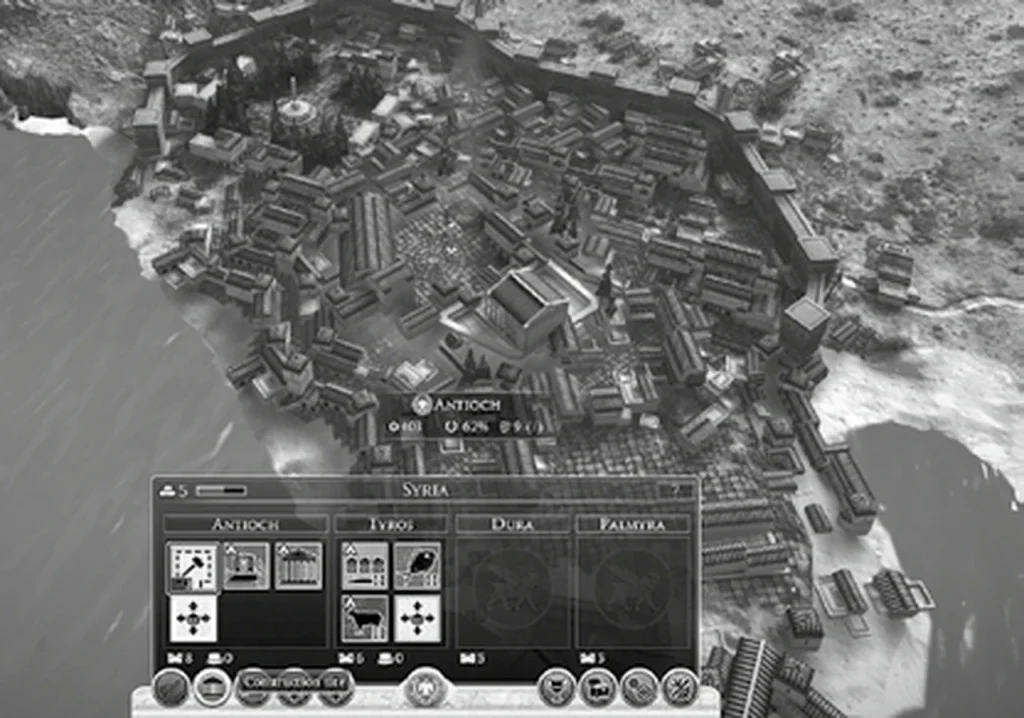
TL;DR: A practical Total War Rome 2 Seleucid campaign opening first makes the Syrian holdings and satrapy frontier manageable, then prepares one supported expansion. The official faction entry lists Tarsus, Edessa, Palmyra, Dura, Tyros and Antioch as starting regions. Its main early problems are Ptolemaic Egyptian pressure and unrest among satrapies and protectorates.
Use diplomacy and focused construction to support a usable army before choosing the southern attack. A dated faction guide proposes Jerusalem as the first Egyptian target after preparation; treat that as a conditional direction rather than a promise of peace, unit unlocks or identical enemy movement in every save.

Sources and scope: The official Seleucid entry establishes the starting-region list and frontier problem. The dedicated Seleucid campaign guide supplies a historical preparation-and-Egypt strategy. Official diplomacy, recruitment and recovery explain its supporting decisions. This is stock Grand Campaign planning for the Seleucid faction, reviewed November 9, 2026, with old costs, fixed AI timing and superseded recruitment claims excluded.
On this page
Total War Rome 2 Seleucid campaign opening: assign one immediate priority
Start by locating the six documented regions and the armies able to defend their approaches. Their spread creates different movement and security jobs. A force guarding the southern route cannot simultaneously cover every eastern border, so choose the immediate threat that the opening army must answer.
Assess the satrapy relationships before declaring another war. The official description identifies upheaval among those subordinate powers as an opening problem. A neighboring territory that looks protected on the map can become a more exposed frontier if that relationship changes.
Then connect the first construction, recruitment and diplomatic choices. Improve a food, income or control function in the holdings that support the army; recruit the roles needed for the chosen frontier; consider a limited agreement or payment where it serves a specific diplomatic problem. Avoid spending independently in every direction.
| Stage | Seleucid task | Condition before moving on |
|---|---|---|
| Opening assessment | Assign defense around the documented starting holdings | A credible response to the actual threatened route |
| Diplomacy | Assess satrapy relations and the immediate war | One manageable external commitment |
| Development | Fund the useful army and provincial support | Food, order and upkeep fit the plan |
| Southern preparation | Scout the route toward the selected Egyptian objective | A recoverable force and supported approach |
| Follow-up | Recover the capture before further expansion | The army and frontier remain usable |
1. Treat satrapies as a changing strategic buffer
The Seleucid position differs from a compact empire with only direct borders. Its subordinate relationships influence which approaches remain protected and where a hostile force can develop. This makes diplomacy part of the first military plan rather than a task postponed until after an invasion.
Identify the relationship creating the greatest immediate exposure. A limited payment or other available deal can be worth considering if it serves that problem, but reserve enough money for defense and development. The dedicated guide favors small gifts; its predicted timing and guaranteed improvement are not rules this article adopts.
The official diplomacy entry explains payments, access and subordinate obligations. Consider the consequences of the new war for those relationships. Do not assume calling on every subordinate automatically supplies reliable help without affecting the broader arrangement.
Do not confuse relations with internal party loyalty
Satrapy relations concern another faction’s relationship to your empire. Internal political parties are a separate management system. Spending on one problem does not automatically solve the other, even if both descriptions use language about loyalty or support.
Keep the military route tied to the external relationship you need. If an eastern buffer becomes hostile, a planned southern invasion may need to wait or retain a separate defensive force. The existing diplomatic colors are information for the next commitment, not permanent security.
2. Make the immediate war manageable before confronting Egypt
The dated opening guide describes an initial war with Qidri and discusses a possible peace offer. Use that evidence as a reason to evaluate peace when the situation permits, not as a guaranteed event or a claim that Qidri can never become dangerous.
A useful peace can remove an immediate obligation while the army and economy prepare elsewhere. Compare its terms with the frontier and resources you would otherwise need to defend. Reject the idea that the only useful opening action is capturing every nearby enemy settlement.
If peace does not materialize or another threat appears, preserve an army arrangement capable of responding. The source’s aggressive later campaign relies on early preparation; it does not justify marching the sole useful force away while an unresolved enemy threatens the holdings behind it.
Keep useful forces rather than disbanding by formula
The old community plan recommends removing particular forces to reduce upkeep. This guide instead reviews each army and fleet against its actual job. A force that provides essential defense or reconnaissance can be worth its wages even during a development phase.
If a force truly has no useful assignment, reducing its cost can support another need. But a blanket instruction to remove every secondary unit ignores the current frontier. Preserve the ability to defend the empire while redirecting resources toward the chosen operation.
3. Develop the Syrian base for food, income and usable recruitment
The official starting-region list includes Antioch and the surrounding documented holdings. Use this base to support the force preparing for the southern frontier. Select construction for a named constraint: food, control, income or the production required by the intended army.
The official construction explanation identifies prerequisites and different building roles. Do not copy the old guide’s exact barracks-to-unit list as a current universal unlock schedule. Fund the required regional access for the troops you intend to recruit.
Public order requires the same cause-based approach. The official entry identifies food, taxes, culture and garrisons among its contributors. An available growth building is not automatically the best investment when the immediate problem prevents the field army from leaving.
Keep development within the military budget
Consider a hypothetical treasury of 4,000 with 1,200 allocated to a defensive response and 1,000 to required construction. Only 1,800 remains for other immediate spending before considering future upkeep. These are illustrative amounts, not current Seleucid unit or diplomatic prices.
Trade can support the development plan where agreements and routes are available. However, a projected trade contribution should not be treated as permanent income regardless of border changes. Keep the army usable if the relationship or route that supports the expected revenue changes.

4. Assemble a combined force before selecting Jerusalem
The official faction description emphasizes a solid infantry core supported by expert cavalry, including horse archers, and other specialist options. That identity supports a combined-force plan. It does not establish that every specialist unit is available in the opening roster.
Use the regional recruitment actually available to create an infantry line, missile support and a credible maneuver role. Keep enough supporting troops to protect vulnerable ranged units and enough reserve to answer an exposed side. Do not replace a missing frontline with an imagined future elite unit.
The dedicated historical route begins the Egyptian campaign at Jerusalem after development. Scout the approach and defending force before committing. The named target supplies a strategic direction; the actual army condition and southern frontier determine when that attack is sensible.
Choose an approach the surviving force can repeat
In the battle, assign infantry to the main contact while missiles and cavalry act where their roles are useful. A supported flank is different from sending cavalry into the first defended unit because it reaches the target sooner. Preserve the force required to hold the capture and answer the counterattack.
Afterward, use friendly recovery and restore needed buildings. An army that wins with severe losses may require replenishment before attempting the source’s next step toward Petra or another Egyptian position. That is a condition of the route, not a failure to follow it efficiently.
5. Adapt through two assumed frontier outcomes
Branch A: relations remain manageable and the southern army is ready
Assume the satrapy frontier remains manageable, the immediate war no longer consumes the whole force and the Syrian base supports recruitment and upkeep. Prepare the selected southern operation with a recovery destination and resources for the captured position.
Once the first target is taken, reassess the enemy field force rather than immediately declaring the rest of Egypt conquered. The historical guide lists further targets, but they require another supported advance. Keep the frontier behind the army usable while moving through the next stage.
Branch B: a relationship breaks or the first fight causes major losses
Assume a subordinate relationship changes while the southern army is understrength. Review whether defense, peace or a smaller commitment serves the empire better than another invasion. Keep a force able to contest the newly exposed route and recover before choosing the next offensive task.
If the first Egyptian attack leaves the core damaged, hold or withdraw to a suitable recovery position rather than spending the entire reserve on hurried replacements. The objective remains a focused expansion, but the timing changes with the force that actually survives.
Use reconnaissance to separate a threat from a possible target
The official spy explanation identifies intelligence and detection roles. Use reconnaissance to investigate the route the army must enter, rather than choosing an invasion only from an attractive settlement name. A defending field force outside the target can matter as much as the visible garrison.
This is particularly useful when the satrapy frontier and Egyptian approach both demand attention. Scout the route that would expose the committed army, then decide whether the information supports preparation or movement. A diplomatic agreement concerns relations; it does not reveal every hidden army or certify that the southern path is clear.
In a hypothetical preparation turn, the spy identifies a nearby enemy force while the legion is still mustering. Keep recruitment and defense aligned with that information. If the force moves away, reassess the opportunity; if it remains, preserve enough fighting strength and a recovery route for the expected engagement. Do not base an irreversible campaign commitment on an assumed enemy absence.
Keep the next war connected to the victory direction
The Seleucid position offers eastern, southern and western possibilities, but a broad map is not a reason to create every war simultaneously. Use the actual campaign objective panel to select the direction that matters. An unsupported distant conquest can consume the resources needed to secure the existing base.
The official faction history describes opportunities toward Egypt and the former western empire, while the opening guide proposes a long sequence beyond them. Treat those as future possibilities. The first useful result is a defensible frontier and a funded army able to make the next choice.
Frequently asked questions
Which starting regions does the official entry identify?
It lists Tarsus, Edessa, Palmyra, Dura, Tyros and Antioch for the Seleucid Grand Campaign entry. This guide uses that identity, rather than substituting a different DLC campaign start.
Should I attack Egypt on the first turn?
Prepare the army and assess the satrapy and immediate-war situation first. Jerusalem is the first Egyptian direction in the dated source plan, but no fixed attack turn or automatic victory is guaranteed.
Will gifts always stabilize satrapies quickly?
No such guarantee is used here. A limited payment is a possible diplomatic tool, weighed against military and construction needs. Reassess the actual relationship and frontier before committing the army elsewhere.
Should I disband every secondary force to save money?
Review its actual defense, scouting or naval assignment. Remove unnecessary costs only when another arrangement preserves the required function. A development phase still needs credible security around the starting holdings.
Sources and further reading
- https://r2enc.totalwar.com/en/manual/single-player/0048_enc_page_campaign_play_characters_agents_spies/
- https://r2enc.totalwar.com/en/faction/rom_seleucid/
- https://steamcommunity.com/sharedfiles/filedetails/?id=187684187
- https://r2enc.totalwar.com/en/manual/single-player/0038_enc_page_campaign_play_faction_diplomacy/
- https://r2enc.totalwar.com/en/manual/single-player/0017_enc_page_campaign_play_military_recruit/
- https://r2enc.totalwar.com/en/manual/single-player/0044b_enc_page_campaign_play_province_public_order/
- https://r2enc.totalwar.com/en/manual/single-player/0026_enc_page_campaign_play_military_replenish/
- https://r2enc.totalwar.com/en/manual/single-player/0045_enc_page_campaign_play_province_construction/
Keep exploring
Total War Rome 2 Diplomatic Expansion: protect your next conquest
Use diplomacy to support an expansion plan through reputation, understood treaty obligations and bounded allied war coordination.
Total War Rome 2 vs Total War Three Kingdoms: territory or characters?
Choose ROME II for classical civilizations and empire development; choose THREE KINGDOMS for Chinese warlords and relationships that connect statecraft with battle.

Total War Warhammer 3 vs Total War Rome 2: fantasy or empire?
Choose WARHAMMER III for fantasy races and Legendary Lords; choose ROME II for classical empire building, politics and historical battles.