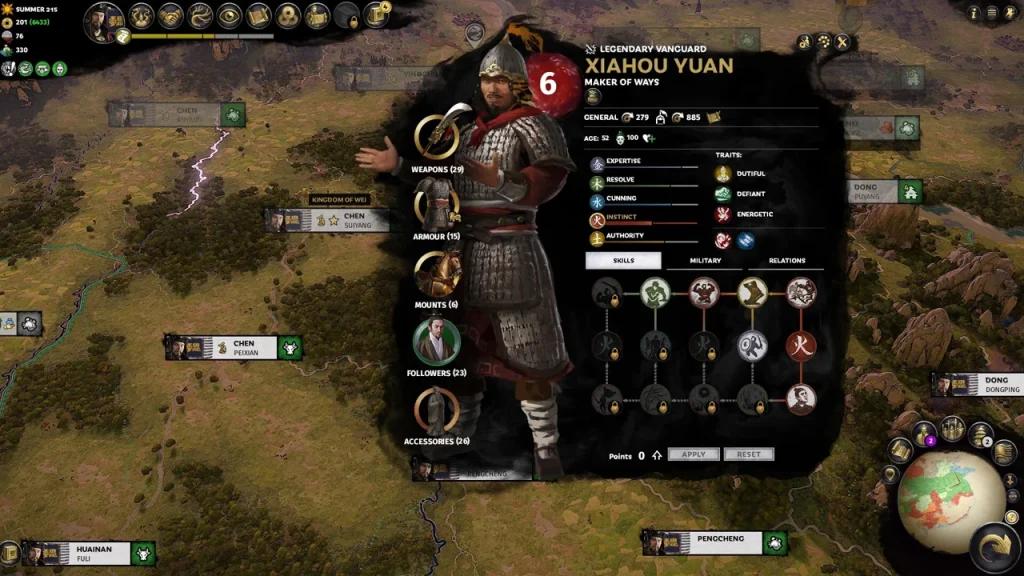
TL;DR: The Total War Three Kingdoms Cao Cao campaign opening for 190 CE starts in Chen commandery. Defeat Yuan Huan, then push south to bring Chen under your control. Preserve the army that wins those battles, develop food and income before committing to another frontier, and treat the later Tao Qian decision as a military choice rather than an automatic declaration. On versions with Cao Cao’s reworked Schemes, pair the immediate campaign task with a useful available scheme.

Cao Cao’s first strategic problem is completing his home base while retaining the ability to defend it. The faction reference identifies Chen, Yuan Huan and the southward objective specifically for Rise of the Warlords. It places the 194 and 200 starts in Yingchuan instead. This guide follows 190 CE and gives conditional decisions, not a claim that every campaign follows identical turns.
On this page
Total War Three Kingdoms Cao Cao campaign opening: the first route
- Fight Yuan Huan with the starting army, protecting its essential infantry and ranged units.
- Assess the survivors before continuing south toward the remaining Chen objective.
- Complete the home commandery when the army can win and hold the next settlement.
- Fund the food, income or recovery bottleneck that now limits further movement.
- Manage relations around the frontier you are leaving quiet.
- Choose whether to postpone or pursue war with Tao Qian when the relevant event arrives.
This route gives the opening battles a common purpose. Taking one settlement, recruiting an expensive new retinue and then marching toward a different neighbor can leave the original objective unfinished. Chen should become the place that supports your next war, rather than an exposed stop behind the army.
1. Defeat Yuan Huan without spending the whole army
Use the existing force to solve the immediate enemy problem before building a second army. The starting reference names Cao Cao, Xiahou Dun and Xiahou Yuan among the 190 CE characters, but that roster does not prove an identical deployed unit composition in every installation. Assign jobs to the units actually present instead of recruiting toward a supposed universal opening stack.
Put the infantry that can withstand contact where it can hold the enemy front. Keep ranged troops behind that line with usable firing lanes. Reserve a mobile unit or suitable general for exposed ranged troops and a flank, rather than sending it straight into the strongest part of the enemy formation. A successful attack should reduce the opposition while leaving a workable force for Chen.
In Romance, a strong named general is an additional tactical tool, not permission to ignore hostile spears, surrounding units or the rest of the army. In Records, manage the general’s bodyguard as a unit whose losses affect the battle. Reject an unfavorable duel rather than risking a valuable commander just because the challenge appears.
After victory, look at which battlefield job you have lost. A battered front line needs recovery more urgently than an intact cavalry wing needs another cavalry unit. If losses were light, continue toward the southward objective with enough movement and fighting strength. If the army barely survived, stop somewhere defensible and restore its damaged roles before another assault.
2. Finish Chen before scattering your commitments
Southward consolidation is the documented opening objective. It links the first battle to control of Cao Cao’s home commandery and gives construction a clear local purpose. Do not confuse a campaign map opportunity with an obligation to take it immediately.
Before attacking the next Chen settlement, consider both the assault and the defense afterward. A garrison you can beat with heavy losses can still leave you unable to withstand the following counterattack. The alternative is a short recovery, a useful reinforcement or a safer battle approach, depending on the position. Waiting is worthwhile when it converts a fragile conquest into a settlement you can keep.
When taking territory, weigh damage and recovery against the immediate proceeds of the occupation choice. A settlement intended to finance the next stage has less value if its productive buildings remain damaged while your army needs upkeep. Choose deliberately according to the settlement’s condition and strategic role; this opening does not require one occupation option everywhere.
A complete commandery is easier to develop coherently than scattered acquisitions, although ownership alone does not make it secure. Keep the army close enough to respond while unrest, damaged production or an enemy nearby remains a concern. Only then decide whether the next march continues the same front or opens a different one.

3. Match Cao Cao’s Schemes to the next real task
Cao Cao’s faction mechanics changed after release. The official Patch 1.7.0 announcement names new Cao Cao and Yuan Shao mechanics. The faction reference describes the reworked system as Schemes tied to Credibility, including schemes that generate the resource and others that spend it. It also describes natural decay. Do not plan a modern opening around an older assertion that Credibility simply rises while you wait.
Useful examples include Arrows From the Enemy, which supports ammunition and military supplies, and Tiger Over the Mouse, which improves public order while reducing reserve capacity. These illustrate two different opening needs: an army preparing for another engagement and a commandery that needs stability. Neither is a mandatory first-turn click; access, targets, duration and cooldown must fit the campaign you are playing.
For diplomacy, the reference lists Rival Tigers and One Prey as improving relations with other factions. Better relations can support a quieter neighboring frontier, but they do not guarantee a treaty. A relationship bonus is useful when it helps a concrete negotiation. It is less useful if the intended partner has no reason to accept your terms or if you immediately undermine the relationship with another action.
Choose the benefit and its tradeoff together. A public-order scheme with a reserve penalty should not be treated as a free improvement in a settlement facing a siege. A temporary army effect should cover a planned movement or battle rather than expire while the army waits for unrelated construction.
Relationship manipulation and proxy wars need a version boundary
The official manual describes Cao Cao influencing others and encouraging a proxy war. Those earlier descriptions should not be merged into the later Schemes system without checking the installed version. If your campaign exposes relationship manipulation or a proxy-war option, treat each as a separate diplomatic action with its own requirements.
A proxy war attempts to set other factions against one another; it does not automatically remove an enemy army from Chen or make a third party obedient. In the opening, direct control of your own front is more dependable than a plan that needs two outside rulers to behave exactly as hoped.
4. Build the economy that supports this army
Prioritize the shortage that blocks consolidation: army recovery, recurring income or food. A large treasury can conceal an unsustainable turn balance, while positive income can still leave too little cash for repairs and replacements. Judge both before extending the front.
A commandery groups its capital with resource settlements, which makes local production relevant to construction. Agricultural settlements and fishing ports can produce food; a city upgrade can increase food demand. Improve a real production source where available before committing to larger consumption. Avoid financing urban growth by selling the same food surplus you still need for your own upgrade.
Cao Cao’s faction reference lists Grain Garrison, Rice Garrison and Tuntian Conscription among his unique building chains. Their availability and displayed effects should guide the actual choice. They are useful reasons to examine Cao Cao’s development options, not proof that every Chen slot should hold a military or agricultural building regardless of local production.
For example, suppose your treasury is 2,500 and you want construction costing 1,200, recruitment costing 800 and a 900 recovery reserve. Those hypothetical commitments exceed your money by 400 before any other expense. Choose the action that solves the next obstacle. If the army is healthy, productive construction might come first; if the infantry cannot take the next settlement, recovery takes priority.
Sell only food that remains surplus after current and planned demand. A short-term payment is attractive, but the recurring delivery can become a liability after losing a producer or expanding a city. Keep a margin so that one setback does not undermine both development and the treaty.
5. Decide whether the Tao Qian war is affordable
The 190 CE faction reference describes an event concerning Cao Song’s death and the choice to wait or declare war on Tao Qian. It does not require an immediate offensive. Let Chen’s condition and the army’s position determine your response.
Branch A: consolidate one front
Assume the southern objective is complete, but Cao Cao’s army is damaged and a new settlement still needs repairs. Postpone the Tao Qian war. Recover near the territory you must protect, repair useful production and pursue a relevant agreement with a neighbor whose frontier you want quiet.
This branch trades immediate expansion for a stronger starting position. Its danger is excessive waiting while rivals grow. Give the pause a measurable end: restored battlefield roles, manageable food demand and enough money to move while paying upkeep. Once those conditions are met, reconsider the next target rather than waiting for every building to finish.
Branch B: expand while the army is ready
Assume Chen is stable, the army is healthy and the proposed campaign against Tao Qian has a nearby objective you can hold. An earlier offensive becomes more reasonable. Keep the new war focused on a settlement or frontier improvement rather than marching deep into hostile territory merely because the first battle went well.
Check the target’s current diplomatic ties before declaring. A war that appears local can become expensive when other factions join. Retain enough treasury and response distance to defend Chen if the diplomatic situation changes. If taking the objective exposes two approaches that one army cannot cover, stop and consolidate rather than widening the war again.
When is Cao Cao ready for the next war?
Cao Cao is ready when the army can fulfill its battlefield roles, Chen can support its upkeep and food needs, and the next objective improves the frontier. Pair an available scheme with that objective. If the plan only works because an ally must intervene or a proxy war must succeed, revise it before moving.
Frequently asked questions
Where does Cao Cao start in 190 CE?
He starts in Chen commandery in Rise of the Warlords. The 194 and 200 starts use Yingchuan and have different opening conflicts.
Who is Cao Cao’s initial enemy?
The faction reference identifies Yuan Huan, sent by Dong Zhuo to arrest him. Defeating that force precedes the southward Chen consolidation objective.
Should I declare war on Tao Qian immediately?
Only if the army, home economy and frontier can sustain it. The event allows waiting, which is useful after costly opening battles.
Does Cao Cao need Fates Divided’s 200 CE start for this route?
No. This route is for 190 CE. Fates Divided’s 200 CE opening is a different campaign; the reworked mechanics also require attention to your installed version.
Sources and further reading
- https://totalwar.fandom.com/wiki/Cao_Cao_(faction)
- https://steamstore-a.akamaihd.net/news/externalpost/steam_community_announcements/4057152305731075940
- https://www.feralinteractive.com/en/manuals/threekingdomstw/latest/linux/
- https://www.gamepressure.com/total-war-three-kingdoms/food/z0c454
- https://www.gamepressure.com/total-war-three-kingdoms/romance-and-records-modes/zdc43c
Keep exploring
Total War Three Kingdoms vs Total War Shogun 2: heroes or clans?
THREE KINGDOMS emphasizes heroic characters and Guanxi; SHOGUN 2 puts generals and agents inside a Japanese clan-unification campaign.
Total War Three Kingdoms vs Crusader Kings 3: battles or heirs?
THREE KINGDOMS fits direct tactical battle command; Crusader Kings III fits a ruling house whose playable heirs carry its story forward.

Total War Warhammer 3 vs Total War Three Kingdoms: who should lead?
Pick WARHAMMER III for fantasy race and lord identity; pick THREE KINGDOMS for Chinese empire strategy shaped by heroic characters and relationships.