TL;DR: Total War Three Kingdoms diplomatic coalitions suit factions that share an immediate strategic interest but are not ready for a binding military alliance. Choose partners whose borders and enemies fit your campaign, inspect the available proposal through diplomacy or Quick Deal, and consider every existing member before joining. Treat a larger group as a negotiation involving several factions: the official manual confirms that members vote on decisions affecting everyone.

A coalition is useful when cooperation has a clear purpose, such as reducing uncertainty along one frontier while you fight elsewhere. A military alliance represents a stronger commitment. Before accepting either arrangement, read the actual treaty and any war request displayed in your campaign. The word coalition alone is not evidence that every member automatically enters every war.
On this page
Total War Three Kingdoms diplomatic coalitions: pick a practical purpose
Begin with your next campaign objective. Perhaps you need a quieter northern boundary, want to avoid fighting two neighboring powers simultaneously, or hope to coordinate against a faction expanding toward both of you. Name that objective before browsing potential partners. Otherwise, an agreeable diplomatic offer can distract you from the territory and armies that matter.
Open diplomacy and select a candidate. Examine its location, current relationships and existing commitments. A faction near the contested border has a different practical value from a distant member whose armies cannot conveniently operate there. Geographic relevance is a strategy judgment, not a hidden bonus that guarantees acceptance.
Ask what the other faction gains from cooperation. If your intended expansion runs directly through its settlements, you have a conflict of interests even when the current relationship looks friendly. A useful coalition partner should help you pursue a plan you can sustain without immediately undermining the arrangement.
Write a simple purpose: stabilize the eastern boundary while finishing the western war, for example. This gives you a way to judge future invitations and votes. An extra member matters only when its participation improves that purpose enough to justify its political complications.
1. Separate a coalition from a military alliance
The official Three Kingdoms manual describes coalitions as looser military agreements added alongside standard, binding military alliances. It also confirms that both arrangements can include multiple factions. That distinction is the foundation of the decision: cooperation and a binding alliance are different levels of commitment.
Choose a coalition when the shared objective is useful but you still need to evaluate the partners. Consider a military alliance when the members have compatible plans and you are prepared for the stronger arrangement described by the treaty. More binding diplomacy is not automatically a better fit for a faction still rebuilding its armies.
Read the terms before agreeing to an upgrade. Inspect any associated negotiations or war decisions individually. Do not infer a universal automatic-war rule, a guaranteed rescue army or a fixed acceptance threshold from the manual’s short summary. The campaign interface is where you check the specific offer you are about to accept.
Keep equal partners separate from subjects. Joining a coalition does not mean the other factions become your vassals or surrender their settlements. If your goal is direct control or an overlord relationship, this arrangement answers a different question.

2. Review every member before joining
A two-faction arrangement is easier to understand than a group with several competing interests. Review the full membership rather than only the faction issuing the invitation. One member may be compatible with your next war while another is a power you planned to confront soon.
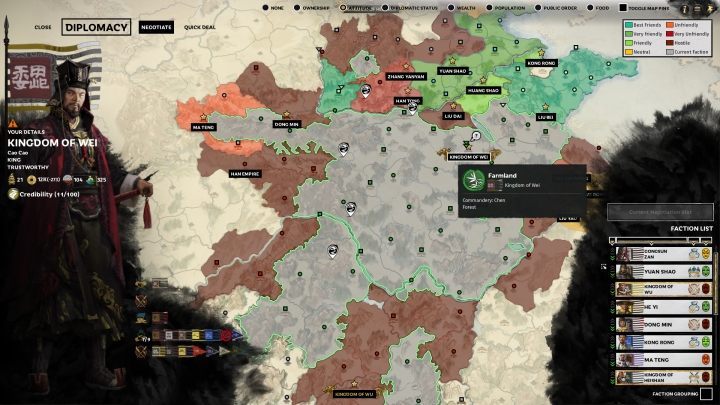
Use the diplomatic map to examine relationships between the proposed members and your likely opponents. The Gamepressure diplomacy guide explains selecting a faction to view its relations and hovering over the relationship icon for details. Use those details to identify existing treaties and changing attitudes instead of relying on a single friendly color.
A relationship trend is context, not a prediction of an inevitable declaration of war. Combine it with geography, visible armies and the proposal itself. You want to know whether the partners are likely to pursue compatible objectives, not calculate certainty from one interface value.
For each candidate, record one benefit and one complication. A neighboring partner may protect a useful diplomatic flank while competing for the same commandery. A distant faction may broaden cooperation but add another voice to collective decisions. This short comparison makes the choice more concrete.
3. Use diplomacy and Quick Deal to inspect a workable offer
The official manual confirms granular bargaining and a Quick Deal option for finding workable exchanges efficiently. Start with the coalition arrangement you actually want. Use Quick Deal to examine available possibilities, then inspect the selected negotiation before confirming it.
Quick Deal is a discovery aid. It does not decide whether the proposal serves your campaign. A possible agreement can still include a payment or another concession you would rather reserve for recruitment, construction or a different relationship.
Compare the complete package. If a concession is needed, ask whether its cost fits the objective identified earlier. Giving up useful treasury to establish a coalition is defensible when it solves a serious diplomatic problem. Paying heavily for a group that contributes little to your frontier is harder to justify.
Keep unnecessary terms out of the first proposal. When you add several unrelated obligations, the offer becomes harder to evaluate. After a counterproposal, inspect what changed instead of accepting because the coalition component is still present. Your decision covers the whole deal.
4. Plan for votes and competing priorities
The manual states that coalition and alliance members vote on future negotiations or decisions affecting all parties. Membership therefore changes how you approach shared decisions. You cannot treat every collective proposal as a private agreement between you and your favorite partner.
Before supporting a new member, consider how it changes future discussions. Does the candidate share the group’s main objective? Is it hostile to an existing member? Does it bring useful strategic reach, or mostly another conflict of interest? These questions are more useful than expanding membership simply because an invitation is possible.
For a proposed war or other collective action, check your own military position first. Identify the frontier you would need to cover, the armies you can spare and the recruitment money required. Political agreement does not create those resources for you.
If a proposal is rejected or lacks support, revise the plan around what the group will actually do. You might retain the coalition while pursuing a narrower objective. Repeatedly proposing the same broad plan without considering the members’ circumstances does not solve the underlying disagreement.

5. Turn shared interests into realistic cooperation
Decide which objective would be useful for a partner to pursue and which remains your responsibility. If war-coordination options are available in your current diplomacy interface, inspect them to communicate a relevant target. A distant target or heavily defended army may be a poor practical request.
Coordinate around access and timing. Review the route a partner would need to take and the treaties shown for the territory involved. Coalition membership should not be used as a blanket assumption that every army can cross every border without consequences.
Preserve an independent military plan for important settlements. Even a strategically sensible partner may be occupied elsewhere. Do not abandon your only defensive force because you expect a coalition member to appear at a particular place on a particular turn.
After territory changes hands, review the arrangement again. A former shared enemy may disappear, or the group may begin competing over the same remaining land. Those developments change the coalition’s usefulness even if its original formation was a good decision.

A hypothetical two-front coalition decision
Assume your faction is fighting in the west while a northern neighbor shares concern about an eastern rival. A second potential member is far south and has conflicting relationships with that northern neighbor. These are invented campaign conditions, not a report of a tested save.
First, define the objective as keeping the northern boundary politically manageable while completing the western campaign. Review the northern faction’s relations and inspect the proposed coalition. If its terms are affordable and its expansion plans are compatible, it is a sensible candidate for that limited purpose.
Next, assess the southern invitation separately. Distance alone does not make it worthless, but adding a member whose interests conflict with an existing partner can complicate votes. Decline or postpone expansion when the benefit does not justify that complication.
Finally, reconsider a military alliance after your western army is available. If the members now agree on a shared objective and the stronger treaty fits your resources, inspect that option. If their priorities have diverged, preserve the looser arrangement or evaluate leaving rather than treating an upgrade as inevitable.
When to review, change or leave the arrangement
Review membership after major wars, border changes and proposals that expose a conflict of interest. Compare the coalition’s present purpose with the one you set when joining. An arrangement that once stabilized your frontier may become awkward when your next objective lies inside a partner’s territory.
Before leaving or changing the treaty, inspect the diplomatic consequences displayed by your campaign. Do not assume withdrawal is consequence-free or that immediate aggression is safe for your diplomatic standing. Plan the next relationship and military position before confirming a change.
Coalition questions
Is a coalition the same as a military alliance?
No. The official manual distinguishes looser coalitions from binding military alliances. Choose according to the commitment your current campaign can support.
Can several factions belong to the same group?
Yes. The manual confirms multiple factions and votes on shared decisions. Review all members before joining, expanding or proposing collective action.
Will coalition members automatically win my wars?
No victory is guaranteed by membership. Inspect each treaty and request, then keep a practical plan for your own armies, routes and defenses.
For related campaign topics, visit the Three Kingdoms game hub and the strategy game guides.
Sources and further reading
Keep exploring

Total War Rome 2 vs Total War Three Kingdoms: territory or characters?
Choose ROME II for classical civilizations and empire development; choose THREE KINGDOMS for Chinese warlords and relationships that connect statecraft with battle.
Total War Three Kingdoms vs Crusader Kings 3: battles or heirs?
THREE KINGDOMS fits direct tactical battle command; Crusader Kings III fits a ruling house whose playable heirs carry its story forward.
Total War Three Kingdoms vs Total War Shogun 2: heroes or clans?
THREE KINGDOMS emphasizes heroic characters and Guanxi; SHOGUN 2 puts generals and agents inside a Japanese clan-unification campaign.