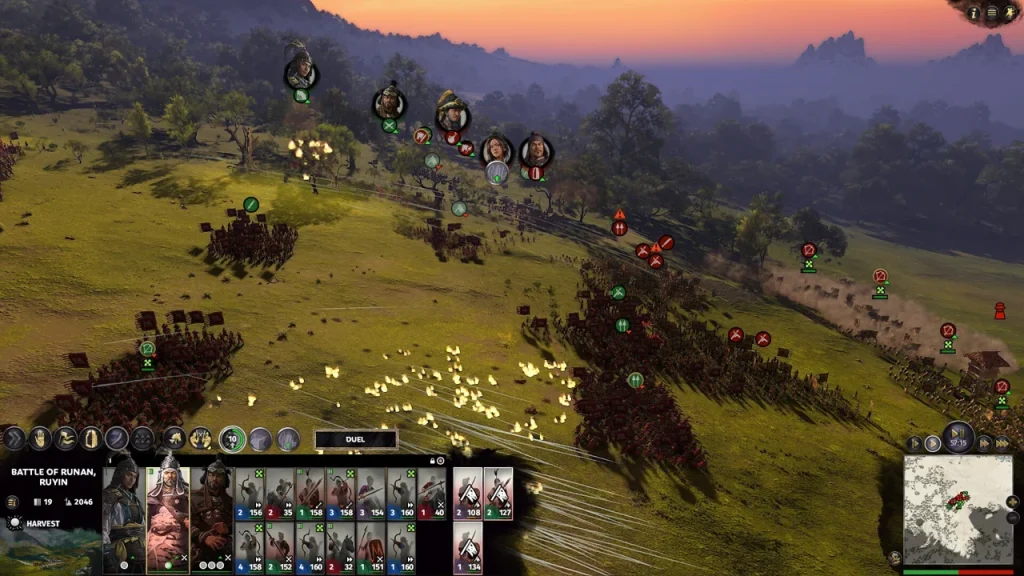
TL;DR: Choose Total War Three Kingdoms Records vs Romance mode mainly by the general-combat model you prefer. Romance gives individual heroes, powerful character abilities and organized duels. Records puts generals in bodyguard units and emphasizes managing them alongside the rest of the formation. Select the mode before beginning the campaign. Keep both choices grounded in unit roles, fatigue and battlefield position; the hero model changes decisions without making the wider army irrelevant.

Romance is the natural choice if you want legendary characters to play a prominent direct role in battle. Records suits a campaign where you prefer general-led units and a more conventional army-combat presentation. Neither choice removes the need to manage your territory, economy or relationships.
On this page
Total War Three Kingdoms Records vs Romance mode: choose before the campaign
Creative Assembly’s 2018 Classic Mode announcement explains the two inspirations: the historical Records of the Three Kingdoms and the later Romance of the Three Kingdoms epic. That announcement used the pre-release Classic Mode name for the history-oriented option.
For the released game’s practical differences, the Gamepressure mode guide, updated May 27, 2019, describes Records and Romance and their selection during campaign setup. Its mechanics are dated third-party evidence, while the publisher announcement establishes the source-material distinction.
After selecting your leader, inspect the mode control during campaign setup and read the descriptions. Confirm the intended option before starting. The guide states that a running campaign does not switch between the two through that normal setup procedure.
Choose according to the kind of battles you want to manage over the campaign, not only the name that sounds more appealing. A player who enjoys character abilities may prefer Romance; someone who wants the general represented through a bodyguard unit may prefer Records.
Consider where you want to spend attention during a fight. Romance can ask you to track a character’s abilities and an organized duel while the formation continues battling. Records directs that attention toward the general bodyguard’s position and condition as part of unit combat. Both can require active control, but the tasks differ. If you dislike monitoring individual confrontations, that is a practical reason to favor Records; if those confrontations are the part you most want to manage, Romance matches that preference.
1. Compare single heroes with general bodyguards
In Romance, the mode guide describes generals as individual battlefield units with heightened combat capability. They can intervene directly in a fight and use abilities that affect enemies or support allies. Assess each character’s actual skills rather than assuming every general fills the same combat role.
In Records, a general fights with a bodyguard unit. You manage that unit’s soldiers, position and condition alongside the rest of the army. A dangerous charge into an unsuitable target can cost the bodyguard even when the general has an impressive campaign reputation.
This changes how you assign battlefield tasks. A Romance character may perform a role through personal combat or an available ability. A Records general must be evaluated as part of a unit engagement, including the route, target and exposure of its accompanying soldiers.
Do not assume a bodyguard unit is expendable or inherently weak. Inspect the actual unit, remaining strength and matchup. The practical point is that the general’s participation follows a different combat model, not that every Records general should be kept inactive.
Equipment also needs to be interpreted in context. The dated guide describes character equipment in both modes, with different practical importance under their battle models. Read what the item changes before assuming an improvement affects the whole army equally.
When comparing two items, separate a character attribute change from an effect described for units or the army. The general’s visible equipment is only part of the battle role you are evaluating.
2. Understand abilities and the duel distinction
Romance’s character abilities are a major part of its battle presentation. Some skills help personal combat, while others weaken opponents or support nearby troops. Review the actual ability and its conditions before planning an attack around it.
The mode guide and Gamepressure duel guide describe organized one-on-one challenges between Romance generals. A duel can occupy or remove an opposing threat while the rest of the army continues fighting.
That system is a tactical commitment rather than a free opportunity. Your own general becomes involved in the confrontation, and withdrawing or intervening has consequences described by the dated guide. Compare the matchup and the army’s needs before accepting.
Records does not provide the same manual challenge because its generals fight in bodyguard units. An attack against an enemy general’s bodyguard is ordinary unit combat, so use the relevant unit matchup and support instead of expecting the Romance challenge procedure.
Avoid importing a Romance ability sequence into Records without checking what is available. The useful lesson is to redesign the task around the current unit and controls. A famous character name does not carry every Romance tactic into the other mode.

3. Adapt movement, fatigue and support
The dated mode guide describes a stronger practical fatigue concern in Records than in Romance. Treat that as a qualitative comparison. It does not justify a universal battle duration, fixed speed ratio or claim that fatigue can be ignored in Romance.
In either mode, examine the units’ current condition after movement and fighting. The Gamepressure starting guide warns against long movement exhausting units before contact. Preserve enough condition for the battle role you want them to perform.
For Records, plan a general bodyguard’s route with the same care as another important mounted unit. Avoid a crowded approach or prepared anti-cavalry frontage unless the actual unit and support make the engagement sensible.
For Romance, a powerful hero still needs a useful target and a manageable exposure. Sending a general far ahead of the army can leave it fighting without the support needed for the situation. A character’s available abilities are tools, not a guarantee against every opposing force.
Keep your infantry, ranged units and cavalry working together. Protect vulnerable missiles, choose appropriate targets and watch morale. The mode comparison’s broad suggestion that tactics matter less in Romance is not a sound reason to abandon those tasks.
4. Separate battle differences from campaign planning
The official manual presents the game’s campaign as statecraft, expansion, diplomacy, construction and character management alongside real-time battles. Selecting a battle model does not give you a reason to neglect those campaign responsibilities.
Evaluate the mode for how you want to fight; evaluate the campaign faction for its actual position and mechanics. A leader’s special system, starting date or downloadable-content rules are separate questions from whether its generals appear as Romance heroes or Records bodyguards.
Retinues remain important to army planning. The manual describes armies organized around generals and their units. Even when a Romance hero can influence a battle strongly, its recruitment and upkeep decisions still sit within a larger army and economy.
Do not infer that choosing Records removes important characters from the campaign or that choosing Romance makes diplomatic relationships predictable. The setting’s character-driven campaign is broader than the model used for a general on the battlefield.
Check faction or mod descriptions separately when they change research, recruitment or other systems. This comparison does not claim every campaign rule or downloadable-content feature is identical between all possible configurations.
5. Work the same battlefield task in both modes
Assume your infantry is holding the center while enemy ranged troops attack from an exposed side. You have a general available nearby and another unit able to protect your own missiles. These are hypothetical conditions for comparing the same task.
In Romance, inspect whether the general’s personal combat and available abilities suit reaching the exposed enemy. Check nearby opposition and the route before committing. If an enemy challenges the general, decide whether accepting would help or distract from silencing the ranged unit.
In Records, inspect the general bodyguard as a unit. Compare its condition and the target, then coordinate the approach with your infantry or other cavalry. Avoid turning the attack into an unfavorable fight against an intercepting anti-cavalry unit.
In both versions, review what happens after contact. Has the enemy stopped firing, is the attacking force trapped and does the center still hold? The different general model changes how you execute the task, while the battlefield objective remains clear.
Now change the assumption so that prepared polearms guard the route. Neither mode makes a direct attack automatically sensible. Seek a better angle or use another unit and preserve the general for a task it can perform effectively.
Make the initial choice with a clear expectation
Before committing to a long campaign, use an available battle setup to examine the mode and unit model you intend to play. Read the general’s controls, abilities and unit information. These are suggested familiarization steps, not claimed personal playtest results.
Record the mode with any tactics you save for later. Advice about a Romance duel or hero ability should not be copied into a Records battle without revisiting its assumptions.
Records and Romance questions
Which mode is better for character-centered combat?
Romance emphasizes individual heroes, abilities and organized duels. Check the character’s actual role before expecting it to dominate every fight.
Does Records remove generals?
No. The checked guide describes generals fighting with bodyguard units. Their position, condition and survival remain important.
Can I normally switch modes during the same campaign?
The dated guide says selection happens before starting and requires a new campaign to change through normal setup. Choose carefully at the beginning.
Find related lessons in the Three Kingdoms game hub and strategy game guides.
Sources and further reading
- https://steamstore-a.akamaihd.net/news/externalpost/steam_community_announcements/2451533424638188945
- https://www.gamepressure.com/total-war-three-kingdoms/romance-and-records-modes/zdc43c
- https://www.gamepressure.com/total-war-three-kingdoms/duels/z2c47d
- https://www.feralinteractive.com/en/manuals/threekingdomstw/latest/linux/
- https://www.gamepressure.com/total-war-three-kingdoms/starting-tips/zec3e3
Keep exploring
Total War Rome 2 vs Total War Three Kingdoms: territory or characters?
Choose ROME II for classical civilizations and empire development; choose THREE KINGDOMS for Chinese warlords and relationships that connect statecraft with battle.
Total War Three Kingdoms vs Crusader Kings 3: battles or heirs?
THREE KINGDOMS fits direct tactical battle command; Crusader Kings III fits a ruling house whose playable heirs carry its story forward.
Total War Three Kingdoms vs Total War Shogun 2: heroes or clans?
THREE KINGDOMS emphasizes heroic characters and Guanxi; SHOGUN 2 puts generals and agents inside a Japanese clan-unification campaign.