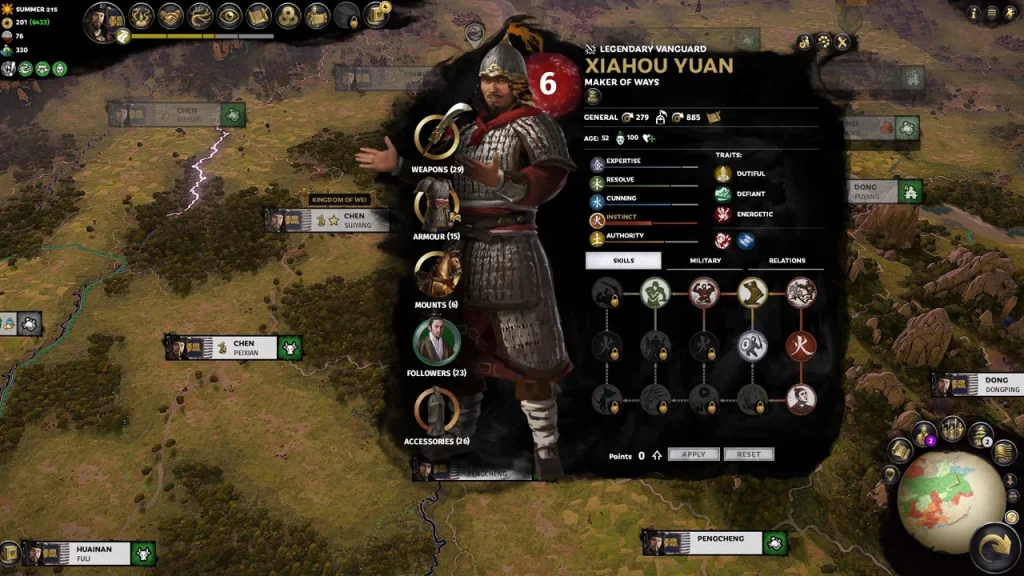
TL;DR: Total War Three Kingdoms retinue composition starts with the army’s job, then the generals who can support its required units. The official manual allows up to three generals, each commanding a retinue of up to six units. Build complementary functions, such as a holding line, ranged support and mobility, rather than treating every six-unit group as an independent all-purpose army.
Match units to their general’s Wu Xing role and relevant benefits, then check what the combined army lacks. Six occupied slots do not establish a useful retinue, and three individually attractive generals do not automatically create a balanced force.

Updated November 9, 2026. This is a source-based guide to Total War: THREE KINGDOMS, using the official Feral manual. It does not claim personal gameplay testing. Numerical examples are explicitly hypothetical; they are not current item statistics or guaranteed campaign outcomes.
On this page
Total War Three Kingdoms retinue composition: plan before recruiting
Write down the army’s immediate task: defending a settlement, fighting an open-field opponent or supporting another force. Select the generals and identify the troop roles available through their retinues. Recruit the unit type that answers a gap in the whole army before adding more of a role you already cover.
The official manual’s Armies and Retinues section states the three-general, six-units-per-retinue structure and connects it to Wu Xing. Its examples distinguish water-associated bows and crossbows, fire-associated shock cavalry and wood-associated spears or polearms. Those examples are a framework for complementary roles, not a universal build order.
1. Count roles across the whole army
Start by identifying which units will hold contact, which will support from range and which will move around the fight. An army with plenty of missile units but little protection can have a different problem from one with infantry that cannot pressure enemy ranged troops.
Count those roles across all retinues. You do not need every general’s six units to contain the same miniature combination. Specialization can make the combined army easier to organize if another retinue supplies the support it needs.
Consider the expected battlefield. A unit intended to move around an open flank has a different job from one defending a cramped approach. Composition should support the army’s current task rather than copy an open-field example into every settlement fight.
Leave space in the plan for what you actually lack. If the frontline is already sufficient but the force has no useful ranged support, the next recruit should answer that problem. Filling a free slot with another familiar infantry unit can preserve the original gap.

2. Select generals for the retinues they support
Compare a general’s element, skills and available troop choices with the role you want. The manual recommends tailoring retinues to their general’s Wu Xing element to improve unit potential. A famous warrior is not automatically the best leader for every group.
Read the scope of a relevant benefit. An effect for a particular unit type or retinue should not be assumed to apply to every soldier in the army. Place the benefiting troops with the general who actually supplies the effect.
Use the recruitment options of the selected character when building the plan. The catalog or another general’s roster does not prove that this retinue can recruit the same units. Faction, campaign variant and progression can affect your practical choices.
Also consider satisfaction. The manual connects character departure with military losses, so a retinue built around a valuable officer needs a retention plan. Selecting a useful general and then ignoring an advancement problem can undermine the composition you intended to preserve.
3. Use Wu Xing as a role framework
Water-associated missile troops can provide ranged pressure, while the manual uses fire-associated shock cavalry as an example of a target they can threaten. This does not mean bows solve every cavalry encounter. Range, protection and the current engagement still matter.
Wood-associated spears and polearms provide another part of the structure. The manual also says a water general can give wood units access to formations that improve defensive potential. General element and unit element therefore interact; they are not simply a rule that every troop must share its leader’s color.
Compare formations or benefits you have actually unlocked before relying on them. The source’s formation example explains a relationship, not a guarantee that every selected general and unit combination has every defensive formation immediately available.
Keep unit roles separate from hero combat advice. The manual describes powerful fire generals and weakening effects from water generals, but this guide’s army example does not depend on a hero duel. Do not transplant Romance ability-based tactics into a Records battle without accounting for the mode’s general behavior.

4. Build a complementary three-retinue example
Here is an illustrative eighteen-unit plan, conditional on the selected generals being able to recruit the stated categories. Give the first retinue six frontline infantry. Give the second four missile units and two additional legal supporting troops. Give the third four mobile units and two troops that cover the remaining gap.
The example uses six slots per general but is not a claimed optimal build. Its purpose is to keep a line in place, supply ranged pressure and preserve a mobile response. The two flexible groups should be chosen for the actual enemy and battlefield rather than filled automatically.
If the opponent has substantial cavalry pressure, review the line’s ability to handle it and whether the supporting troops need to strengthen that role. If the expected fight is confined, reconsider how much of the mobile retinue can usefully perform its intended job.
For a smaller early army, apply the same logic without filling all eighteen slots. A useful partial force can still have a recognizable line and supporting role. More occupied slots do not compensate for unaffordable upkeep or units that duplicate a function you do not need.
5. Recruit the missing function before the expensive upgrade
Select the relevant general and recruit into the intended retinue. Confirm that the new unit belongs to the group whose role and benefits you planned around. An available recruitment option is useful only when it improves the army’s current structure.
Prioritize an absent function over a marginal upgrade to a role already covered. If the army has no ranged support, buying a more expensive version of an existing frontline unit does not answer that omission. Define what the recruit will do before committing the money.
Compare recruitment and ongoing upkeep with your campaign finances. The manual’s Sun Jian example includes Heroism reducing these costs, which shows that faction circumstances can matter. Do not use one faction’s affordability as a universal budget for another.
Keep the force’s actual strength in view. A recruited or damaged unit’s presence in the list does not establish that it is ready to perform at full capacity. Plan the next action around the soldiers available, rather than counting unit cards alone.

6. Deploy by function while preserving retinue logic
On the battlefield, arrange the holding troops, missile support and mobile elements for their jobs. A retinue is a command relationship in the army structure; it does not force every troop in that retinue to stand next to its general’s portrait group during deployment.
Use battlefield groups to make the intended functions easier to select. The official manual lists grouping and unit-type selection controls. A functional group can help you move the line or support troops consistently even when the units belong to different generals.
Protect the role that enables another role to work. Missile troops need a useful firing opportunity and protection; mobile troops need somewhere relevant to move. Composition and deployment should support each other rather than assume a good recruitment list guarantees a good fight.
If a general’s benefits are position-dependent or tied to an ability, respect that actual scope. Do not assume all benefits are permanent army-wide effects. This guide does not invent an aura radius or ability duration for a named character.
7. Diagnose a defeat before rebuilding everything
After a battle, identify whether the missing function or the execution failed. A line that collapsed before support could act suggests a different problem from mobile units that had no usable space. Record the event you can explain before choosing replacement troops.
Look at losses by role and the opponent’s pressure. If the force lacked protection against a particular threat, change the relevant retinue. If the required role was present but placed poorly, adjust deployment instead of paying for a completely new army.
Revisit the generals when progression changes their useful options. A new troop choice or relevant skill can justify a different retinue arrangement. Keep the comparison tied to the army’s task rather than replacing every older unit simply because a later option appeared.
Use the Three Kingdoms game hub and strategy guide archive for adjacent campaign lessons. End the review by naming the next missing function, the general who can support it and the money needed to field it.
Questions about retinue composition
How many units can a general command?
The official manual describes a retinue of up to six units per general and an army with up to three generals. Treat this as the normal structure explained by the source; inspect faction or DLC-specific alternatives before applying it universally.
Should all six units match the general’s element?
Use element alignment as a starting point, then read the actual benefits and recruitment choices. The manual’s water-general and wood-unit formation example shows that useful combinations can cross element categories.
Is the eighteen-unit example a best build?
No. It is a conditional illustration of complementary roles, not a tested ranking. Change the flexible slots for the selected opponent, legal recruitment pool, battlefield and budget.
Can I use Romance hero advice in Records?
Keep mode-specific hero behavior separate. The retinue plan here is based on troop functions and general-supported units, not solo hero duels or special ability timings. Adapt any character-combat advice to the mode actually selected.
Sources and further reading
Keep exploring
Total War Three Kingdoms vs Total War Shogun 2: heroes or clans?
THREE KINGDOMS emphasizes heroic characters and Guanxi; SHOGUN 2 puts generals and agents inside a Japanese clan-unification campaign.
Total War Three Kingdoms vs Crusader Kings 3: battles or heirs?
THREE KINGDOMS fits direct tactical battle command; Crusader Kings III fits a ruling house whose playable heirs carry its story forward.

Total War Warhammer 3 vs Total War Three Kingdoms: who should lead?
Pick WARHAMMER III for fantasy race and lord identity; pick THREE KINGDOMS for Chinese empire strategy shaped by heroic characters and relationships.