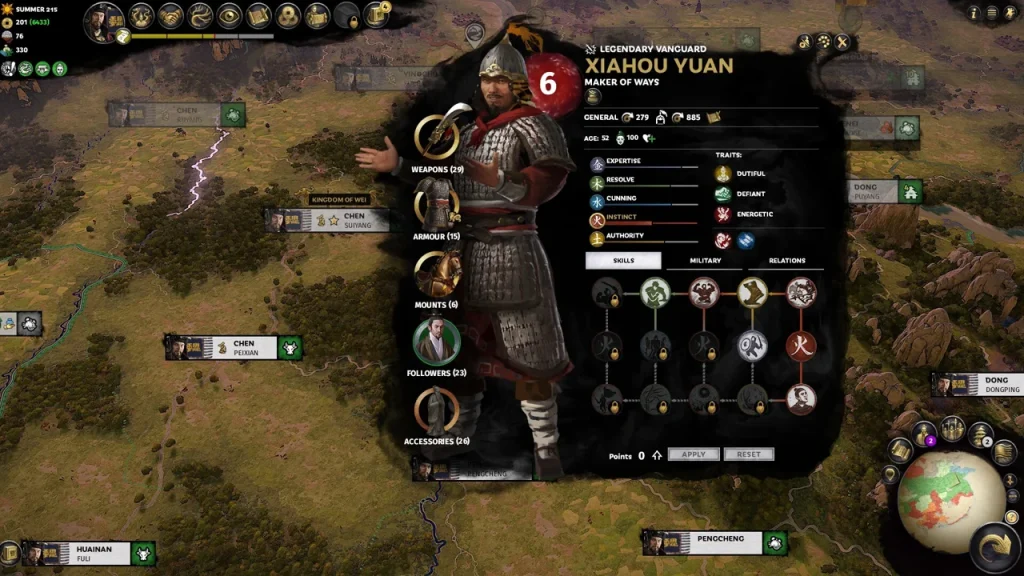
TL;DR: Total War Three Kingdoms spies and infiltration begin with an eligible character entering a rival’s recruitment pool. Hiring is not guaranteed. Once the rival employs the agent, the position obtained determines which operations become available, while Cover and Undercover Network resources limit what you can do. Choose a target worth the waiting time, preserve the agent’s loyalty and compare gathering information with spending resources on sabotage.

Do not plan an immediate destructive operation simply because you deployed a spy. Recruitment, appointment and resource accumulation are separate stages. The practical approach is to prepare for the position your agent actually receives, rather than assuming the rival will provide the role you hoped for.
On this page
Total War Three Kingdoms spies and infiltration: define the target
The official manual’s Undercover Network section describes spies entering a rival’s recruitment pool and potentially becoming governors, generals or heirs. It distinguishes feeding back information from stronger subterfuge made possible by an established network.
Choose the faction and the problem you want espionage to address. You might need information about a rival’s resources, want to weaken a force before a campaign offensive or seek influence inside its administration. These objectives require different positions and different levels of patience.
Compare the target’s likely importance with the time available. A faction you expect to eliminate immediately may not justify a deployment that depends on future recruitment. A durable rival with territory you will contest later gives the infiltration process a clearer purpose.
Keep a conventional plan for the same objective. If an army must be defeated soon, prepare your own military response. Espionage can complement that operation, but a plan that requires an unconfirmed appointment on a specific turn is unreliable.
1. Select an eligible agent and protect loyalty
Open the Undercover Network through the campaign’s eye control and examine available positions and candidates. The Gamepressure espionage guide, updated June 5, 2019, describes eligible characters carrying an eye indicator and the deployment list identifying available agents.
Check the character’s suitability as well as eligibility. Its level, skills and class can affect its usefulness as a recruit to the rival. The guide emphasizes that a desirable candidate may have a better opportunity to be hired, but it does not guarantee recruitment.
Decide whether you can spare that character from your own army or administration. Sending a useful general away has an opportunity cost even before an operation succeeds. A strong agent may be valuable inside the rival, but its absence can also weaken your immediate campaign.
Review satisfaction and relationships before deployment. The official manual warns that a spy can come to prefer the enemy faction and defect or return as a double agent. Treat loyalty as a continuing concern, not an assumed property of every eligible character.
Do not use a fixed satisfaction number as an invented guarantee against betrayal. Check the character’s actual status and relevant descriptions, then reassess while it operates away from your court. Eligibility and trustworthiness answer different questions.
2. Deploy into the recruitment pool and wait for employment
In the Undercover Network, choose an available position, select the eligible character and target faction, then inspect the deployment before confirming. Gamepressure describes the plus control, character list and Deploy action. Follow the controls shown by your campaign if bindings or presentation differ.
After sending the agent, monitor its actual status. The official manual describes the rival potentially recruiting the character from its pool. Deployment therefore does not directly appoint the agent as an enemy general or administrator.
Distinguish waiting for recruitment from being employed without the desired appointment. A recruited court character has entered the rival’s faction, but that is not the same as governing the commandery you want to influence or commanding the army you want to weaken.
Use available intelligence while waiting, but do not present limited early information as complete knowledge of every enemy army. The Gamepressure guide describes resource and faction information during the process. Review the information actually exposed in your network screen before making a campaign decision.
If deployment ends without useful employment, inspect the returned character and current target situation before sending it again. The dated guide describes unsuccessful agents returning after a period, but this article does not assert a universal return timer or a guaranteed way to force recruitment.

3. Match operations to the position obtained
Once the agent is employed, open its available actions and read the current role. Gamepressure divides operations into court actions, administrator actions, general actions and family subterfuge. Those categories show why appointment matters.
A court appointment can provide opportunities to affect the rival’s internal relationships or espionage protection. An administrator position creates options associated with its commandery. A general position creates opportunities tied to the army the agent serves. Inspect the actual menu before choosing the operation.
The official manual also allows agents to reach more influential roles, including heirs, and mentions civil-war possibilities for sufficiently powerful infiltration. Treat those as later potential outcomes, not routine actions every newly deployed spy can perform.
Identify the target of the operation precisely. Weakening one army is different from affecting one commandery or the rival’s court. If your military offensive is aimed at a particular settlement, an action elsewhere may consume resources without addressing the immediate problem.
For a local defensive operation, compare the affected garrison with any field army also defending the settlement. Reducing one component does not establish that the whole battle is now easy. Reopen the military situation after the operation and check the force you will actually face. This is a planning recommendation: it avoids treating the spy’s local effect as a substitute for scouting or assuming that walls, reinforcement routes and enemy characters disappear with the garrison change.
Read whether the agent currently has more than one relevant role. The dated guide notes that an administrator can also serve as a general. Do not assume every appointment is exclusive, but use the roles actually displayed to determine the available options.
4. Compare information gathering with sabotage
Gamepressure identifies Cover and Undercover Network as espionage resources. It describes Cover in terms of the agent’s integration into the enemy faction and the network as its clandestine connections. Read both available amounts before attempting an action.
Inspect the operation’s resource cost, stated effect and any risk or follow-up prompt. Stronger infiltration is not permission to spend blindly. After an expensive action, the resources available for another operation or response may be reduced.
Information can be the more useful result when you are still deciding where to fight. Knowing the rival’s situation may help allocate your armies without exposing the agent through a premature operation. Choose sabotage when its verified effect supports a concrete campaign action.
The official manual mentions poisoning supplies as one possible subterfuge. If such an operation is available, connect its target and timing with your military plan. Do not promise a fixed casualty total or assume that damaging supplies automatically defeats the enemy army.
Check the result after acting. Confirm which faction, army or commandery changed and whether the intended effect occurred. If another operation would be needed, reassess the remaining resources and your agent’s position rather than treating the first action as a reason to keep spending.
5. Work a hypothetical administrator-versus-general infiltration
Assume you plan to contest an enemy frontier several turns from now. Your spy has been hired, but the appointment could be either administrator of a nearby commandery or general in an army operating elsewhere. These are invented conditions illustrating how the plan changes.
If the agent becomes administrator of the relevant commandery, inspect the available local actions and their costs. An operation affecting that commandery’s defensive situation may fit the approaching offensive. Confirm the actual effect before committing your army on the assumption that the settlement has been weakened.
If the agent instead commands an army far from the target, its military operations may not help that immediate siege. Keep gathering information or reconsider the offensive timetable. Do not invent the ability to transfer the agent directly into the desired appointment.
In either case, compare current Cover and network resources with the intended action. If resources are insufficient, waiting can be useful when the rival remains a relevant target. If the agent’s loyalty or situation becomes concerning, inspect available recall or recovery options before escalating.
The choice depends on the role actually obtained. The same character can support a different plan after its appointment changes, but an espionage objective should not require the rival to follow a script you cannot control.
Monitor the agent after useful infiltration
A successful appointment is the start of ongoing management. Review the agent’s status, resources, satisfaction and available operations after relevant campaign developments. The official manual’s warning about defectors and double agents remains important even after the network has produced useful intelligence.
Read the interface before attempting recall, extraction or a risky action. This guide does not provide an unverified universal escape procedure or detection formula. Use the options and consequences shown for the agent’s current situation.
Espionage questions
Does deployment guarantee enemy recruitment?
No. The agent enters a recruitment process. Monitor employment and appointment before relying on role-specific operations.
Can every spy affect an enemy army?
Available actions depend on the role obtained. Inspect the agent’s actual military appointment and operation menu.
Is sabotage always better than intelligence?
No. Information can guide deployment without an expensive operation. Choose sabotage when its effect supports a specific, timely objective.
Continue with the Three Kingdoms game hub and strategy game guides.
Sources and further reading
Keep exploring
Total War Rome 2 vs Total War Three Kingdoms: territory or characters?
Choose ROME II for classical civilizations and empire development; choose THREE KINGDOMS for Chinese warlords and relationships that connect statecraft with battle.
Total War Three Kingdoms vs Crusader Kings 3: battles or heirs?
THREE KINGDOMS fits direct tactical battle command; Crusader Kings III fits a ruling house whose playable heirs carry its story forward.
Total War Three Kingdoms vs Total War Shogun 2: heroes or clans?
THREE KINGDOMS emphasizes heroic characters and Guanxi; SHOGUN 2 puts generals and agents inside a Japanese clan-unification campaign.