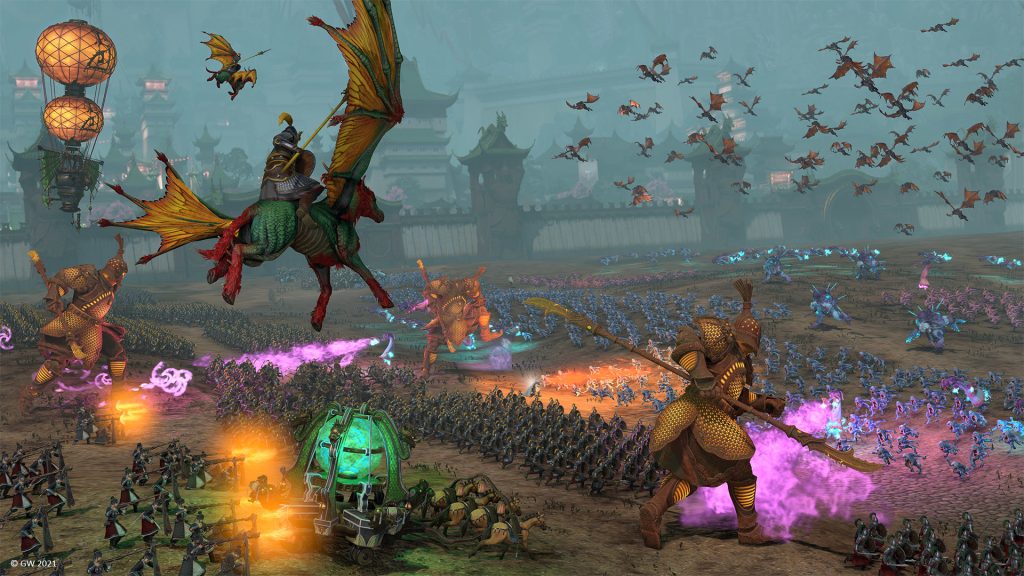
TL;DR: Total War Warhammer 3 Cathay Harmony uses two separate systems: province-level building balance on the campaign map and Yin/Yang support between units in battle. Balance buildings within each province, rather than recruiting spare lords to fix a faction-wide meter. In combat, keep compatible support near the units that need it without blocking their fire or exposing the support unit.
For established provinces, a balanced building plan is a sensible default. Temporary Yin or Yang specialization needs a purpose and a check of its net benefits and penalties. On the battlefield, inspect each unit’s Harmony ability and arrange the army around useful pairs; the campaign meter does not tell you whether a particular formation is receiving its battle effect.

Creative Assembly moved campaign Harmony to provinces in Update 4.0. Hotfix 4.1.1 then added escalating disharmony penalties, and Update 8.0 introduced additional battlefield support options. Those changes matter: an early guide recommending character recruitment to repair global Harmony, or claiming provincial disharmony has no drawback, is describing an earlier system.
On this page
Total War Warhammer 3 Cathay Harmony: audit one province
Select a province and inspect its Harmony state before planning new construction. Under the published Update 4.0 rules, each province has its own value. Buildings in settlements belonging to that province influence it; characters and technologies do not enter that building balance.
Review every settlement in the province, not only its capital. A building in a minor settlement belongs to the same provincial decision as a building in the main city. Balancing the capital alone can leave the province leaning toward one side because of construction elsewhere.
Identify which completed buildings contribute Yin, which contribute Yang, and what the proposed upgrade or conversion will change. Work from their actual displayed contributions. This guide does not assume every building tier contributes the same amount, so adding two buildings does not automatically mean adding two identical points.
Finally, separate what exists now from what is still being built. A queue is a plan, while the active province effects describe the current state. If the queue will move the province away from balance, decide whether the intervening benefit is worth the temporary change before committing the treasury.
Stop using spare characters as balance repair
Recruiting another lord or hero is not the published solution to provincial Harmony. Creative Assembly specifically removed character and technology contributions when it moved the mechanic from a faction resource to province-level building composition.
That changes the cost of a mistake. A needless character adds another campaign expense without fixing the local meter. Choose a new character because you need another army, an agent, or a particular battlefield role. Repair the buildings of the affected province when the problem is the province’s balance.
Likewise, do not postpone useful research merely because an old guide says completing a technology will change global Yin or Yang. Update 8.0 reorganized Cathay’s research into Military and Provinces trees. Pick the effects that serve your army or settlements, then manage building Harmony separately.
This separation also helps diagnose a surprise. If recruiting a character coincides with a provincial change, inspect construction and captured settlements first. Timing alone does not establish that the character caused it. The balance needs a building-level explanation under the reworked rules.
Compare a balanced province with deliberate specialization
The Update 4.0 developer explanation allowed a province to specialize in Yin or Yang, or remain balanced. It described specialization as providing more transient benefits, with a developed province eventually settling into balance. That is a planning direction, not a guarantee that every unbalanced state is equally profitable.
Hotfix 4.1.1 matters when making that comparison. It introduced escalating penalties based on distance from Harmony, mirroring benefits from the strong side and making the first disharmony tier somewhat less punitive. Read the negative effects alongside the bonuses before deciding to push farther.
Use the province’s immediate job to make the decision. A province building toward a needed recruitment option has a different short-term task from a quiet interior province that should fund the next war. Specialization is useful only when its current package helps that task enough to justify the accompanying costs.
For a developed province with no urgent transition, plan a balanced composition that preserves the buildings you actually need. Balance is not a reason to fill valuable slots with irrelevant structures. Compare a useful conversion or a complementary building in another settlement before spending on an otherwise unnecessary chain.
Plan construction as a sequence
Choose the essential building first: the recruitment access, income, or other province function you intend to gain. Then inspect its Harmony contribution and find a complementary change if the intended final state is balanced. This produces a province plan instead of a series of repairs after each building finishes.
An example can be simple without prescribing a universal build order. Suppose one planned construction moves your province toward Yin, while another available choice moves it back toward the displayed center. Check both buildings’ effects, costs, and completion times. Choose the pair only if both have a useful role in that province.
If the balancing option finishes later, evaluate the temporary disharmony explicitly. The important questions are how many turns the province will spend in the new state, which effects apply during that interval, and whether you can afford the plan. A final balanced screenshot does not describe the entire transition.
Recheck after an upgrade or conversion completes. A plan that relied on a building you canceled, lost, or replaced is no longer the same plan. Update 8.0.1 specifically fixed Conscription-chain upgrading and conversion between Yin and Yang; a malfunctioning chain should not be worked around by recruiting pointless lords.

Audit captured provinces before expanding the building queue
A newly acquired settlement can change the buildings you control inside a province. Inspect the captured structures before applying the same queue used in your original territory. The province’s resulting composition may require a different complementary building or conversion.
Decide what to keep based on the province’s role. A border province intended to support a local offensive might need recruitment, while an interior one may be better suited to funding armies elsewhere. Treat Harmony as one part of that decision, with building utility, available slots, and treasury alongside it.
Avoid repairing a small temporary imbalance by demolishing a key recruitment chain just before the army needs replacements. Compare the immediate military cost with the provincial penalty. A useful repair is one that leaves the province able to perform its actual job.
After territorial changes, repeat the same short audit: current buildings, current state, queued changes, intended final role. Because Harmony is provincial, you can solve this locally. You do not need to rebuild unrelated provinces simply to produce one perfect faction-wide total.
Read battlefield Harmony on the unit, not the province panel
Battle Harmony is a separate tactical system. Inspect the unit’s Yin or Yang attribute and Harmony ability before deployment. Use the displayed activation conditions and range to position supporting units. A province being balanced does not demonstrate that a unit’s local battle effect is active.
Arrange compatible formations close enough to support one another while preserving their jobs. A missile formation still needs a usable firing lane. A supporting unit that blocks shots or sits directly in an enemy charge route can make the formation worse even while helping activate Harmony.
Start with a simple arrangement that you can monitor: a holding formation, a firing formation behind or beside it, and a clear response to an enemy flank. Inspect the actual ability state once they settle into position. Adjust spacing when movement breaks the support relationship.
Do not chase the Harmony icon so aggressively that the army loses its formation. The tactical aim is useful fighting units receiving support, not an aesthetically perfect cluster. An artillery line, a mobile wing, and the center may need different nearby support arrangements rather than one packed group.
Use newer support options with their actual unlocks
Update 8.0 added Harmonic Anchoring to the Alchemist’s skill options. The published description says it lets the unit count as both Yin and Yang for activating Battle Harmony. That can make the character a useful support anchor, but it is an unlocked skill rather than a property to assume on every newly recruited Alchemist.
Inspect the character’s learned skills before building a plan around that effect. An unlearned skill cannot support your formation merely because an online guide lists it. Also consider the character’s other task, such as spell support, when deciding where the anchor should stand.
The same update changed the Sky Lantern toward a ranged-support role and described both Yin and Yang activation, similar to the War Drum. The following hotfix explicitly acknowledged an unresolved display issue for the Sky Lantern’s Yin classification. Avoid relying on one old icon or treating that announcement as proof that every displayed attribute is correct in every build.
Use the current unit’s ability and observed activation in your own battle to confirm the support plan. The Sky Lantern’s Eye of the Dragon was also described as improving nearby allied range, reload speed, and leadership, while being removed from the Sky Junk. Those are separate support effects; neither should be confused with provincial building balance.
Diagnose missing effects before rebuilding everything
If campaign Harmony looks wrong, check the province, the completed buildings, and any changed construction. Hotfix 5.2.3 fixed a display issue where adding Yin could show Harmony building effects as negative. Historical interface bugs are a reason to verify the effect list, not to assume the old global mechanic returned.
If battle Harmony disappears, select the affected unit and check its nearby support, ability conditions, and current position. A supporting formation that moved elsewhere is a different problem from a character lacking its intended skill. Resolve that local cause before rearranging the entire army.
If the setup depends on a new DLC character or unit, confirm ownership and unlocks. Race-wide free updates and paid character content are different parts of the release. The province system is not a reason to buy a specific lord pack simply because its release accompanied the rework.
Use the Total War Warhammer III guides hub for the next focused campaign task. For your next turn, audit one province and make one deliberate construction plan. For your next battle, test one support pair with clear firing space before extending that arrangement across the whole army.
FAQ
Do Cathay lords and technologies balance province Harmony?
No under the Update 4.0 provincial system. The developer notes say buildings within the province influence Harmony, while characters and technologies do not.
Is being unbalanced always harmless?
No. Hotfix 4.1.1 added escalating disharmony penalties. Temporary specialization needs a comparison of its complete benefits and drawbacks.
Does a balanced province activate battle Harmony?
Do not use the campaign meter to judge a unit’s tactical effect. Inspect that unit’s Battle Harmony ability and nearby compatible support.
Does every Alchemist count as both Yin and Yang?
Update 8.0 lists that effect under Harmonic Anchoring. Check whether the character has learned the skill before relying on it.
Sources and scope
- Update 4.0 Grand Cathay developer notes: provincial building-only Harmony and specialization rationale.
- Hotfix 4.1.1: escalating provincial disharmony penalties.
- Update 8.0 notes: Alchemist Harmonic Anchoring, support units, Cathay research, and commandments.
- Hotfix 8.0.1: Conscription conversion fix and explicit Sky Lantern classification ambiguity.
- Hotfix 5.2.3: Harmony display correction.
Sources and further reading
- https://store.steampowered.com/news/app/1142710/view/3641775142542410815
- https://store.steampowered.com/news/app/1142710/view/3873720583813470727
- https://store.steampowered.com/news/app/1142710/view/684128677863096799
- https://store.steampowered.com/news/app/1142710/view/4615714711226603571
- https://news.totalwar.com/wh3-update-800
Keep exploring

Total War Warhammer 3 vs Stellaris: battles or a galaxy to discover?
Choose WARHAMMER III for commanding fantasy armies; choose Stellaris for exploring a galaxy and shaping the society, technology and fleets of an empire.
Total War Warhammer 3 vs Total War Rome 2: fantasy or empire?
Choose WARHAMMER III for fantasy races and Legendary Lords; choose ROME II for classical empire building, politics and historical battles.
Total War Warhammer 3 vs Total War Attila: fantasy or survival?
Choose WARHAMMER III for fantasy races and Legendary Lords; choose ATTILA for late-antique survival, vulnerable territory and destructive warfare.