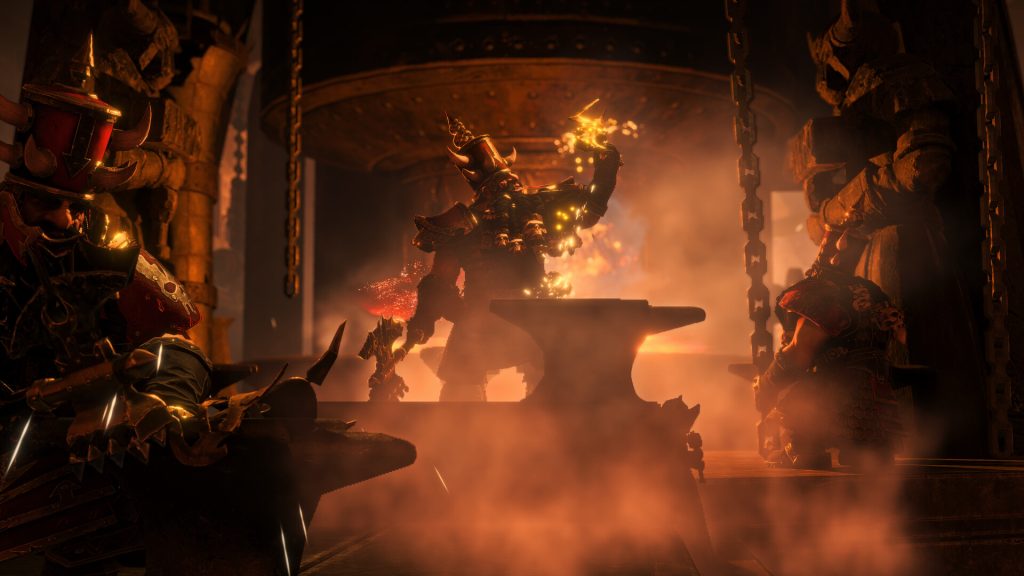
Total War Warhammer 3 Chaos Dwarf labor economy works as a production chain: battles supply Labour, Mining Outposts turn that workforce into Raw Materials, and industrial development supports stronger armies. Fix the weak link before adding another expensive project. A full treasury does not solve an understaffed outpost, and a large workforce does not automatically pay the army’s upkeep.
The official Forge of the Chaos Dwarfs description establishes this capture-and-production loop. The useful first question each turn is therefore specific: are you short of workers, construction resources, armaments, or money? These shortages need different answers.

On this page
Total War Warhammer 3 Chaos Dwarf Labor Economy: Read the economy as four separate accounts
Keep Treasury, Labour, Raw Materials and Armaments separate in your planning. Look at both the stockpile and the projected change. A large reserve can conceal a worsening production balance, while a small reserve can be acceptable when the next necessary purchase is already funded.
Treasury supports the ordinary cash expenses of your campaign. Raw Materials support the industrial expansion described in the official source. Labour belongs to the workforce feeding Mining Outposts. Armaments matter to the army-development side of the economy; the official Drazhoath introduction explicitly highlights his ability to generate them.
Start with one planned purchase, such as a building upgrade or the next military improvement. Read its actual currency requirements. Then work backward to the production that funds it. This prevents the common mistake of treating every new resource building as equally urgent.
Supply the outposts you have before opening more
Inspect the Labour panel province by province. Compare the workforce present with the workforce required by the production you have built. Look for a shortfall in an important established mining province before committing resources to a new one.
The game calls the resource Labour, even if you searched for “labor economy.” It represents the Chaos Dwarfs’ captive workforce. Victories can supply it, as the official description explains. Choose the relevant post-battle reward deliberately rather than automatically selecting money because the treasury number is easier to understand.
Allocate incoming Labour with a destination in mind. A province already contributing useful Raw Materials is a clearer candidate than a frontier region you cannot defend. Read any distribution and transfer controls in the installed panel before confirming; the cost and resulting allocation matter more than a remembered rule from an older guide.
Check Control alongside workforce demand
Open the province’s Control tooltip while reviewing its workforce. Identify the actual positive and negative effects, then inspect the Labour panel’s projected losses and output. Deal with the displayed problem rather than applying the same control-building order everywhere.
If a valuable province shows an unsustainable workforce trend, adding more captives repeatedly can conceal the underlying problem. Compare the cost of improving its local conditions with the cost of continually replacing what it loses. If the workforce is sufficient but output remains poor, inspect building effects and damage before sending another shipment.
Do not spend excess Labour merely because the interface offers an action that consumes it. First check the receiving province’s requirements and the consequences shown by the action. A short-term benefit becomes expensive when it removes the buffer needed for the next production cycle.

Build factories for an army plan
Decide which military capability you want before expanding the factory side of the economy. More industrial capacity is useful when it supports an intended purchase. It is less useful when it diverts Raw Materials from the mining development that must keep the wider system supplied.
Read the complete building effect, including its inputs, output and available upgrades. Compare the resulting production balance with your construction commitments. Queueing several industrial upgrades at once can make every individual purchase look affordable while leaving too little reserve to finish the sequence.
Use the Hell-Forge with the same discipline. The official DLC description documents schematics that apply bonuses to allocated units. Choose an improvement for units your army actually fields. A bonus to a unit family you do not recruit is a poor immediate use of the resources needed elsewhere.
Choose an expansion that feeds the chain
When considering another war, look beyond the nearest capturable region. Ask whether the route provides battles, a defensible production base and a way to support the army after it moves on. A successful campaign can feed industry; uncontrolled territorial expansion can also create a long line of provinces requiring attention.
Review convoy offers by the resource you receive, the resource you commit and the route’s risk. Compare the offer with your current bottleneck. A tempting exchange is not automatically helpful if it spends the reserve earmarked for an important building. Leave room for the army and production system to operate while the convoy is away.
Drazhoath’s documented industrial strengths and Zhatan’s association with Labour are reasons to read their faction effects carefully. They do not justify copying one lord’s starting construction order into every Chaos Dwarf campaign.
A practical end-of-turn check
Before ending the turn, identify one understaffed mining province, one production commitment and the army expense you must preserve. Correct the most consequential shortage first. If none is urgent, save the reserve for the next planned operation instead of buying another upgrade simply because it is available.
For the wider campaign, use the Total War Warhammer 3 game hub. The economy should supply your chosen army and route; it does not need to maximize every resource simultaneously.
Sources and scope
The official Forge of the Chaos Dwarfs store description supplies the workforce, mining and Hell-Forge overview. The official Drazhoath announcement supplies the industrial specialization. This guide uses those systems for a bottleneck-based planning method. It does not supply an independently verified current Labour-loss formula, convoy exchange table or exact building ratio; use the installed tooltips for those values. No played campaign or benchmark is claimed.
Sources and further reading
Keep exploring

Total War Warhammer 3 vs Stellaris: battles or a galaxy to discover?
Choose WARHAMMER III for commanding fantasy armies; choose Stellaris for exploring a galaxy and shaping the society, technology and fleets of an empire.
Total War Warhammer 3 vs Total War Rome 2: fantasy or empire?
Choose WARHAMMER III for fantasy races and Legendary Lords; choose ROME II for classical empire building, politics and historical battles.
Total War Warhammer 3 vs Total War Attila: fantasy or survival?
Choose WARHAMMER III for fantasy races and Legendary Lords; choose ATTILA for late-antique survival, vulnerable territory and destructive warfare.