On this page
Total War Warhammer 3 Ogre Camp Management: TL;DR
Total War Warhammer 3 Ogre camp management now revolves around Meat, recruitment access and planned relocation. Camps can be packed up and redeployed, and their buildings use Meat rather than Horde Growth. Feed a camp from a productive army, build the recruitment you actually need, and move the camp when the next front justifies the downtime.
An Ogre Camp is a development base, not a spare unit storage army. The released 6.0 rules prevent exchanging units between camps and field armies, and Meat transfers have directional restrictions. You need to arrange recruitment and construction around those limits rather than rely on older tricks that move an existing garrison into a field army.

This guide follows the official Ogre rework and subsequent fixes. The system applies to the Ogre Kingdoms racial framework; Golgfag’s contracts, Greasus’s treasury actions and Skrag’s offering bonuses create different priorities within it. Other systems are collected in the WARHAMMER III guide hub.
Give the camp a job before spending Meat
Choose whether the camp will serve the current front, develop your next recruitment tier, or remain a safer long-term base. A camp doing all three jobs badly can consume Meat while your army still lacks the troops it needs.
Start with the next army operation. If the field force must replace losses and add ranged support, prioritize the relevant recruitment chain and a location from which that army can use it. If your starting roster already handles nearby opponents, a more advanced building can be worthwhile. The deciding factor is the next recruitable capability, not the number of completed building slots.
Read the building requirements and resulting unit unlocks before constructing. With Horde Growth removed from camp progression, you are not simply waiting for a growth threshold to dictate every choice. Meat is the limiting resource. Spending it on a chain that does not help your active army delays the chain that would.
Keep a short camp plan: the next required upgrade, its Meat cost in your installed version, and the army that will supply it. That gives every sack or raid a purpose. Avoid developing several camps identically before you know whether you can keep all of them supplied.
Transfer Meat from armies to camps deliberately
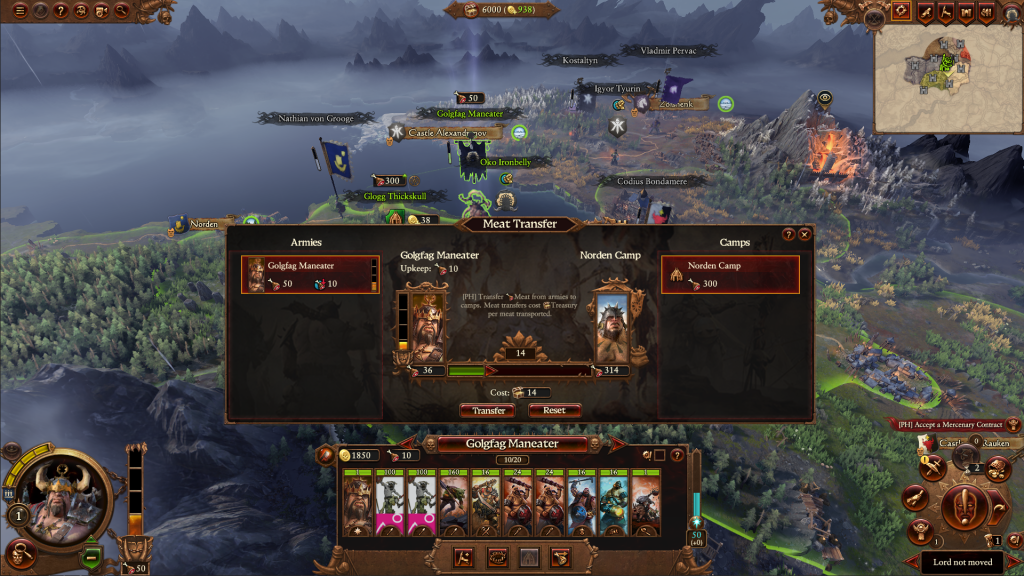
Use an army’s successful operations to fund camp construction. Sacking and raiding supply the development loop described in the rework: armies gather Meat, send it to a camp, and use the resulting recruitment improvements to undertake stronger operations.
The released 6.0 notes specify that Meat can move from forces to camps. It cannot move directly between forces or between camps. That restriction matters when you create a new base far from the army that has accumulated most of your resource. A large stockpile in another camp is not automatically available to the new one.
Before confirming a transfer, check the sending army’s remaining Meat and Hunger benefits. The reworked Hunger system scales army abilities and mass with Meat levels. Sending every available point into construction can improve future recruitment while weakening the force that must fight to refill the camp.
Inspect the transfer panel’s total treasury charge as well. The official preview shows a money cost alongside the Meat transfer. Treat the current panel as the authority for that charge. A transfer you can afford in Meat terms can still damage your treasury reserve if you ignore the second currency.
For example, keep enough Meat on the advancing army for its intended performance and send a measured amount toward one specific camp upgrade. After that upgrade finishes, recruit the needed units and reassess. This staged approach keeps the field force productive instead of converting its whole buffer into several speculative buildings.
Place the camp where recruitment will remain useful
Choose a location with an army route and a defensible purpose. The ability to relocate does not make position irrelevant. Moving too frequently creates resource costs and interruption exactly when the army wants replacements.
Look at the next several operations rather than only the nearest enemy settlement. A central base behind the route can support several battles before needing to move. A camp placed to chase every single capture will spend more of the campaign packing and redeploying.
Consider enemy approach routes and the protection you can actually provide. A distant camp with valuable upgrades becomes a separate obligation if the field army marches away. A location on a convenient recruitment route is less useful when a hostile force can reach it before you can respond.
Avoid treating every occupied settlement as a permanent expansion target. The rework frames Ogre settlements as strategic strongholds or disposable outposts, depending on your aims. A camp and a field force can support profitable operations without requiring you to hold every recently sacked region. Decide which territory secures the route and which merely extends your defensive burden.
Pack up only when the next front warrants it
Relocate when the next stage of the campaign makes the old base inconvenient enough to justify Meat expenditure and downtime. Prepare that decision before your army runs out of replacement access.
The camps can be packed up and redeployed, but they are not ordinary marching armies. Hotfix 6.0.3 reduced the documented redeployment period from five turns to three. Later modifiers or changes can alter what your interface presents, so check the actual completion time before committing.
Finish essential recruitment first, maintain a field army reserve, and decide where the camp will reappear. Then confirm the relocation cost and timer. If a siege or enemy counterattack is imminent, postpone a nonessential move or complete the army preparation while the camp remains available.
Do not start a move merely because the map now permits one. A safe established camp can remain valuable while an army temporarily operates farther away. Compare the return journey and recruitment inconvenience with the move cost and lost availability. Relocation should solve a logistical problem that persists, not answer a momentary desire to place the tent beside the army.

Recruit replacements instead of expecting unit exchanges
Plan recruitment through the camp’s available buildings. The rework explicitly says camps cannot exchange units with armies, so a camp garrison is not a collection of ready-made units you can drag into a field force.
When the army needs an upgrade, inspect the recruitment list, duration and costs. Maintain enough treasury to recruit the replacements after spending Meat on their building. Unlocking a stronger unit is only half the investment if you cannot afford to add it to the army.
Keep units that still perform useful roles. Replace a weak or redundant unit when the new recruit solves a clear battle problem, such as damage against armor or support for your melee line. Upgrading every slot at once can leave you paying for an army that exceeds the income its campaign route produces.
Camp Tyrants gained skill trees in the rework. Read their actual effects and recipients. A camp-related skill can improve the base, while another can affect its own defensive force. Do not assume every Tyrant skill strengthens the field army that recruits nearby.
Account for Offerings and your selected lord
Offerings to the Great Maw are toggled passive effects with increased Meat upkeep and a cooldown, rather than the earlier isolated ten-turn purchase. Add that continuing cost to the army’s Meat budget before promising a large construction transfer.
If the next section of the route has few easy opportunities to gather Meat, review active offerings. A bonus that helped win the last battle can become too expensive during several quiet turns. Read its cooldown before turning it off or assuming you can immediately reactivate it for another fight.
Skrag rewards active offerings through his Path of the Butcher system, including camp construction benefits in the published rework. Greasus instead has treasury-funded Tyrant’s Demands, and Golgfag’s mercenary contracts offer their own rewards and route priorities. These lord features modify the plan; they are not identical camp income sources available to every Ogre faction.
For Golgfag, consider whether the next client changes the useful camp position. For Greasus, leave money for the campaign actions you intend to use. For Skrag, compare the offering benefit with the recurring Meat burden. In each case the camp still needs a supplying army and recruitment purpose.
Troubleshoot unexpected camp movement
Hotfix 6.1.5 fixed a bug that moved camps after every battle and game load. That is a historical defect, not normal relocation behavior you should plan around.
If your camp changes location unexpectedly, verify your installed version and check mods before treating it as a feature. Keep a save from before the triggering battle or load. Report the precise sequence if you can reproduce it, and avoid spending more Meat on a relocation you did not initiate.
Frequently asked questions
Do Ogre Camps still need Horde Growth?
The 6.0 rework removed Horde Growth from camp development. Camp buildings require Meat instead.
Can I move Meat from one camp to another?
The released rules disallow direct camp-to-camp transfers and direct force-to-force transfers. Plan supply from forces into the camp that needs development.
Can a camp transfer its units to my army?
No. The reworked camps do not exchange units with armies. Use the available camp recruitment instead.
When should I relocate?
Move when a sustained new front makes the old recruitment base inconvenient enough to justify its cost and downtime. Recruit essential replacements first and check the actual redeployment timer.
Your next camp upgrade
Choose one unit capability your field army needs, identify the camp building that unlocks it, and budget both its Meat and the subsequent recruitment bill. Keep the supplying army ready to fight. Once the front moves for good, relocate the camp as a planned operation rather than an emergency reaction.
Sources and scope
The official 6.0 release notes supply the racial rules. The Golgfag developer article provides historical interface previews and lord distinctions; Hotfixes 6.0.3 and 6.1.5 supply released corrections. Preview values are not treated as universal current costs. No hands-on campaign or performance test is claimed.
Sources and further reading
- https://community.creative-assembly.com/total-war/total-war-warhammer/blogs/53-total-war-warhammer-iii-update-6-0-0
- https://community.creative-assembly.com/total-war/total-war-warhammer/blogs/38-omens-of-destruction-introducing-golgfag-maneater
- https://store.steampowered.com/news/app/1142710/view/538842566974505652
- https://store.steampowered.com/news/app/1142710/view/497196316182447186
Keep exploring

Total War Warhammer 3 vs Stellaris: battles or a galaxy to discover?
Choose WARHAMMER III for commanding fantasy armies; choose Stellaris for exploring a galaxy and shaping the society, technology and fleets of an empire.
Total War Warhammer 3 vs Total War Rome 2: fantasy or empire?
Choose WARHAMMER III for fantasy races and Legendary Lords; choose ROME II for classical empire building, politics and historical battles.
Total War Warhammer 3 vs Total War Attila: fantasy or survival?
Choose WARHAMMER III for fantasy races and Legendary Lords; choose ATTILA for late-antique survival, vulnerable territory and destructive warfare.