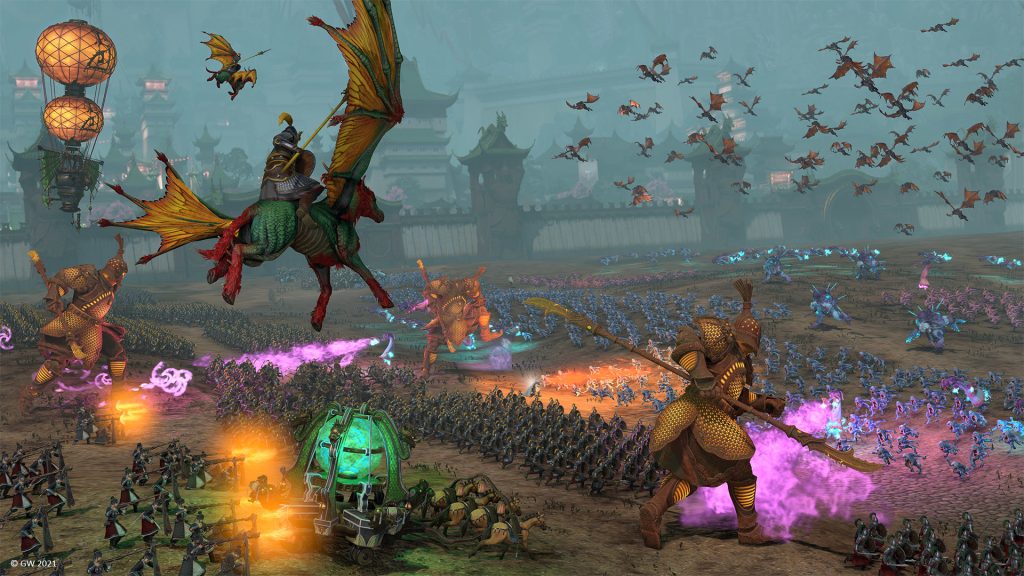
Total War Warhammer 3 spell overcasting is worth using when the upgraded spell changes the result of the next engagement enough to justify its extra cost and risk. Compare the normal and overcast tooltips before targeting. Do not assume an upgraded spell simply doubles damage: the useful change can be a larger area, longer duration or a different targeting effect.
Start with one spell your caster already has. Learn what the upgraded version changes and what you would give up by spending the additional Winds of Magic. That is a more reliable habit than leaving overcasting selected for every spell.

On this page
Total War Warhammer 3 Spell Overcasting: Select the upgraded version before aiming
Select the caster and inspect the available spell controls. Use the overcast toggle to switch versions, then read the selected spell’s tooltip again. Confirm that the displayed cost and effect belong to the version you intend to cast before placing the target.
The official Hotfix 5.1.1 notes explicitly refer to this overcast toggle and a change that gave it more space beside the spell-lore controls. This guide uses that visible control rather than requiring an old double-click habit.
In a campaign, inspect the spell’s skill ranks if its upgraded version is unavailable. Read the node’s description and prerequisites rather than assuming every unlocked spell immediately includes overcasting. Also check the caster’s condition, available magic and the target restrictions shown in battle.
Compare the change you actually receive
Read both versions in sequence. Look at damage, armor-piercing components where listed, duration, area, target type and cost. The important comparison is the extra useful effect, not how impressive the upgraded icon looks.
For a damage spell, consider how many enemies will remain inside the affected area. More potential damage is wasted when the target leaves before the spell does its work. For a buff or debuff, consider whether the additional duration or affected units cover the decisive part of the fight.
If the normal version already accomplishes the task, keep the savings. Finishing a nearly defeated enemy does not necessarily require the stronger cast. The saved Winds can support another engagement, protect a valuable unit or let the caster answer a later threat.
Spend on a good target, not an available target
Look for the situation the spell is designed to exploit. A tightly engaged formation can be a better area-spell target than a fast unit crossing open ground. A useful buff target is a unit whose performance can change the fight, rather than a regiment already winning comfortably.
Pause in single-player when the rules permit it, inspect the target preview, and account for movement. Avoid treating the preview as a guarantee that enemies will remain in place throughout the effect. Keep friendly troops clear of harmful area effects where the spell can damage them.
Some spells do work against individual characters, but an area spell should not be chosen merely because an enemy lord is visible. The official Hotfix 8.0.2 corrected AI prioritization of single-entity targets for area spells. The broader lesson for your own casting is to match target density to the spell’s job.

Budget the next two casts
Compare one overcast with the normal casts you could make instead. Two well-placed normal spells can be more useful than one upgraded spell into a mediocre target. Conversely, a decisive upgraded effect now can be worth more than saving magic for a battle phase that your army will not survive.
Do not mix up Winds reserves, available power and spell cost. Check what the battle interface currently permits and how the pool is changing. A large-looking reserve is not a reason to ignore whether the caster can fund the next spell when it is needed.
Spell Mastery is also a separate consideration. The official Update 5.0 notes state that it appears for units casting true spells and changes as effects raise or lower it. Read the caster’s current value instead of assuming overcasting itself is the same as increasing mastery.
Include the caster’s miscast risk
Check the displayed miscast chance and the caster’s remaining health. An upgrade that is attractive on paper can be a bad choice when the caster is already close to being lost. Protect the caster’s position before committing to a riskier sequence.
Inspect items and effects that modify casting. Hotfix 6.2.1 describes the Chalice of Malfleur as offering powerful rewards with substantial miscast penalties. That is a documented example of why the caster’s equipment matters to the decision.
This guide does not give a universal miscast percentage or damage figure. Use the installed tooltip, including the effects active on this character. A chance is also not a promise: one safe cast does not prove the penalty has disappeared.
Separate ordinary spells from other abilities
Breath attacks, bound spells and limited-use abilities need their own checks. Do not assume a dragon’s visible fire attack has the ordinary overcast controls or uses the same resource rules as a wizard’s spell.
Update 5.0 explicitly distinguishes true spells from bound spells for the displayed Spell Mastery value. Read the ability’s uses, recharge and target description. A visually magical attack is not enough to establish that it can be overcast.
Use the Total War Warhammer 3 game hub for related battle planning. Before your next cast, make one concrete decision: does the upgraded version secure an outcome the normal version cannot? If the answer is unclear, keep the normal spell selected and wait for a better target.
Sources and scope
Official Hotfixes 5.1.1, 6.2.1 and 8.0.2 support the toggle, item-risk example and area-targeting correction. Update 5.0 supports the Spell Mastery distinction. Tooltip comparison and casting scenarios are practical planning advice, not a verified damage benchmark or a claim that every spell upgrades in the same way.
Sources and further reading
Keep exploring

Total War Warhammer 3 vs Stellaris: battles or a galaxy to discover?
Choose WARHAMMER III for commanding fantasy armies; choose Stellaris for exploring a galaxy and shaping the society, technology and fleets of an empire.
Total War Warhammer 3 vs Total War Rome 2: fantasy or empire?
Choose WARHAMMER III for fantasy races and Legendary Lords; choose ROME II for classical empire building, politics and historical battles.
Total War Warhammer 3 vs Total War Attila: fantasy or survival?
Choose WARHAMMER III for fantasy races and Legendary Lords; choose ATTILA for late-antique survival, vulnerable territory and destructive warfare.