TL;DR: Age of Empires II: Definitive Edition is a strong fit if you want historical real-time strategy built around worker economies, age progression, campaigns, and repeated multiplayer or custom-map play. It is less suitable if you want turn-based pacing, minimal production management, or a game focused entirely on modern armies.
This Age of Empires 2 Definitive Edition review evaluates the game’s documented features and practical fit rather than claiming a personal performance benchmark. The core appeal is a familiar economy-and-production loop with a substantial campaign and civilization catalog. The tradeoff is that maintaining workers, capacity, resources, research, and unit selection requires attention even before a complex scenario is considered.

Our sources are the current Steam listing, the official game page, selected official support articles, and checked unit and building references. Prices and package inclusions were inspected on November 9, 2026. No frame-rate test, firsthand completion time, competitive benchmark, or numeric review score is presented.
On this page
Age of Empires 2 Definitive Edition review: who should buy it?
Choose it if you enjoy building an economy that funds later choices. Villagers gather resources, buildings unlock production and research, and age advancement changes what can be purchased. That structure suits players who like improving a repeatable opening, choosing a civilization, and learning why an unfunded queue or missing prerequisite changes the rest of a match.
Campaign-focused players also have a clear reason to consider it. The publisher describes a broad collection of historical scenarios, with additional narrative content and expansions. Multiplayer, co-op options, the Scenario Editor, and mods create other routes beyond a single campaign run. The appropriate purchase depends on which of those modes you actually expect to use.
Consider another style if production maintenance feels like unwanted work. This is a real-time strategy game rather than a turn-based campaign in which you can consider every move without time advancing. A large feature catalog does not change that basic interaction. The meaningful question is whether you enjoy repeated economy and selection tasks, not merely whether historical units look appealing.
What the economy loop asks you to do
A standard Villager costs 50 food, while a House costs 25 wood and supplies five population spaces in the checked baseline. Those small purchases connect resource income with production capacity. If food is missing, a worker cannot be trained; if capacity is missing, a funded queue can still be blocked. The game rewards noticing which condition is actually preventing the next action.
Age advancement adds another planning layer. Feudal Age needs 500 food and two eligible Dark Age building types in the ordinary reference. A Lumber Camp and Mill can support gathering while meeting that building condition. Houses do not substitute for it. This makes the construction plan part of the economy decision rather than a decoration added after the important actions.
That is the appeal for a player who likes cause and effect in a strategy system. The next purchase explains which resource job matters, and the resulting building changes later options. It is also the learning burden: workers can become idle after a source finishes, builders need new jobs after construction, and a chosen army requires income that can keep its queue running.

Production and research create distinct commitments
The ordinary Barracks costs 175 wood and is a prerequisite for a Stable or Archery Range, each also costing 175 wood. Building one route therefore involves 350 wood before the units and related research. A completed structure creates capacity, but it does not automatically supply the resources to use that capacity. This distinction gives the game much of its economic decision-making.
Different units add different resource pressures. Ordinary Scout Cavalry costs 80 food, sharing that resource with Villagers, while an Archer costs 25 wood and 45 gold before modifiers. Changing the production route requires changing the income and construction plan too. A player who enjoys those connected choices has a stronger reason to buy than one seeking a strategy game with little ongoing base management.
Technologies are separate purchases rather than automatic rewards for arriving in another age. A Blacksmith provides applicable military research, while unit-line upgrades and other improvements belong to their own buildings. Civilization availability and modifiers matter. The breadth can support repeated learning, but it also means a general instruction must be checked against the specific civilization and mode.
Campaigns give the systems a different context
The publisher’s campaign emphasis is a major part of the value proposition. Scenarios can begin with their own units, buildings, objectives, and restrictions instead of a standard empty economy. That makes campaigns useful for players who want a directed setting for the RTS systems. It also means a random-map opening guide cannot be assumed to solve every mission.
Choose a manageable available difficulty when learning an unfamiliar scenario and read the actual objective. The right first task is the one the mission permits. A player interested mainly in campaigns should consider whether that mix of scenario instructions and real-time maintenance sounds enjoyable, rather than measuring the purchase only by the existence of multiplayer features.
Steam advertises co-op, and official multiplayer support describes a Co-Op Campaign lobby selection. Check the actual scenario and mode offered when planning to play with another person. The presence of co-op support is not a promise that every solo mission uses an identical co-op setup. A specific shared campaign plan should be verified before it drives the purchase.
Understand the edition and additional content
The current Steam description says the base purchase includes Lords of the West, Dawn of the Dukes, and Dynasties of India. That matters for value because an older description of the bundle may no longer match the product sold now. Check the actual package and your existing ownership instead of assuming that every expansion listed beside the game requires a separate new purchase.
Additional content still needs its own inclusion check. The base-game label does not mean that every later DLC or narrative collection is included. Decide which campaigns or features you want, then inspect the product or package that contains them. Buying a larger bundle is useful only when its additions fit the modes you intend to play.
Official Chronicles guidance describes a separate main-menu entry for that narrative content. It also says the Chronicles civilizations are not available in ranked play. A buyer interested in a new campaign should distinguish that purchase from an assumption that its civilizations become ordinary ranked options.

Visual presentation and hardware expectations
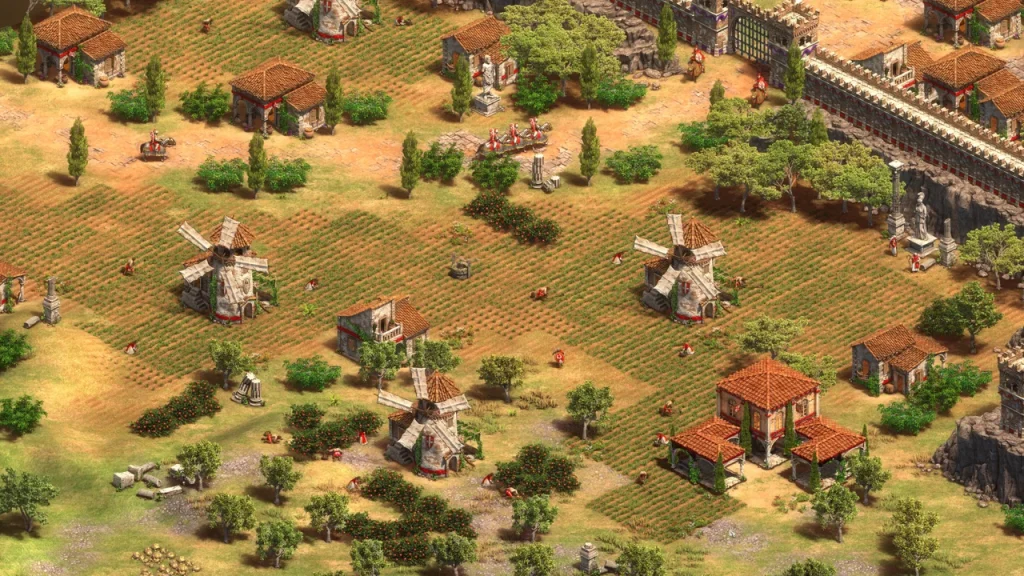
The publisher describes 4K Ultra HD graphics and a fully remastered soundtrack. Those are documented presentation features rather than performance results from this review. The screenshots show detailed settlements, varied architectural styles, terrain, and units, but an official image cannot certify frame rate or readability under every display setting and hardware configuration.
The checked Steam Windows requirements list 4 GB RAM and 15 GB storage as minimum figures, with 8 GB RAM recommended. Treat these as the publisher’s requirements, not a promise of smooth performance at a particular resolution or match size. Inspect the current requirements and available storage for the actual package and optional assets you intend to install.
Check the platform-specific store and requirements when planning a purchase. This review’s hardware discussion uses the Windows requirement text inspected on Steam; it does not certify another operating system or input setup from a platform flag alone. Console controls and store offerings should be evaluated from their own current product information.

Controls can be learned in a small routine
You do not need to memorize every command before deciding whether the game fits. A small keyboard routine can begin with Town Center selection, worker production, idle-worker checks, House construction, and one control group. Those commands support a complete economy task rather than an abstract speed target.
The learning burden remains real even when the keys are configured comfortably. Selection context, resources, population capacity, and prerequisites can all determine whether an action is available. A player who likes diagnosing those conditions may enjoy the repeated improvement loop. A player who wants units to manage the entire economy automatically should consider that expectation carefully.
Official cloud-storage support describes PC saves, hotkey profiles, options, and campaign progress using cloud storage. That is a practical convenience, but the actual messages and available space still matter when persistence problems occur. Preserve a useful setup and read the support guidance rather than assuming every change is retained without checking.
Multiplayer and custom content add repeat uses
The official multiplayer guide describes lobby choices including game mode, AI Difficulty, map options, speed, and other rules. That flexibility supports different ways to use the underlying game, but it also makes context important. A guide written for ordinary settings may not apply unchanged to a custom starting age, resource level, handicap, or scenario.
The Steam description also highlights Scenario Editor support and mods. These features give players reasons to return beyond the publisher’s campaigns, especially when they enjoy creating or selecting custom scenarios. They do not remove the need to check what a particular mod changes. A custom ruleset should not be treated as proof that the ordinary unit costs and availability are identical.
No current player-population estimate or matchmaking-speed claim is supplied here. If a specific online mode is central to your purchase, verify its current activity and requirements through the game or current community information. A source-based feature review can explain the available systems without inventing the live experience of a queue it has not measured.
Price and practical value
The US-English Steam API showed$34.99USD with no listed discount on November 9, 2026. This is a dated observation, not a permanent price promise. Check the live checkout, package contents, and owned-game overlap before paying. Store region, promotions, and product editions can change the relevant comparison.
The strongest value case is using several parts of the game: campaigns, repeated skirmishes, a chosen multiplayer mode, or custom scenarios. A player interested in only one narrow feature should inspect that feature and the included content first. A large catalog is less valuable when most of its interaction does not suit your preferences.
Avoid translating the publisher’s campaign-hours claim into a guaranteed personal playtime. Completion pace, replaying, difficulty choices, and the content actually owned all change the result. The practical question is whether you expect to enjoy the economy-and-production loop repeatedly. That is a stronger purchase reason than an unmeasured hour total.
Where the review’s evidence stops
This verdict is based on documented mechanics, current product text, support guidance, and publisher screenshots. It does not substitute for a firsthand performance test or a full campaign-completion review. Exact civilization and mission totals are not certified here, because broad store summaries can describe the catalog differently and package contents change.
The fit judgment follows the documented interaction: repeated resource, capacity, production, age, and selection decisions. Choose the game if that loop and its historical campaign framing appeal to you. If you want turn-based pacing or a different setting, compare alternatives by those preferences instead of assuming that a remaster fits every strategy player.
Review questions
Is every expansion included?
The checked current Steam description names three included expansions, but that is not an all-DLC promise. Inspect the package for the campaign or feature you actually want, especially when comparing additional narrative content or a larger bundle.
Is this review based on a performance test?
It is a source-based feature and fit evaluation. No measured frame rate, competitive result, or firsthand completion time is claimed. Use current hardware information or an actual test when those outcomes are central to the purchase.
What should a new buyer learn first?
Read the AoE2 beginner guide for the worker-and-capacity loop, then use the guide library for a manageable next topic. Choose one setting and production route before adding more simultaneous tasks.
Sources and further reading
- https://www.ageofempires.com/games/age-of-empires-ii-definitive-edition/
- https://store.steampowered.com/app/813780/
- https://support.ageofempires.com/hc/en-us/articles/4406237657236-Cloud-File-Storage
- https://support.ageofempires.com/hc/en-us/articles/31839163606932-Chronicles-Expansions-FAQ
- https://support.ageofempires.com/hc/en-us/articles/360047306372-How-do-I-create-a-multiplayer-match-in-Age-of-Empires-II-Definitive-Edition
Keep exploring
Age of Empires 2 Definitive Edition vs Total War Rome 2: choose your scale
Choose a historical RTS scenario library or an ancient territorial campaign linked to real-time battles.
Age of Empires 2 Definitive Edition vs Age of Empires 4: where to start
Choose campaign breadth in AoE II DE or documented onboarding and newer presentation in AoE IV.
Age of Empires 2 Definitive Edition vs Total War Shogun 2: match or campaign?
A comparison of immediate RTS development and the continuing clan campaign in SHOGUN 2.