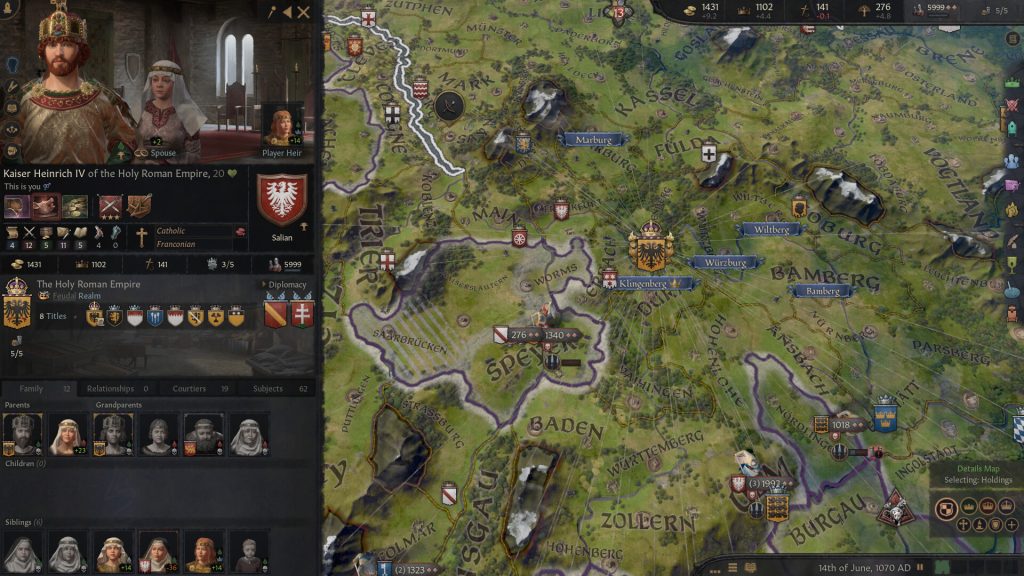
TL;DR: This Crusader Kings 3 review recommends the game to players who want political strategy shaped by individual characters, family relationships, and succession. Its appeal is the connection between a personal decision and a changing realm: a marriage can create an alliance, an inheritance can split your plans, and a new ruler can make familiar territory politically unfamiliar. Choose it when that uncertainty sounds interesting.
Crusader Kings 3 is a strong fit for a player who enjoys managing a dynasty as much as expanding a map. It asks you to think about people, titles, and future heirs alongside armies and income. A player mainly seeking direct battlefield control or a neat sequence of conquest objectives has a different set of priorities.

Review basis: This assessment draws on the official game description, the published guides cited below, and the documented design of its political and military systems. The judgments concern those systems and player fit.
On this page
Crusader Kings 3 review: the dynasty is the real continuity
The defining idea is that your campaign continues through playable heirs. Your current ruler’s death changes the person you control, while the family’s position and past decisions shape what comes next.
That creates a more personal form of long-term planning. A capable ruler can accumulate land and resources, but the succession rules determine who receives them. A great military expansion can become an administrative problem if you never prepare the next generation to hold it together.
The official description places lineage, heirs, education, marriages, and titles at the center of the experience. Those systems make a family member more than a portrait on an appointment screen. The character can be an heir, ally, claimant, useful court member, or source of a future dispute.
For an illustrative campaign, imagine a ruler who wins new territory and creates several powerful relatives. That looks successful on the map. The interesting question is what happens when the ruler dies: which relationships survive, who inherits the important titles, and whether the new player character can manage the resulting realm.
Character politics gives strategic decisions a clear identity
CK3’s most persuasive feature is how often a strategic choice involves a particular person. A vassal has an opinion and a position, an ally belongs to a relationship, and a rival has a family that may outlast them.
This makes politics easier to connect to a story. You can understand why a marriage matters because it links named families, or why a council appointment creates tension because the disappointed candidate remains a powerful subject.
The Gamepressure vassal guide explains obligations, relationships, and faction management. Its useful lesson for evaluating the game is that an internal political problem can remain consequential even when no foreign army is attacking.
The drawback is the amount of context a player needs to retain. A person can occupy several important roles at once. Solving one relationship may not solve the legal or economic problem attached to that character. The game rewards checking what the interaction actually changes.
Succession makes success temporary enough to stay interesting
Succession adds a recurring reason to rethink the campaign. A ruler’s achievements become the starting conditions for the next ruler, whose relationships, abilities, and inherited titles can create a different problem.
This gives expansion a useful counterweight. Acquiring land is one objective; preserving a workable realm through inheritance is another. The player has to connect those objectives instead of treating every new county as an uncomplicated improvement.
That is attractive if you enjoy recovery and political adaptation. A disrupted succession can provide a new campaign goal: rebuild authority, recover an important title, or stabilize the new ruler’s position.
It can also frustrate a player who expects acquired territory to remain under identical control indefinitely. The rules and previews matter. CK3’s proposition is stronger for someone willing to learn inheritance early and accept that an imperfect succession can be part of the story they are choosing to play.
Roleplaying and optimization pull on the same decisions
Characters have traits and lifestyle choices that influence their actions. The official description also presents dynastic education and inherited qualities as parts of the campaign. These systems give you reasons to care how a ruler achieves an objective.
A player can pursue a strategic advantage while also deciding what kind of ruler this character should become. A diplomatic solution, a threatening posture, and an intrigue plan can lead toward similar political goals while producing different relationships and future consequences.
The value lies in that overlap. Roleplaying becomes more interesting when it affects useful decisions, and strategic planning becomes more memorable when the people making those decisions have distinct qualities.
The tradeoff is that some players will want a single best move where the game offers a choice between priorities. A family attachment, the ruler’s character, and a territorial goal can point in different directions. Enjoying that tension helps you enjoy CK3.
The military game supports a larger political plan
Armies matter, but military success sits inside the character and title systems. You need a reason for the war, a force suited to the task, and a result that helps your wider realm.
The official description includes men-at-arms, knights, mercenaries, and Holy Orders. The community combat guide discusses troop roles, commanders, counters, supplies, and siege requirements. Those distinctions make army planning more involved than comparing a total soldier count.
This is a good fit when you want warfare to reflect preparation. Recruiting suitable troops, maintaining a treasury reserve, selecting a useful route, and understanding the objective can all matter before the confrontation itself.
The military layer has limits for a player seeking a dedicated battlefield tactics game. Its appeal is the relationship between warfare and the realm: the army costs money, the commander is a character, and the war outcome changes titles and politics. Evaluate it for that connected role.

Internal management can be as demanding as expansion
A larger realm creates more people and obligations to manage. Personal holdings, vassal contributions, council work, and military expenses give you several ways to improve the same position.
The economic guide distinguishes recurring taxes from other receipts and explains why the domain’s condition matters. It supports a useful evaluation: the game offers meaningful work during peace because economic and political preparation affects the next war.
For example, the next useful action can be a building investment, a better appointment, or stabilizing an important relationship. A player does not need to declare a new war every time the map stops changing.
The burden is that these tasks compete for attention. A campaign can have an urgent succession concern, a budget problem, and an attractive foreign opportunity simultaneously. Learning to choose one priority is part of the game rather than a sign that every visible issue must be fixed at once.
Intrigue offers agency, with consequences beyond the target
Intrigue gives the player another way to alter the political situation. The official description includes recruiting agents and influencing or undermining rivals, while the scheme redesign diary explains the more involved agent and execution choices.
Its appeal is that a small set of characters can matter across a much larger map. A plan may address an obstacle without requiring a conventional war, and preparation can depend on the particular people you can recruit.
That flexibility does not make every plot a good idea. The target’s replacement, the risk of exposure, and the cost of recruiting help all belong to the decision. A successful operation can still produce a political situation you did not intend.
Players who enjoy checking those consequences have another strategic tool. Players who want certainty should recognize that even a carefully prepared scheme remains a plan with a chance of failure and a changing context.
Learning the interface is part of learning the rules
The main learning challenge is understanding how character relationships, titles, and available interactions fit together. A button can be available while its consequences are poor for your current goal.
The first-steps guide emphasizes inspecting the ruler, heir, council, and nearby situation. That is a useful approach to the learning curve: understand the immediate realm before trying to optimize every system.
Start with a limited goal. Check your succession, maintain a usable budget, and identify one expansion or political objective. Each new interaction then has a reason to be learned. Treating every panel as an equal emergency makes a complex game harder to read.
The payoff is a clearer link between a decision and its outcome. The cost is time spent reading previews, tooltips, and relationships. That cost is reasonable for a player who wants political depth, but it belongs in the buying decision.
Who should buy Crusader Kings 3?
Consider CK3 if you want a long campaign with family continuity, political adaptation, and goals you help define. It suits a player willing to accept setbacks and investigate why a realm behaves differently under a new ruler.
It also suits someone who likes combining military preparation with diplomacy and character development. A war can be one step in a family plan rather than the only measure of progress.
Compare another strategy game if your main priority is direct tactical control, a tightly bounded historical operation, or a clearer national war economy. The published Hearts of Iron 4 versus Crusader Kings 3 comparison is useful when deciding between national warfare and dynastic politics.
For edition choice, inspect the current storefront’s exact included content. Buy according to the features you want to use, rather than assuming every advertised expansion feature belongs to every package. Prices, promotions, and bundles need a current check.
Verdict: choose it for people-driven political strategy
Crusader Kings 3’s strongest proposition is a political world where family decisions and personal relationships shape the long campaign. The same systems that create memorable opportunities also make success less permanent and require careful reading.
Choose it if succession, character politics, and rebuilding after setbacks sound like worthwhile strategic problems. Your best first step is to select a manageable ruler, understand the heir and treasury, and give the dynasty one clear goal.
FAQ
Is Crusader Kings 3 mainly a war game?
War is a major tool, but diplomacy, dynasty management, succession, and internal politics are central to its appeal.
Do I need every expansion to decide whether I like it?
Evaluate the core dynasty and realm systems first, then check the feature lists for specific packages. Match an edition to your interests using the current storefront.
Is it suitable for a complete strategy beginner?
A beginner can approach it through a small goal and careful previews. Expect to spend time learning relationships, titles, succession, and budget rather than mastering everything immediately.
Does this review include a performance benchmark?
No performance measurements are claimed. Check the current official system requirements for compatibility; the assessment here concerns game systems and player fit.
Sources and further reading
- https://store.steampowered.com/app/1158310/
- https://www.gamepressure.com/crusader-kings-3/vassals/z0f0fd
- https://www.gamepressure.com/crusader-kings-3/gold-and-buildings/z1f0fe
- https://www.gamepressure.com/crusader-kings-3/first-steps/z4f0f8
- https://steamcommunity.com/sharedfiles/filedetails/?id=2222736076
- https://steamstore-a.akamaihd.net/news/externalpost/steam_community_announcements/6250522009531192816
Keep exploring

Crusader Kings 3 cultural innovations: choose the unlock your realm needs
Prioritize the innovation that removes a current realm obstacle; check the head, matching skill, cultural Development, spread and era restrictions.
Crusader Kings 3 faith reformation: holy sites, rites and the realm afterward
Reform an unreformed rite with holy-site access and Piety, then check doctrine choices, divergence and which rulers will follow the change.

Manor Lords vs Crusader Kings 3: build a town or guide a dynasty?
Pick Manor Lords for a medieval settlement and its household economy; pick Crusader Kings III for rulers, relationships and a realm passed between generations.