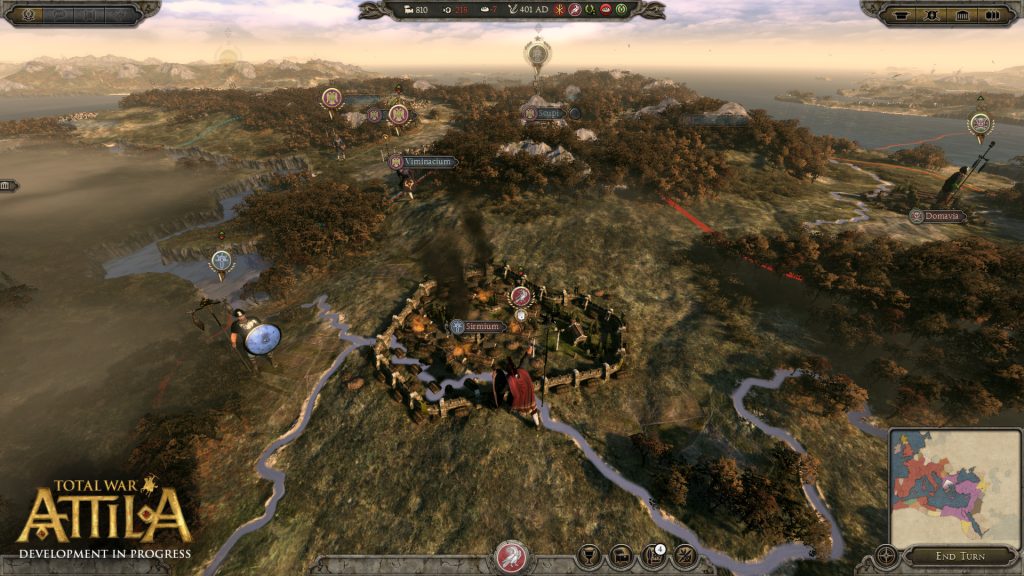
TL;DR: This Total War ATTILA review recommends it for players who want historical warfare tied to a demanding survival campaign. Food, climate, recovery and faction politics give conquest consequences beyond winning the next battle. It is a less comfortable choice if you primarily want uncomplicated expansion, quick campaign turns or a game whose performance on your machine is already established.
ATTILA’s strongest reason to buy is its combination of real-time battles and a campaign about keeping a state or migrating people alive. The same management pressure that gives the game an identity can become its main drawback. Choose it because that pressure sounds interesting, then check the current package and platform requirements before purchasing.

This is a buying assessment based on the official game description, manual, developer explanations and an attributed launch-era review. It does not present new playtest results or current hardware benchmarks. The distinction matters for a game first released in 2015 and still receiving specific updates years later.
On this page
Total War ATTILA review verdict: buy for survival and adaptation
ATTILA fits a player who considers preserving an army, adapting food production and deciding where to settle part of the appeal. Its campaign makes strategic support a reason to choose a route or delay a war.
The official description sets the Grand Campaign in 395 AD and presents famine, disease and warfare as its backdrop. The Western Roman Empire starts with extensive territory but political weakness and threats on multiple sides. That starting position explains the game’s appeal better than a promise of another straightforward rise from a small province.
There are other campaign identities, including migrating factions and established eastern powers. The important buying question is which form of pressure you want to manage. Large borders, mobile camps and a settled economy can create different problems even before their armies meet.
For someone seeking late antiquity and the Total War campaign-and-battle format, those differences are compelling. For someone seeking only spectacular unit clashes, the management layer can occupy more attention than desired.
The survival campaign gives expansion a cost
Food and declining fertility connect long-term planning with immediate military readiness. A province that supports you now may need a different production plan later, so the campaign cannot be assessed solely by how much territory you capture.
Creative Assembly’s fertility explanation distinguishes food buildings that depend on fertility from those providing a flat output. It also connects poor conditions with slower replenishment. Those relationships make support infrastructure relevant to where an army can operate and recover.
That is a useful design strength if you enjoy diagnosing a strategic problem. An attack can succeed while leaving the victorious army without a sustainable follow-up. Delaying an upgrade, taking a different route or preserving a food margin becomes part of the same military decision.
The drawback is the amount of upkeep in your attention. If you prefer a campaign in which every new city simply increases power, checking the obligations attached to that city can feel like another interruption. ATTILA asks you to manage the state supporting the army, not only the army itself.
Exact building values and seasonal effects depend on the current campaign. The attraction is the relationship between systems; an old developer example is not a permanent construction formula.
Hordes make faction choice more than a roster selection
A migrating faction changes the meaning of economic development because an army can also function as an encampment. You move the force to pursue a destination, then use its camp to support production and recruitment.
The official manual describes the army and buildings views of a horde and the importance of stance to its economy. It also warns that settling a migratory faction changes the whole faction’s economic model: the other hordes lose their ability to encamp and contribute in the same way. The Huns are an exception to ordinary settlement.
This is an appealing alternative to treating the map as a collection of permanent cities. Choosing a destination can become a major campaign objective, and protecting a mobile economic base gives army preservation additional weight.
It also creates a learning cost. A successful battle followed by an unplanned settlement can leave the faction with a different support system than expected. Players who want to try hordes should learn that transition before treating the first available city as an automatic improvement.
Choose a settled faction if you want to learn provincial support first. Choose migration because its mobile-to-settled decisions interest you, rather than assuming mobility makes the campaign simpler.
Real-time battles reward morale and fatigue management
ATTILA’s battle systems give you reasons to preserve formation, rest exhausted troops and protect leadership. Winning involves how units enter and remain in combat, beyond the size of the roster.
The manual emphasizes faster fatigue changes, recovery when troops rest and sensitivity to shock tactics. Flank and rear attacks can combine with local superiority to break a unit. The general also supports army morale, and losing him penalizes the remaining force.
Those connections suit players who want battlefield control to matter to the campaign. Preserving troops through a well-timed reserve or avoiding a needless chase can leave a stronger army for the next operation. Cavalry maneuver and careful infantry commitments have a reason beyond creating an attractive replay.
The same battle pace can require attention across several places at once. A player who mainly wants to watch formations collide may be less interested in cycling tired troops or responding quickly to a threatened general. Difficulty settings and battle controls should be explored before deciding that one lost engagement defines the game.
Fire and sieges reinforce the campaign’s destruction theme
Settlement damage persists until repaired, while fire and prolonged siege can change the conditions facing defenders. The manual links destruction with morale and combat penalties and explains siege escalation.
That makes a damaged city more than a visual effect. The way you take it can affect what remains to occupy and support. The limitation is that extended sieges and rebuilding obligations can add time to a campaign when you wanted the next open-field battle.

Politics supplies decisions and another management burden
Family relationships, character influence and governors connect the ruling faction with the provinces and armies it commands. They give the campaign a political layer beyond selecting a national banner.
The official manual distinguishes control of the political situation from dominion based on the ruling family’s influence relative to other nobles. Characters can hold offices or govern, while political actions use influence. This creates tradeoffs rather than one universally desirable political number to maximize.
Governors also provide practical provincial effects through traits, skills and edicts. A useful appointment can serve a local problem, giving individual characters a purpose outside the next battlefield command.
If you enjoy character roles and succession, these systems add reasons to care about the people directing the faction. If you find political panels distracting, ATTILA combines that distraction with food, recovery and military planning. Its appeal depends on enjoying several connected responsibilities.
Difficulty, waiting and performance need separate judgments
Campaign pressure and technical performance are different buying concerns. The game’s documented systems support a judgment about its management demands, but they cannot establish frame rates or turn times on your present computer.
PC Gamer’s February 2015 review praised the theme and faction differences while describing difficult horde campaigns, frustrating agent encounters and slow AI turn processing. Those were that reviewer’s launch-era observations. Its hardware results and bug descriptions should not be repeated as a current benchmark.
They do identify sensible things to investigate: the pace of campaign turns, the experience of army movement and sieges, and how much repeated management you enjoy. Recent footage from the same platform can help assess presentation and pace, but it still does not substitute for performance on your own machine.
Nor is the game’s age evidence that no update has occurred. Creative Assembly published a crossplay update in 2026. That specific update does not establish that every historical complaint is fixed, or guarantee every mod and operating-system combination works together.
Judge value by the campaign you want to play
Start with the base game’s setting and systems. Buy additional content because a named faction or campaign interests you, after checking what the selected package includes.
A large bundle is not automatically better value if you only want to try the Grand Campaign’s survival decisions. Conversely, a player interested in a particular additional campaign should verify that it is part of the purchase rather than infer inclusion from the game’s name.
Use the current US store for price and package contents. This review does not carry forward launch pricing or temporary discounts from older articles. Content quantity and suitability are separate: more campaigns do not remove a dislike of the underlying management workload.
Make these checks before buying
- Pick the experience: identify whether you want a settled state’s survival, a migration campaign or real-time battle control.
- Check your platform: read its current store requirements and support notes. Windows, Mac and Linux listings are different; legacy hardware requirements do not guarantee a modern configuration.
- Inspect representative play: include campaign management and an end-turn sequence, rather than judging from a cinematic trailer alone.
- Confirm the package: check any faction or campaign you specifically intend to use.
- Plan multiplayer deliberately: verify the intended mode, platform setup and mod requirements with the other players.
Frequently asked questions
Is Total War ATTILA worth playing in 2026?
Yes for players who want its late-antique survival campaign and real-time battles, provided the current purchase and platform fit. Age alone does not decide either suitability or technical performance.
Is it a good first Total War game?
It can work if its setting interests you and you are willing to learn its management systems. Use the prologue and a deliberate first campaign instead of assuming the largest Roman territory is the easiest start.
Do I need mods to enjoy it?
The documented base game already provides the campaign and battle systems discussed here. Add a mod for a specific desired change and check its requirements separately.
Choose ATTILA if adapting a faction to a deteriorating world sounds like the campaign you want to manage. Before beginning, the Total War ATTILA beginner guide connects its food, recovery and faction decisions into a practical first-campaign plan.
Sources and further reading
Keep exploring

Total War Warhammer 3 vs Total War Attila: fantasy or survival?
Choose WARHAMMER III for fantasy races and Legendary Lords; choose ATTILA for late-antique survival, vulnerable territory and destructive warfare.

Total War Rome 2 vs Total War Attila: build an empire or survive?
Choose ROME II for classical empire growth; choose ATTILA for late-antique survival, a vulnerable Western Roman Empire and destruction mechanics.
Total War Attila vs Total War Shogun 2: survive or reunite?
ATTILA offers late-antique survival and destructive warfare; SHOGUN 2 centers a clan campaign on reunifying Japan.