TL;DR: This Total War Three Kingdoms review recommends the game to players who want character relationships, diplomacy and economic planning to matter alongside large real-time battles. Romance suits a campaign built around individual heroes; Records gives generals bodyguard units and a different tactical emphasis. The main tradeoff is management: building armies, maintaining satisfaction, funding territory and handling agreements can demand as much attention as fighting. Choose it for the existing historical campaign systems and a start date that interests you.

Three Kingdoms is a strong fit when deciding whom to trust sounds as interesting as deciding where to charge. A player seeking only uninterrupted battlefield action should consider how much of the game takes place between battles. Its character and diplomatic systems are part of the central proposition, rather than optional decoration.
Assessment method: This is a reference-led review of the official game description, manual, documented campaign rules and named faction mechanics. The judgments below concern fit and design tradeoffs. No numerical review score, hardware benchmark or personal playtime is claimed.
On this page
Total War Three Kingdoms review: who should play it?
| Your priority | Fit | Reason |
|---|---|---|
| Character-led historical campaigns | Strong | Relationships, satisfaction and leadership connect people to the faction |
| Diplomacy with several ways to grow | Strong | Agreements, coalitions, vassals and faction tools create alternatives to direct conquest |
| Heroes who can fight individually | Romance | Individual generals, abilities and duels support that battle model |
| Generals embedded in units | Records | Bodyguard formations and fatigue receive more tactical emphasis |
| Minimal campaign administration | Conditional | Retinues, salaries, food and character ambitions require continuing decisions |
The game combines a turn-based campaign with real-time battles across ancient China. Its Steam page lists a May 23, 2019 release and presents the 190 CE struggle as the central setting. That makes it a purchase of an established game’s available systems, with chapter packs and later changes worth evaluating separately.
The characters give campaign management a clear purpose
Characters lead armies, hold office, manage commanderies and develop relationships. The official manual connects Guanxi, satisfaction and court roles to the campaign. A valued general is therefore more than a portrait attached to an army.
This is the game’s most appealing design choice for a player who enjoys political consequences. Hiring someone raises questions about where they should work, whether they get along with the surrounding people and what they expect from your faction. Keeping a useful commander can require an office or promotion whose salary affects the same treasury that pays troops.
The drawback is additional administration. A player who wants every character to remain a simple, interchangeable combat bonus can find satisfaction and ambitions an unwanted obligation. These systems are more rewarding when you see maintaining the court as part of your strategy, rather than an interruption before another battle.
Succession adds another meaningful distinction. Faction leader, heir and prime minister can contribute different faction-wide effects. An heir taking over can change the leadership specialization while preserving the faction specialization described in the official glossary. A campaign can therefore change direction as the people governing it change.
Diplomacy offers useful alternatives to another front
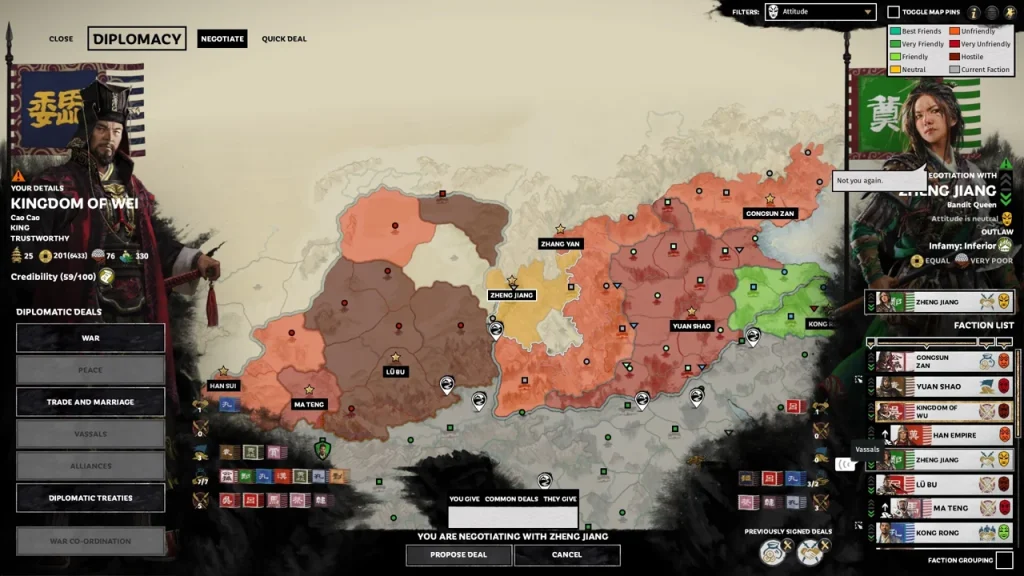
Three Kingdoms supports trading, agreements, coalitions, alliances and vassal relationships. The manual presents overhauled diplomacy as a campaign foundation. Its value is the way these options let you solve a specific problem without immediately adding another territory to defend.
A trade agreement can help finance the current army. A food agreement can turn a genuine surplus into a resource for development, with the obligation to keep supplying it. A coalition can align interests, while a vassal relationship leaves another faction governing its own land. These are different tools with different commitments.
The appealing part is choosing the tool that matches the frontier. A nearby ruler whose territory would stretch your army thin may be more useful as a stable neighbor or subject. Diplomacy is especially engaging when you compare that choice with the actual cost of taking and holding the land.
Consider a campaign where your main force is recovering after completing a commandery. Funding it through a workable trade agreement and keeping the next border quiet can be a better result than immediately taking another damaged town. The game gives that pause a purpose: improve the position you have, then choose the next war from strength.
The limitation is dependence on outside decisions. Other rulers do not become obedient because their diplomatic relationship is favorable. A coalition does not guarantee rescue in every battle, and vassal management can create obligations you cannot comfortably fulfill. Evaluate the visible terms instead of treating a positive relationship as a promise that an ally will behave exactly as planned.
Romance and Records serve different battlefield preferences
Romance emphasizes individual heroes, abilities and duels. Records represents generals through bodyguard units and puts greater emphasis on fatigue and conventional unit handling, as described in the released-game mode guide. Select the model before starting the campaign.
Choose Romance if commanding named heroes directly is part of the attraction. Their abilities create additional tactical decisions, and a duel can isolate a specific contest within a larger fight. That appeal comes with the need to manage matchups and protect the surrounding army. A famous name alone does not turn a bad attack into a sound one.
Choose Records if you prefer the general to behave as a battlefield unit whose positioning, bodyguard and condition matter. It is a better conceptual fit for players who want the troops, terrain and fatigue to remain central to the commander’s role. It still uses the game’s character-driven campaign, so the choice does not remove court management or relationships.
Neither mode makes cavalry flanks, missile protection or formation discipline irrelevant. Judge the choice by the way you want generals represented, rather than a claim that one mode always produces shorter, harder or more realistic battles. Those outcomes depend on the battle and the player.
Retinues link army composition to the people you recruit
The manual describes an army with up to three generals and a retinue of up to six units for each. Recruitment opportunities and unit roles connect to general classes and development. That creates an extra decision beyond filling a list of available units.
A useful army combines a front that can hold, ranged support and mobile forces with a purpose. Recruiting the right general can open the relevant options, but the commander and troops also add deployment and continuing costs. The best choice is the person and retinue that solve the next battle without undermining the treasury.
This structure is a strength if you enjoy building a team of commanders. It gives recruitment and character progression an obvious military consequence. The same structure can frustrate a player who wants every unit available from one generic recruitment menu without considering which general leads it.
Faction tools create further differences. The Cao Cao reference describes Schemes affecting armies, commanderies and diplomacy. Liu Bei uses Unity and Han integration. Sun Jian uses Heroism and immediately mustered unique mercenaries. These offer distinct campaign decisions without requiring every faction to follow the same opening.

The economy makes expansion a commitment
Commanderies group capitals with resource settlements. Income categories, corruption, food production and urban consumption affect how a conquest becomes useful. Taking a city is the beginning of a development decision, rather than an automatic improvement to every part of the budget.
This is worthwhile strategic pressure. An industrial resource creates a reason to consider compatible local development. A food producer can support towns whose upgrades increase consumption. An administrator can improve a commandery but adds a character appointment and salary to assess. The military and government systems meet at the treasury.
The cost is the number of things that can go wrong at once. An army may win an assault while the settlement needs repairs, food is tight and a new office adds pay. Expanding quickly can leave the realm too fragile to retain what it captured. That is interesting if you like logistics; it can feel laborious if conquest is the only part you want.
The food guide is a useful reminder that farms, fishing and other resource settlements have different roles. Do not evaluate the game with an expectation that all newly acquired land automatically supplies the army and larger cities. Successful development depends on the production you actually control.
Spies add options, with time and uncertainty
Espionage lets a suitable character seek employment inside another faction and build the access needed for actions. The manual’s Undercover Network section describes that process. It offers ways to affect a rival through characters and opportunities rather than another direct assault.
The system fits players who enjoy preparing a future advantage. It is less suitable as a guaranteed emergency solution when an enemy army already threatens your capital. Employment, access, resources and the chosen action matter. Treat a spy as a developing opportunity within the campaign, rather than an instant button that always removes the target.
Start dates and chapter packs need separate decisions
The conventional 190 CE campaign provides the core warlord struggle. Different chapter starts alter the political and military position. The official Fates Divided description centers on 200 CE and the conflict involving Cao Cao and Yuan Shao, rather than replaying their initial 190 CE positions.
Mandate of Heaven reaches back to 182 CE. Its Liu Hong reference describes an emperor in Luoyang with Political Influence and imperial court groups. That is a different management problem from an ordinary warlord building a first power base.
Choose extra content for the particular start or faction system you want. A bundle can include campaigns whose appeal differs substantially, so more content is not automatically better value for your preferences. Current prices and discounts should be checked at purchase; this review does not supply an invented cost comparison.
Judge the version and existing content you will use
The official 1.7.0 announcement names new Cao Cao and Yuan Shao mechanics plus Emperor and Imperial Intrigue changes. Older launch guides can therefore describe faction rules differently from later references. That is relevant to a new player choosing which instructions to follow, not evidence that every old tactical recommendation is invalid.
In its 2021 development update, Creative Assembly said the team had transitioned to pre-production on another entry in this universe and announced Patch 1.7.1. Buy for the game and content available to you. That announcement is not a promise of a future expansion schedule or a completed sequel.
The purchase decision
Choose Three Kingdoms when its combination of people, agreements, territorial development and battles matches the campaign you want. Start with a documented 190 CE leader, choose Romance or Records deliberately and add a chapter pack only for a specific setting or mechanic. Players who dislike managing a court and economy should weigh that recurring work before purchasing for the battles alone.
Frequently asked questions
Is Three Kingdoms suitable for a Total War newcomer?
It can be, if you want the campaign systems as well as battles. The official manual recommends Cao Cao’s 190 CE start as a newcomer suggestion.
Which mode should I choose first?
Romance for individual heroes and duels; Records for generals with bodyguards. Both retain the character-led campaign.
Do I need every DLC?
No. Choose a chapter or faction pack for the actual campaign features you want, after evaluating the base game’s fit.
Sources and further reading
- https://store.steampowered.com/app/779340/
- https://www.feralinteractive.com/en/manuals/threekingdomstw/latest/linux/
- https://3kglossary.totalwar.com/
- https://www.gamepressure.com/total-war-three-kingdoms/romance-and-records-modes/zdc43c
- https://www.gamepressure.com/total-war-three-kingdoms/food/z0c454
- https://www.gamepressure.com/total-war-three-kingdoms/developing-commanderies-districts/zcc450
- https://totalwar.fandom.com/wiki/Cao_Cao_(faction)
- https://totalwar.fandom.com/wiki/Liu_Bei_(faction)
- https://totalwar.fandom.com/wiki/Sun_Jian_(faction)
- https://store.steampowered.com/app/1493250/
- https://totalwar.fandom.com/wiki/Liu_Hong_(faction)
- https://steamstore-a.akamaihd.net/news/externalpost/steam_community_announcements/4057152305731075940
- https://steamstore-a.akamaihd.net/news/externalpost/steam_community_announcements/4069544815356399742
Keep exploring
Total War Rome 2 vs Total War Three Kingdoms: territory or characters?
Choose ROME II for classical civilizations and empire development; choose THREE KINGDOMS for Chinese warlords and relationships that connect statecraft with battle.
Total War Three Kingdoms vs Crusader Kings 3: battles or heirs?
THREE KINGDOMS fits direct tactical battle command; Crusader Kings III fits a ruling house whose playable heirs carry its story forward.
Total War Three Kingdoms vs Total War Shogun 2: heroes or clans?
THREE KINGDOMS emphasizes heroic characters and Guanxi; SHOGUN 2 puts generals and agents inside a Japanese clan-unification campaign.