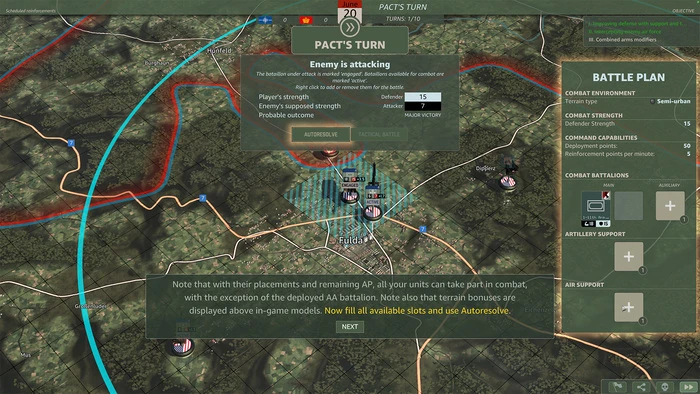
TL;DR: For WARNO Army General battles, inspect the objective, available battalions, remaining action points and fatigue before choosing participants. Use the Battle Plan phase to select eligible formations with complementary roles, then choose tactical play or autoresolve according to the encounter and your priorities. Preserve useful strength for later turns: a victory that commits unnecessary tired formations can still leave the campaign in a worse position.
Practical goal: Prepare a useful set of participants, choose how to resolve the encounter and carry its actual losses and fatigue into the next campaign decision.

Checked November 9, 2026. This is not a hands-on test or a guaranteed autoresolve formula. Advice uses WARNO’s official campaign description, dated Army General explanations and the source-limited observations in official game screenshots. Preview slot counts and proposed future changes are kept separate from current installed conditions.
On this page
WARNO Army General battles: prepare for the next turn too
| Battle question | Useful decision | Check before committing |
|---|---|---|
| Which formations should participate? | Match eligible strength and support with the encounter | Composition, fatigue, action points and current role slots |
| Should I play tactically? | Choose according to objective, control and time | Available resolution buttons and displayed forecast |
| Should every available formation join? | Weigh its actual contribution against later needs | Remaining strength and next-turn tasks |
| What happens afterward? | Inspect recorded losses and changed campaign state | The result, not only the preparation forecast |
1. Start with the encounter’s purpose
Read the campaign objective and the battle context before selecting participants. A battle that helps hold a necessary area, protects a useful formation or advances the displayed campaign task can deserve different attention from an encounter with little immediate value. Do not treat every contact as a reason to commit everything available.
Identify the campaign, current turn and formations involved. Army General uses formation-level pawns, while the tactical battle contains individual game units. A familiar vehicle in the Armory is not proof that the selected campaign battalion has that exact current composition.
Choose what the encounter needs to accomplish, then consider the result you can accept. Preserving useful strength can matter across several turns. If the campaign task can be served without exhausting an additional formation, compare that option before filling a preparation slot merely because it is available.
The 2022 Army General preview describes persistent battle results and losses and emphasizes conserving formations over multiple turns. Use that campaign relationship when judging an encounter; exact current outcomes and replacement conditions still come from the selected campaign and installed rules.

2. Inspect readiness and eligibility before choosing participants
Select each candidate formation and inspect its actual composition, condition and remaining resources. A large-looking pawn can represent a different mix of units from the one you need. Read the available details rather than assuming every formation with an armored label supplies the same tactical tools.
Check current eligibility in the Battle Plan window. The earlier campaign explanation names distance, remaining action points and status among the conditions affecting nearby battalion participation. Treat those as reasons to inspect the installed feedback, not as permission to invent one current join-distance or action-point formula.
Consider fatigue alongside strength. A formation that can join now may also be needed in another encounter or later turn. Ask what it adds to this battle and what committing it removes from the remaining campaign plan. Availability is a choice to evaluate, not an automatic instruction to participate.
Use the Order of Battle to locate the right formation and inspect its hierarchy. The official tutorial screenshot shows a square location control beside an entry. That makes it easier to match the preparation candidate with its campaign position instead of choosing a similarly named entry by memory.
3. Build complementary roles in the Battle Plan phase
The March 2023 Battle Plan explanation separates Combat Battalions, Artillery Support, Air Support and Auxiliary Support. At that development stage it described two combat slots and one slot for each support category. The important decision is matching participants with distinct jobs; those archived counts are not a permanent present slot formula.
Start with the ground formations suited to the encounter, then examine eligible support for what they lack. Infantry, armor and auxiliary formations can contribute different tools. Do not assume a smaller-looking supporting formation is useless simply because it contains fewer heavy vehicles.
The October 2023 update explains that support formations have their own categories rather than competing directly with infantry and armor. Inspect current category feedback to see which candidate can contribute to the selected battle. An unavailable entry can be a role or state issue before it becomes evidence that the campaign removed it.
Choose support with a useful task and remember its later availability. Filling every category without considering the encounter can commit strength you wanted elsewhere. This guide does not calculate a strongest composition: the current roster, eligibility, condition and objective determine the useful combination.
4. Choose tactical play or autoresolve deliberately
Inspect the actual resolution options offered by the current encounter. The official preparation screenshots show Autoresolve and Tactical Battle separately. Tactical play gives you the battle to manage; autoresolve saves the time of playing it. Choose according to your priorities and the available information rather than assuming one method always preserves more strength.
For a battle where you want to learn the available ground roster or manage a particular objective, tactical play can be a useful choice. For another encounter, you may prefer automatic resolution. The displayed probable outcome is helpful preparation information, but it is not the actual result already recorded.
Compare the forecast, committed participants and next-turn needs before confirming. A favorable forecast does not establish zero losses or zero fatigue. If preserving a specific formation matters, account for that priority when deciding how much to commit and whether to play the battle.
The early campaign preview also describes assigning the AI some battalion control in tactical play. When that option is currently available, choose a manageable set of jobs for yourself and monitor the delegated units. Delegation reduces attention demands; it does not prove every current AI decision matches the plan you intended.

5. Use the tactical ground roster for the displayed objective
When entering tactical play, inspect the actual roster and resource labels before purchasing or deploying. The official Battle Plan image separately labels deployment points and reinforcement points per minute. Use the current battle’s fields to decide what can start and what can arrive later.
Give the opening ground group a clear objective and supporting jobs. Reconnaissance supplies information, relevant ground weapons address detected threats, appropriate command units serve the objective rules, and supply keeps needed resources available. A scripted or campaign roster may differ from your favorite standalone deck, so adapt to what the encounter provides.
Use the sight tool to inspect a useful ground position before relying on a weapon’s maximum range. Shared contact information, actual sight and relevant weapon reach are distinct. If a ground unit cannot accomplish the assigned task from its current location, change the position, target or supporting unit instead of repeating the same order indefinitely.
Watch damaged and depleted units and preserve those that can still contribute after recovery. A campaign battle’s consequences continue after the tactical session. Completing the objective while retaining useful ground strength can serve the next turn better than pursuing every visible unit beyond the encounter’s needs.

6. Read losses and fatigue before the next commitment
After resolution, inspect the recorded result and the formations that participated. Compare remaining strength, fatigue and current availability with the next campaign task. Do not keep using the preparation forecast as if it were the post-battle record.
A surviving formation can still need a different next job because its condition changed. Consider a fresher eligible formation, a less demanding task or another available response when repeated commitments would leave important strength exhausted. Read the current status and campaign conditions rather than assuming a fixed recovery schedule.
The September 2026 Cuba Libre announcement discusses fatigue after autoresolved Total Victories and considers reducing that burden. It also describes planned changes to defending AI assessment. Those passages are announcement or proposal evidence; this guide has not read release confirmation and does not claim they are already active.
The practical lesson remains to evaluate what each additional participant contributes. Do not calculate a guaranteed fatigue saving from a future proposal or assume the defending AI will select the same combination every time. Use the recorded current encounter to decide which formations remain useful afterward.
7. Review one campaign decision at a time
Record the encounter objective, participants, resolution choice and actual result. Then identify one decision to improve: a missing support role, an unnecessary commitment, an unsuitable ground opening or a failure to account for the next turn. Changing one relevant choice makes the next attempt easier to assess.
Use the dedicated Army General tutorials when learning campaign preparation. The February 2024 Housecleaning Part V announcement confirms that GROUCHY delivered four tutorials and BRUDERKRIEG as a playable single-player campaign then. This supports the distinction between an earlier tutorial preview and a documented delivery; it does not assert today’s complete tutorial count.
Keep the source version alongside any copied numbers. Development-era slot counts, calendar descriptions and future AI proposals answer different historical questions. They should not become a mixed current rules table without checking the installed campaign.
Continue with the Army General campaign map guide, deployment planning and the WARNO hub. WARNO Army General battles are useful campaign decisions when the chosen participants, resolution method and later condition serve the objective together.
Sources and further reading
- https://store.steampowered.com/app/1611600/
- https://steamstore-a.akamaihd.net/news/externalpost/steam_community_announcements/6402455182507273521
- https://steamstore-a.akamaihd.net/news/externalpost/steam_community_announcements/5070528176564937637
- https://steamstore-a.akamaihd.net/news/externalpost/steam_community_announcements/5218041989042214472
- https://steamstore-a.akamaihd.net/news/externalpost/steam_community_announcements/5395938616793407646
- https://steamstore-a.akamaihd.net/news/externalpost/steam_community_announcements/5728086065181094533
- https://steamstore-a.akamaihd.net/news/externalpost/steam_community_announcements/1845383656380001
- https://steamstore-a.akamaihd.net/news/externalpost/steam_community_announcements/5036749277232271511
Keep exploring
WARNO Recon Positioning: observe the fight before you join it
Put recon where it answers the force’s next movement question; preserve a useful view, cover the flank and move it when the front changes.
WARNO Command Unit Placement: capture safely, then use the leader
Bring command behind protection, complete the capture, then relocate or support nearby troops; WARNO does not require permanent parking after capture.
WARNO Division Deck Building: give every card a battlefield job
Build a division deck around an opening and reinforcement plan; cover battlefield jobs before spending cards on optional specialists.