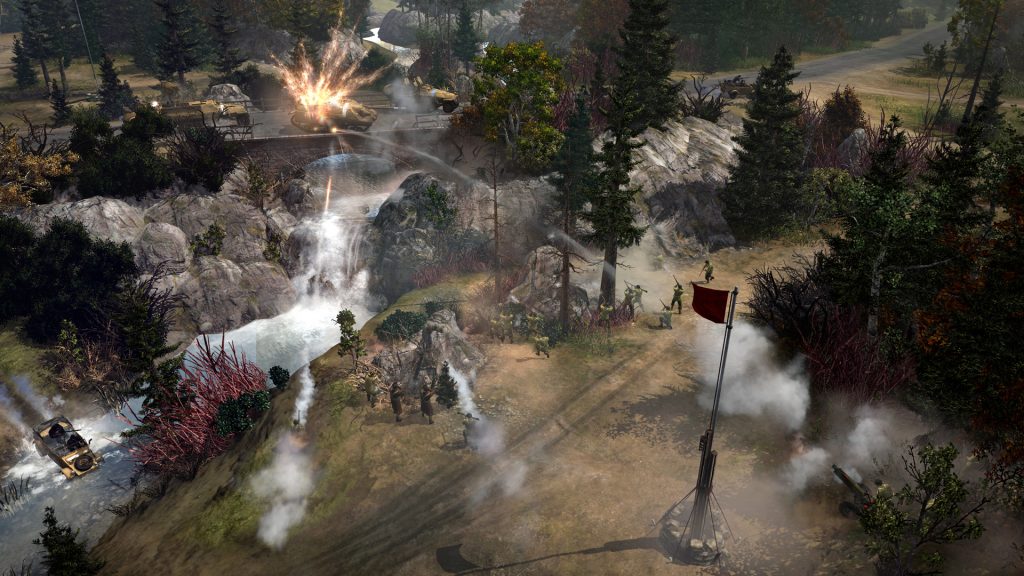
TL;DR: Company of Heroes 2 cutoff points matter because they connect captured resource territory to the base. Trace the friendly sector chain, find the link whose loss breaks it and choose whether attacking the enemy link or restoring your own connection helps the current army. A cutoff is a supply function, not automatically the map’s central point.
Neutralizing a necessary link can interrupt the connected income before the whole area changes ownership. Check alternative routes before calling the attack successful. Capturing one connector does not automatically capture every sector beyond it, and a VP’s score role is separate from fuel or munitions income.

Sources and scope: The connection and resource rules come from Tomy’s beginner guide, with the publisher manual supplying HUD context. All branch examples below are hypothetical diagrams described in words, not claims about a named current map. Checked November 9, 2026.
On this page
Company of Heroes 2 cutoff points: trace the chain to base
Start at the resource sector you want to keep and follow the captured links back toward headquarters. A nearby territory point can be strategically important if it provides that connection, even when it has no large dedicated fuel icon. Its value comes from the sectors depending on it.
Do the same for the opponent’s route. A point close to the middle is not necessarily a cutoff; another captured path may connect the resource area. Identify the actual connection before sending squads into a costly attack that only changes an ordinary sector.
Keep the army’s tasks separate while tracing the route. Infantry still needs to contest useful ground and avoid unnecessary losses. The supply plan should tell those squads where to act, rather than encouraging every unit to stop fighting while you study the map.
1. Identify the resource flow the link supports
Look at what lies beyond the connector. A chain serving fuel, munitions and several ordinary sectors presents a different target from a link serving only a small peripheral area. Choose the attack from the income it can interrupt and the position your force can reach.
Fuel supports relevant technology and vehicles; munitions supports upgrades and abilities. Cutting either can change future spending, but the opponent’s existing bank and units do not vanish. Expect an income interruption, not an instant loss of every weapon already on the field.
Manpower has a different flow, including automatic income and army upkeep. Do not diagnose every manpower shortage as a lost fuel connection. Repeated model losses can consume manpower even while your fuel sectors remain connected and productive.
Compare the payoff with the fight required
A valuable connector heavily defended by supported weapons may be expensive to contest directly. Another attack can create an opening or force those defenders to move. Choose an approach your army can support rather than sending one isolated squad into the strongest part of the enemy line.
If the connector serves little income and reaching it costs several squads, reconsider the objective. The word cutoff does not make every supply attack worthwhile regardless of the position or losses needed to hold it.
2. Choose neutralization or capture for a clear result
When the necessary connecting point becomes neutral, the previously friendly chain through it is interrupted. This can already serve the income-denial task. Completing capture gives you ownership of that point, but it remains a separate step with its own exposure and position to defend.
Judge whether the squad can stay for that second step. If the enemy is about to overrun the area, preserve the unit instead of treating a completed capture as more valuable than the surviving army. Another supported attack can continue the denial without relying on one squad to fight every response.
Capturing the connector does not transfer the distant fuel or munitions sectors automatically. Those points keep their own ownership states. To gain their income for your army, you need the appropriate capture and connection, not merely the enemy’s lost route.
Avoid chasing the wrong resource icon
If your distant fuel point is disconnected, taking another farther-forward resource sector may leave both without the needed route. Restore the connector first when that is the missing condition. Expansion helps only when the captured territory supports a functioning chain.
Likewise, an enemy fuel point may be easier to deny through its connecting sector than through the heavily defended fuel location itself. Compare the two approaches from your force’s current position and the actual alternative links.

3. Protect the squad doing the cutoff job
Use infantry to capture while another suitable role watches the approach. A machine gun can control an infantry route, another squad can contest nearby cover and an anti-tank role can cover a vehicle response. Choose that support from the enemy units actually threatening the area.
Do not send every unit through the same suppressing arc. A machine gun guarding the connector needs another direction, smoke or appropriate pressure before the capture squad can approach usefully. Buying more infantry for the same stopped route repeats the problem without improving the connection plan.
Watch health and remaining models during capture. A supply attack that ends in a full wipe loses experience and adds rebuilding cost. Retreat while the squad still has a useful escape if the pressure makes continued capture untenable.
Hold the approach after the link changes
If the point is captured, move recovered units into positions that can defend likely returns. The enemy may prioritize that connector because it restores several sectors at once. A capture squad standing unsupported on the flag can lose the point immediately afterward.
If the point remains neutral and the enemy approaches from another route, decide whether denial still serves the army. Preserve the units and pressure the connection from a useful position; the goal is a sustainable resource effect, not endless casualties at one icon.
4. Restore your own route and check alternatives
When income drops, inspect the link before assuming every resource sector was lost. You may still own the distant area while its connector is neutral or enemy-held. Recapturing the necessary link can restore the route more directly than attacking a new remote point.
Check whether another friendly path already exists or can be established. A chain with two separate connections is not severed by losing only one of them. This changes both defense and attack: guard the actual vulnerable route and avoid celebrating a cutoff that leaves the opponent’s second path intact.
An alternative connection also has to be usable captured territory, not simply a route your units can walk. Movement through ground and resource connectivity are different questions. A squad reaching the fuel sector does not prove the income chain is restored.
Keep VPs distinct from resource links
In VP mode, majority control pressures the opponent’s score. A VP can lie near an important supply fight, but its score function is separate from the connector’s income function. Decide which objective the army needs at that stage rather than treating every central VP as a cutoff.
If your score is under urgent pressure, an extended supply raid can leave the match objective unattended. Use income denial to support the broader win plan and retain enough force to contest the VPs that matter.
5. Work through a hypothetical branch map
Assume a simplified route with Base linked to sector A, A linked to B and B linked to fuel sector F. Your army owns A, B and F. If B becomes neutral, F loses this friendly connection even though you still own the fuel point.
Sending another squad beyond F does not restore the broken link. Recapturing B reopens the route through A, provided the other required sectors remain friendly. Defend B’s approaches afterward because the opponent can interrupt the same chain again.
Now add a second route: A links to C, C links to D and D links to F. If C and D are also friendly and connected, losing B alone does not sever F. The attacker needs to account for the alternative path before calling B the decisive cutoff.
Finally, assume the opponent captures B while you still own F. The opponent has gained B, not automatically gained your fuel point. F’s income and capture state must be considered separately. This distinction prevents confusing denial with ownership when choosing the next squad task.
Choose the next action from the changed chain
If B is the only broken link, restore B. If the alternative path is working, focus on the relevant contested objective rather than withdrawing the whole army to solve a connection that still exists. If the enemy’s route has two paths, compare the cost of denying both with a direct resource attack.
These labels are a teaching example rather than a named map route. Apply the same tracing process to the actual captured sectors in your match, keeping ownership, connection and the unit’s safe movement distinct.
Cutoff questions
Is the central point always a cutoff?
No. A cutoff is a connection function. Trace the sectors it serves and check alternative paths before assigning it that importance.
Do I gain the enemy’s distant fuel by taking the connector?
No. The distant point has its own ownership state. Your action can deny the enemy route without automatically giving your army that resource sector.
Should I expand while my existing fuel is disconnected?
Restore the required link when that is the missing condition. More disconnected territory does not repair the route supplying the sectors you already hold.
Where should I develop the tactic?
Use the Company of Heroes 2 guides and strategy game guides to connect supply decisions with the battlefield roles. Practice tracing one important resource chain and naming the exact capture task needed to preserve it.
Sources and further reading
Keep exploring
Company of Heroes 2 vs Gates of Hell Ostfront: what should carry the battle?
Company of Heroes 2 vs Gates of Hell Ostfront: choose squad cover and counters or switchable direct control with a developing Conquest army.
Company of Heroes 2 vs Men of War Assault Squad 2: squads or direct control?
Company of Heroes 2 vs Men of War Assault Squad 2: compare cover and combined arms with direct soldier control, skirmishes and the right game package.
Company of Heroes 2 Veterancy Mechanics: 7 Squad Decisions
Understand what veterancy changes, why surviving squads retain value and how to use infantry, weapon-team and vehicle experience in real decisions.