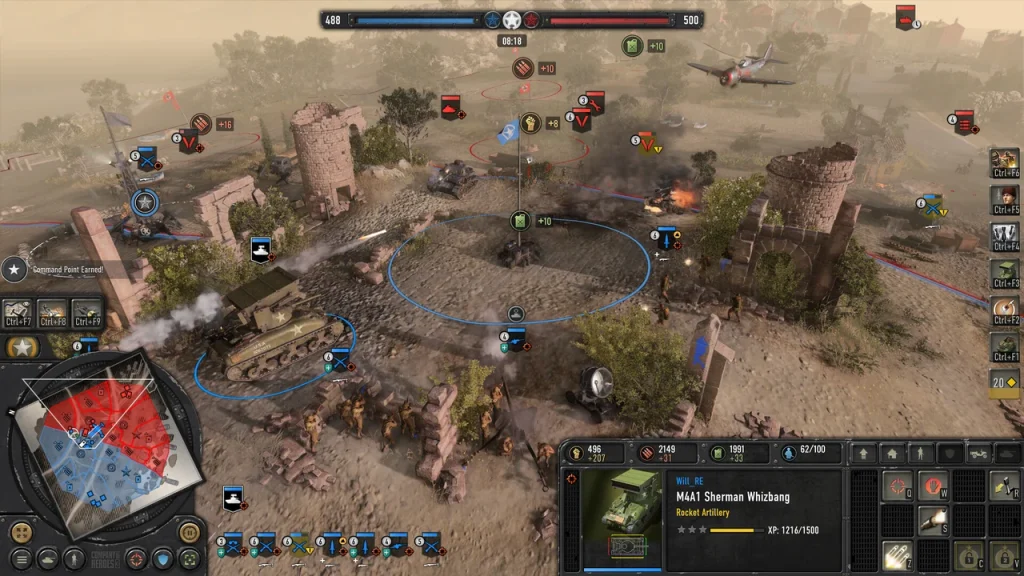
TL;DR: For Company of Heroes 3 vs Company of Heroes 2, choose CoH3 for its Mediterranean campaigns, Italian Dynamic Campaign Map and explicitly advertised Full Tactical Pause. Choose CoH2 when its Eastern Front base campaign, a particular standalone multiplayer army or the separate Ardennes Assault campaign is the content you actually want.
Quick verdict: This is a choice between related games with different campaign and purchase structures. CoH3 being newer does not prove better performance or multiplayer conditions. CoH2 offering several army products does not mean every faction and campaign is included in the base purchase.

Checked November 8, 2026. The comparison uses CoH3’s official Steam listing and CoH2’s official Steam listing, including the developer’s explanation of its related products. It is an editorial buying assessment, not a side-by-side playtest. We do not compare current prices, player counts, frame rates or balance rankings.
On this page
Company of Heroes 3 vs Company of Heroes 2: the buying differences
Both games belong to the same squad-focused RTS series. Their documented appeal includes unit command, combined-arms systems, cover and line-of-sight information. The useful buying question is which game’s campaigns, content access and supported platform fit your intended sessions.
We compare seven things: the base campaign, additional campaigns, planning controls, starting army access, multiplayer structure, platform listing and the cost of switching in terms of learning and coordinating with friends. The same criteria apply to both games.
| Criterion | Company of Heroes 3 | Company of Heroes 2 |
|---|---|---|
| Base campaign focus | Italy and North Africa | Soviet Eastern Front campaign |
| Strategic campaign structure | Italian Dynamic Campaign Map | Separate Ardennes Assault is described as non-linear |
| Documented planning feature | Full Tactical Pause in single-player | No equivalent feature description in the product material read |
| Base multiplayer armies | Four factions advertised | Red Army and Wehrmacht Ostheer |
| Other army products | Additional specialization content listings | Western Front Armies and British Forces |
| Steam platform listing | Windows | Windows, macOS and Linux |
1. Start with the campaign you want to play
CoH3’s base product description identifies two campaigns in the Mediterranean setting, including the Italian Dynamic Campaign Map. If choosing the direction of a broader campaign is your main interest, that named strategic layer is a direct reason to shortlist CoH3.
CoH2’s base listing describes a Soviet campaign on the Eastern Front. It provides a different historical focus, rather than simply an older presentation of the same campaign. Someone specifically seeking the Soviet side of that setting has a clearer reason to choose CoH2 than someone looking only for the latest series entry.
The difference is especially relevant to a solo buyer. You can enjoy the same series-level style while preferring a particular theater or campaign structure. Multiplayer improvements or additional faction options are secondary if they are not part of the activity you plan to play.
Use the campaign as the first filter, then inspect the edition that includes it. This prevents a purchase based on an attractive multiplayer army from becoming a disappointment when the desired solo campaign turns out to be a different product.

2. Keep Ardennes Assault separate from the CoH2 base game
The official CoH2 listing explains Ardennes Assault as a separate US-focused, non-linear campaign. It describes selecting companies, customizing abilities and carrying company health between missions. Those are meaningful campaign features, but they should not be attributed to the base Soviet campaign.
This is the key qualification when comparing strategic campaign maps. Saying that only CoH3 offers a broader campaign structure would overlook the separately described CoH2 campaign. Saying that CoH2’s base purchase includes Ardennes Assault would make the opposite mistake.
Compare the exact campaign products you intend to use. CoH3’s Italian map and CoH2’s Ardennes campaign are not interchangeable historical experiences simply because both involve decisions beyond one battle. Their setting and company framework belong in the buying decision.
For CoH3, also distinguish released base content from upcoming additions. As checked for this article, Operation Torch remains a separately listed upcoming campaign. An announced campaign should not be used to inflate the amount of playable content currently included in the base product.
3. Decide how much the advertised planning pause matters
CoH3 explicitly advertises optional Full Tactical Pause for single-player. Relic describes planning and queuing orders before the action resumes. That documented feature gives a player who wants time to consider several commands a concrete buying criterion.
Our source material does not describe an equivalent named feature for CoH2. That is a limit of this comparison, not proof that CoH2 has no pause function of any kind. Do not collapse different pause behaviors into a claim that one game can pause and the other can never pause.
If a planning pause is essential, inspect how the current game handles the exact single-player activity you want. CoH3’s explicit description is helpful evidence, but it does not make multiplayer turn-based or promise that competitive matches use the same system.
If real-time command is already your preferred style, campaign and army access may matter more than this feature. The practical recommendation is to prioritize the control requirement you will actually use, rather than treating a longer feature list as automatically more valuable.
4. Compare starting army access with the correct purchase
The CoH2 base listing identifies two multiplayer armies: the Red Army and Wehrmacht Ostheer. It then describes The Western Front Armies as adding US Forces and Oberkommando West, and The British Forces as a separate army product. Treat those distinctions as part of the shopping decision.
CoH3 advertises four multiplayer and co-op factions in its base description. That is useful for a buyer who wants several starting choices in the newer game’s setting. It does not mean all future specialization packs are included, or that every faction has identical content.
The current Relic 3.0 notes identify CoH3’s US Forces, British Forces, Wehrmacht and Deutsches Afrikakorps. Compare that roster with the CoH2 army product you want, rather than assuming similarly named armies have identical content across the two games.
The benefit of CoH2’s product structure is being able to identify a particular multiplayer army as the reason to play. The drawback is that the product family can be confusing to a new buyer. A listing mentioning the US Forces does not automatically identify whether you are looking at its multiplayer army or the separate US campaign.
For Company of Heroes 3 vs Company of Heroes 2, compare what the exact cart grants. Count the army and campaign access relevant to your plans, rather than relying on a general statement that one game has “more content.”

5. Match the multiplayer product to your friends
Both current Steam listings include online PvP and online co-op. The CoH2 developer description also states that multiplayer standalones can play on any map against owners of other CoH2 products. That explains how its related army products fit into the CoH2 multiplayer environment.
It does not turn a CoH2 product into access to CoH3. It also should not be used as proof that every platform version has identical multiplayer compatibility. Before a group purchase, confirm the exact game, platform build and intended mode.
CoH3 offers a simpler first question for a group considering its base roster: do you all want the Mediterranean-era game and its available multiplayer formats? CoH2 requires an additional ownership question about which army each person wants to use.
We do not rank their communities by size or promise how quickly a particular queue will find a match. A current product listing establishes advertised formats, not the conditions at your play time. If matchmaking availability is decisive, obtain current evidence for the specific mode rather than inferring it from either game’s age.

6. Use the platform listing without making a performance claim
The current CoH3 Steam data lists Windows. CoH2’s listing includes Windows, macOS and Linux, with Feral Interactive identified for the Mac and Linux versions. That gives a buyer using those systems a concrete reason to investigate the relevant CoH2 version.
Platform availability does not establish cross-platform multiplayer compatibility, identical update timing or suitability for every current operating-system release. Read the requirements and compatibility information for the version you will install.
The older game’s release date is not a benchmark. This comparison does not claim that CoH2 will run faster on your laptop, or that CoH3 will run at a particular frame rate. Those conclusions need tests with known hardware and settings.
For a returning player with an existing library, identify the version you own before purchasing for a different computer. A storefront platform badge is more useful when paired with the actual installation and multiplayer requirements of your group.
7. Consider what changes if you already know one game
Series familiarity is helpful context, but it does not make the games identical. Their campaign structures, army products and content options differ. A player moving from CoH2 to CoH3 should choose for those documented differences rather than assuming existing habits transfer without adjustment.
There is also a coordination decision if friends currently play CoH2. Moving the group means agreeing on a new game and mode, not merely changing the page you launch from. The strongest reason to switch is a shared attraction to CoH3’s campaigns or control features.
If you already own the CoH2 content you enjoy, keeping it remains a reasonable choice. You do not need to replace it just because a newer numbered game exists. CoH3 can instead be evaluated as an additional campaign and multiplayer experience.
If you own neither, avoid buying multiple editions immediately to settle the comparison. First identify one campaign or multiplayer activity and the product that grants it. That gives you a clearer basis for evaluating the next purchase after you understand what you enjoy.
Choose by the situation that describes you
You mainly play solo and want a Mediterranean campaign. Choose CoH3. Its Italian Dynamic Campaign Map and North African setting are directly described in the base listing. The optional single-player planning pause is an additional reason if pacing is a concern.
You want the Soviet Eastern Front campaign. Choose the CoH2 product that includes that base campaign. Do not substitute a multiplayer standalone army purchase for a campaign purchase just because both belong to the same game family.
You want a US campaign with company persistence. Inspect Ardennes Assault as its own content decision. The CoH2 listing describes that structure explicitly, but it should not be treated as included in every CoH2 purchase.
Your friends already play CoH2 with particular army products. Confirm the compatible version and the army you want before joining them. Keep CoH3 on the shortlist if everyone also wants its different setting and campaign features.
You use a Mac or Linux system. Investigate the relevant CoH2 platform version and its current requirements. CoH3’s current Steam listing does not provide the same native platform listing.
The final Company of Heroes 3 vs Company of Heroes 2 decision is about the experience and content access you need. CoH3 is the clearer choice for its named Mediterranean and planning features; CoH2 remains a specific choice for its Eastern Front base game and separately defined army or campaign products.
Use the CoH3 guide hub or the CoH2 guide hub to explore the game you select. The CoH3 beginner guide is a separate next step for a new player.
Sources and further reading
Keep exploring
Company of Heroes 2 vs Gates of Hell Ostfront: what should carry the battle?
Company of Heroes 2 vs Gates of Hell Ostfront: choose squad cover and counters or switchable direct control with a developing Conquest army.
Company of Heroes 2 vs Men of War Assault Squad 2: squads or direct control?
Company of Heroes 2 vs Men of War Assault Squad 2: compare cover and combined arms with direct soldier control, skirmishes and the right game package.
Company of Heroes 2 Veterancy Mechanics: 7 Squad Decisions
Understand what veterancy changes, why surviving squads retain value and how to use infantry, weapon-team and vehicle experience in real decisions.