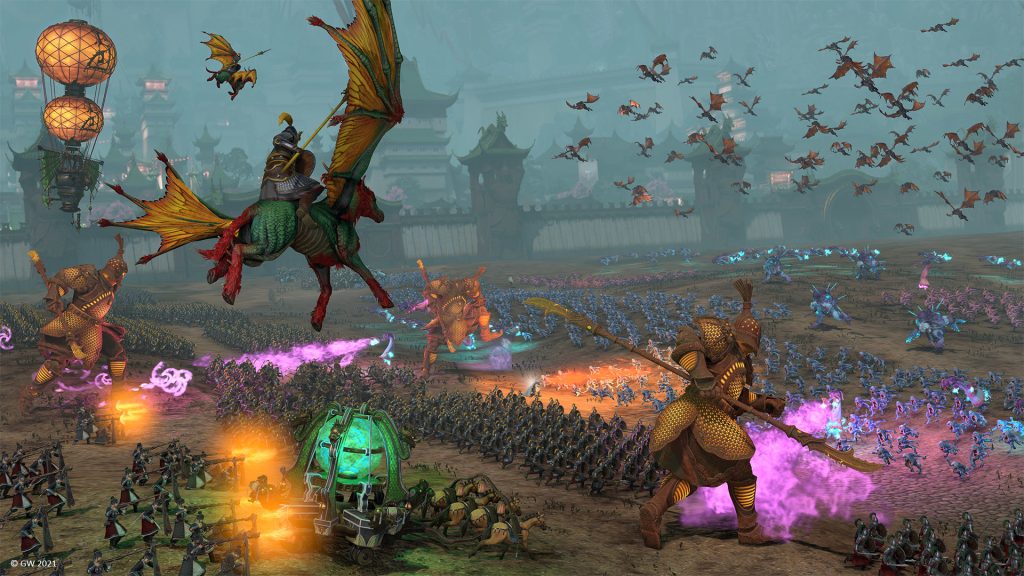
Choose Total War: WARHAMMER III if your main reward is personally commanding a fantasy army in real-time battles. Choose Stellaris if you want to explore a galaxy, shape an alien society and expand an empire through discovery, technology and diplomacy. Total War Warhammer 3 vs Stellaris is a choice about where you want to direct your attention, as well as a choice of setting.
This comparison uses official descriptions to judge the repeated decisions each game emphasizes: leadership, expansion, preparation for war and discovery. It is not a timed playtest. Both games let warfare contribute to an empire’s story, but liking strategy and large armies alone does not tell you which one will suit the campaign you imagine.

On this page
What would make an evening feel productive?
For WARHAMMER III, imagine choosing a fantasy ruler, assembling the army that expresses that choice and wanting to see it fight. For Stellaris, imagine sending science ships toward unknown systems, deciding what discoveries mean for expansion and considering the civilization you want to become. These are illustrative session goals rather than promises about what you can finish in a fixed amount of time.
The distinction also helps if your preference is mixed. A player who likes science fiction but mainly wants ground-unit battle command should look carefully at Stellaris’s emphasis on exploration, diplomacy and customizable fleets. A player who likes fantasy but would rather spend an evening shaping society than directing an army should examine whether WARHAMMER III’s campaign is the attraction they actually want.
Build an army you want to command
WARHAMMER III presents distinct fantasy races and Legendary Lords as its core appeal. The official description names Kislev, Grand Cathay and the Chaos powers, with leaders such as the Ice Queen, a transforming dragon and the Daemon Prince. Choosing a ruler gives the army and campaign a concrete fantasy identity from the beginning.
The Daemon Prince’s documented body-part and power customization reinforces that focus. If building a supernatural champion sounds like an enjoyable decision in its own right, it is a stronger reason to choose WARHAMMER III than simply wanting another empire game. The real-time battles then give the force you selected a direct battlefield role.
The official description also introduces the Realm of Chaos narrative and a strategy sandbox. That combination supports a buyer interested in fantasy conquest and a world organized around recognizable factions and rulers. It does not establish the current access rules for every campaign or the contents of every edition, so verify the particular campaign you intend to play.
The meaningful drawback for this comparison is scope of interest. If surveying unknown stars, meeting unfamiliar species and directing a society’s long-term evolution are the decisions you want most, WARHAMMER III’s fantasy armies do not substitute for those galactic systems. Choose it because you want its battles and faction identity to be central.

Build a galaxy-spanning society you want to understand
Stellaris begins its official description with science ships surveying and exploring, while construction ships build stations around newly discovered planets. Exploration is therefore connected to expansion: discovering a place and developing your presence there are different parts of the empire-building process.
The description goes on to mention anomalies, strange worlds and discoveries that can change a campaign’s outcome. Choose Stellaris if uncertainty about what lies beyond your borders is an attraction. The next interesting decision can arise from finding something new, rather than from choosing the next fantasy army you want to field.
Society and diplomacy provide another reason to choose it. The official text describes customizable species traits and ideologies, negotiation, alliances and wars. You are deciding how an empire develops and how it deals with other civilizations. That makes Stellaris a particularly clear fit if the identity you want to create belongs to a society as much as to its ruler.
Its corresponding drawback is the kind of reward you must enjoy. If surveying systems and managing a growing society feel like a detour before the battle you really wanted, the main reasons recommended here may not suit you. A space setting alone is not enough; the exploration and empire decisions should sound worthwhile on their own.
Compare the preparation for war
WARHAMMER III’s description emphasizes armies under your command in real-time battles. Stellaris’s warfare description emphasizes customizable fleets, technologies and a ship designer. Those are different decision priorities: fantasy army command on one side, and the capabilities of an expanding galactic empire and its fleets on the other.
Stellaris is not a recommendation to avoid conflict. Its official text explicitly includes wars alongside diplomacy and alliances. Instead, ask whether preparing an empire, selecting technology and designing ships is the part of warfare that draws you in. If directing a fantasy force during a battle is the stronger attraction, WARHAMMER III is the clearer recommendation.
Buy for the decisions you will repeat
Choose WARHAMMER III when a specific fantasy lord, race and army are already the campaign you want. Choose Stellaris when your imagined campaign begins with unknown stars and a society whose direction you want to determine. If both appeal, watch examples of the campaign decisions described here, not only battle trailers, and check that your intended purchase includes the content you expect. The better choice is the one whose ordinary decisions remain interesting after the first spectacular fight or discovery.
Sources and scope
Researched on November 10, 2026 from archived official product descriptions: Total War: WARHAMMER III official Steam description; Stellaris official Steam description. This comparison explains documented systems and buyer fit, without claiming hands-on testing. Check current purchase contents on the official listings. Archived screenshots illustrate their games; they do not establish current interface rules or balance.
Sources and further reading
Keep exploring
Stellaris vs Crusader Kings 3: build a society or guide a dynasty?
Pick Stellaris when your campaign idea starts with a civilization and unknown stars; pick Crusader Kings III when rulers, relationships and the next heir are the central attraction.
Stellaris vs Hearts of Iron 4: discovery or industrial war planning?
Choose Stellaris for discovering a galaxy and shaping a space society; choose Hearts of Iron IV for coordinating industry, army design and politics around a WWII nation.
Games like Stellaris: 3 choices by campaign style
Three fit-based alternatives preserving space empire strategy while changing turn structure, automation or tactical control. Each recommendation illustrated by its own verified official game screenshot.