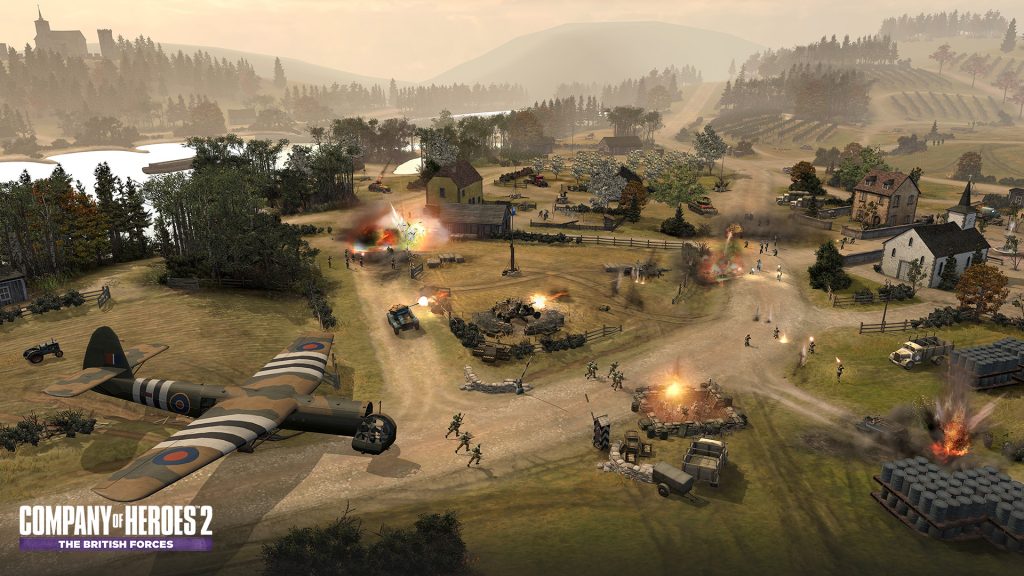
TL;DR: This Company of Heroes 2 British Forces build order uses Infantry Sections to claim and fight from useful cover, with Royal Engineers handling support and suitable capture work. Add Vickers control or the missing support role, advance to Platoon Command Post and prepare a 6-pounder or AEC response when enemy vehicles threaten the position.
The opening is a sequence of jobs: connect income, establish covered infantry positions, recover survivors and buy the role needed to keep access to the map. Three Infantry Sections are a practical learning core, not a requirement. An optional fourth Section should wait when healing, an anti-tank gun or another support function is missing.

Sources and scope: The British Forces unit guide supplies unit roles. The 2020 and 2021 patch records supersede its older engineer, medic and tech details. These examples assume normal multiplayer resources without a commander-specific substitute. Checked November 9, 2026; archived prices and percentages are excluded.
On this page
Company of Heroes 2 British Forces build order: start with terrain jobs
Recruit enough Infantry Sections to capture connected territory and contest the nearby approach, using three as the practice example. Add a Royal Engineer squad when you need its support, capture or repair work. Choose the next purchase from what prevents those squads from carrying out their tasks.
In the post-2021 arrangement, Royal Engineers are recruited at HQ rather than waiting for Platoon Command Post. Some engineering capabilities, including HEAT grenades and Forward Assembly construction, still require Platoon tech. Buying the squad early does not unlock all of its later functions immediately.
This gives the opening more choices than a list of identical Sections. An engineer can handle a suitable supporting task while Sections occupy the better infantry fighting positions. Keep the engineer alive for the repair and construction jobs that become relevant when the first vehicle or forward recovery plan arrives.
1. Capture the connector before overextending
Use one squad on the route linking useful sectors to your base and another toward the contested position. Fuel or munitions territory disconnected by a lost connector cannot deliver the income you intended. Running farther forward does not repair that missing link.
Protect the route with the part of your army suited to the approaching threat. A Section in useful cover can contest infantry while another squad captures. If the enemy instead attacks the connector, redirect enough force to restore the route rather than leaving every squad near the distant fuel sector.
Avoid treating fuel ownership as the only opening result. You also need surviving squads, manpower for recovery and access to relevant tech. A fuel sector that costs continuous losses to hold can delay the very production you wanted its income to support.

2. Keep Infantry Sections in useful cover
Infantry Sections have cover-dependent firing performance and are described as effective at long-range infantry combat. Establish cover that faces the enemy rather than leaving the squad in exposed ground. Moving closer is not automatically an improvement when it gives away the position supporting its firing role.
Compare both positions before committing. A Section behind useful protection can hold while another unit changes the angle. A Section walking toward a protected enemy across open ground needs support or another route. Its ability to win that exchange does not come from the word British on the roster.
When artillery, grenades or a flank makes the cover unsafe, move. Cover supports a fight; it is not an instruction to remain in one location after the threat changes. Withdraw and recover before the position produces a complete squad wipe rather than another model-replacement bill.
3. Add a Vickers for an approach, not a unit quota
The Vickers supplies machine-gun suppression and area control. Buy one when it can watch a useful route and free the Sections for capture or supported fighting. Place infantry where it can observe the approach and guard the crew’s side.
A machine gun covering the wrong path does little for the opening, even when its firepower is strong. Reposition as the contested ground changes. Keep a way out if enemy infantry or indirect fire reaches the position rather than leaving the crew exposed while the rest of the army moves away.
A constrained map can justify earlier Vickers control. A wide map with several active routes may need another mobile capture task first. The choice follows the position you want to maintain, not a rule that every build must contain the same support team at the same minute.

4. Pay for recovery before repeating the fight
Infantry Section medical supplies provide a healing option for injured infantry outside combat. Medics are another recovery option available through Platoon Command Post in the revised arrangement. Put recovery somewhere the survivors can use it safely and return to a useful task.
Healing and reinforcement solve different problems. Healing restores damaged living models; reinforcement supplies missing models. Complete both when necessary. A newly reinforced Section can still contain injured survivors, so its model count alone does not prove it is ready for another demanding exchange.
Choose recovery timing from the army’s condition. If several Sections return wounded after each contest, postponing healing to buy an optional squad can leave more infantry with the same health problem. Recover the core that already exists and reserve manpower for the next required support purchase.
5. Advance Platoon tech for the relevant support
Platoon Command Post supplies important support options, including the 6-pounder anti-tank gun and the route toward AEC production through its requisition upgrade. Royal Engineers exist earlier, but Platoon also enables their gated functions. This makes the tech purchase useful beyond adding one more rifle-type squad.
The 6-pounder provides a positioned anti-vehicle weapon; the AEC supplies a mobile vehicle-focused option after its own unlock. Choose the gun when you need to control a known road from a supported position. Choose a mobile response when the threat and map justify the additional vehicle investment.
AEC and Bofors requisition tech are no longer mutually exclusive in the 2021 patch record. That does not mean researching and buying both is automatically affordable or useful. A static Bofors protects a position, while the AEC can move; match their different roles to what the opening needs.

6. Separate infantry upgrades from unit purchases
Weapon-rack research unlocks access to Bren guns and PIATs, while equipping weapons costs munitions separately. Researching the racks does not automatically arm every Section. Plan which squad benefits and retain munitions for the other actions you intend to use.
Bolster increases the relevant squad sizes but requires Platoon Command Post in the revised gate. It is an infantry investment competing with support and technology. Taking every upgrade before solving the vehicle or recovery problem can create a stronger-looking infantry roster that still lacks the necessary counter.
Ordinary Infantry Sections are not automatically the army’s anti-vehicle-snare solution. Royal Engineer HEAT grenades have their Platoon requirement, and specialized commander units differ. Keep the 6-pounder or other appropriate vehicle answer in the plan instead of sending ordinary Sections to perform an ability they do not have.
7. Compare an open-map and a constrained-map opening
Assume an open normal-resource match with several useful capture routes and limited early machine-gun pressure. Use Sections on covered fighting positions and an engineer for a supporting route. Recover injured squads, advance Platoon and choose the 6-pounder or AEC from the enemy vehicle pressure you observe.
Keep the force connected enough that a threatened squad can receive help. A wide opening is not permission to leave every unit isolated. When the vehicle withdraws, recapture the sector or connector that matters instead of pursuing it beyond the supporting infantry and anti-tank coverage.
Now assume a narrow approach with enemy infantry concentrated around a key building. Earlier Vickers control may stabilize the entrance while Sections approach through other useful cover. If indirect pressure is needed, a mortar-emplacement investment has a fixed location to protect; do not build it where the enemy can easily overrun the construction.
Both examples still need a vehicle response. Static anti-infantry pressure does not replace anti-tank coverage. The purchase order changes because the initial obstacle changes, while recovery and connected income remain the conditions supporting the next step.
8. Plan Company tech without losing the opening position
Company Command Post opens the later armor stage, with choices such as Cromwell, Centaur and Firefly performing different tasks. Reserve the resources for the relevant transition, but do not leave the current army without an immediate vehicle answer while saving for a more expensive future unit.
Cromwell supplies a general medium-tank role, Centaur emphasizes anti-infantry work and Firefly is an anti-vehicle platform requiring support. Choose from the threat the enemy has actually fielded. An armor roster cannot perform every job efficiently merely because each option is built in the later stage.
When tech slips, count reinforcement and optional purchases before blaming fuel alone. Another Section, a static emplacement and multiple infantry upgrades all compete with the transition. Keep the investment that changes the current fight, then use the stable position to support the later purchase.
British opening questions
Do Royal Engineers require Platoon Command Post?
The 2021 revision moves recruitment to HQ. Specific functions, including HEAT grenades and Forward Assembly construction, remain gated by Platoon. Distinguish recruiting the squad from enabling those capabilities.
Must I choose permanently between AEC and Bofors?
Their requisition tech no longer locks the other out in the revised record. You still pay for each unlock and unit, so buy both only when their separate roles justify the combined investment.
Should Sections leave cover to fight closer?
Use the position that supports their infantry role. Advancing across exposed ground can give away their cover-dependent performance. Change the angle with support before abandoning a useful protected position.
Where can I develop the next lesson?
Use the Company of Heroes 2 guides for faction tactics and the strategy game guides for supporting concepts. Practice one purchase branch and its battlefield purpose before adding more optional upgrades.
Sources and further reading
Keep exploring
Company of Heroes 2 vs Men of War Assault Squad 2: squads or direct control?
Company of Heroes 2 vs Men of War Assault Squad 2: compare cover and combined arms with direct soldier control, skirmishes and the right game package.
Company of Heroes 2 vs Gates of Hell Ostfront: what should carry the battle?
Company of Heroes 2 vs Gates of Hell Ostfront: choose squad cover and counters or switchable direct control with a developing Conquest army.
Company of Heroes 2 Veterancy Mechanics: 7 Squad Decisions
Understand what veterancy changes, why surviving squads retain value and how to use infantry, weapon-team and vehicle experience in real decisions.